
Burnout isn't a lack of stamina; it's the cognitive cost of inefficient, high-volume prep methods that belong in a museum. If you're currently drowning in massive outlines and feeling the crushing weight of decision fatigue, you aren't alone. Most students believe that ten-hour days are the only path to success, but this legacy approach is exactly why avoiding burnout during bar prep feels like an impossible task. We understand that the stakes for the California Bar Exam are absolute, and the traditional "grind" is failing a generation of lawyers who are already 3.6 times more likely to face depression than their peers.
It's time to stop treating your mental health as a secondary concern and start seeing it as your primary competitive advantage. You deserve a clear path to passing that doesn't require a total mental breakdown or the sacrifice of every waking hour. You're about to discover why precision beats volume in 2026. We'll break down how to study less while retaining more, shifting your focus from rote memorization to the high-level skills that actually drive results. This guide explores a structured, modern methodology that replaces anxiety with the absolute confidence that your schedule is actually working.
Key Takeaways
- Stop viewing exhaustion as a badge of honor and learn to identify cognitive saturation before it sabotages your performance.
- Break the "Volume Trap" by understanding why more hours spent reading legacy outlines rarely translates to higher scores on the California Bar Exam.
- Master the art of avoiding burnout during bar prep by implementing a yield-based strategy that prioritizes high-frequency exam topics over academic fluff.
- Use the 2026 Resilience Framework to audit your schedule, removing passive tasks and replacing them with high-impact, time-boxed active output.
- Leverage the power of a binary performance guarantee to eliminate decision fatigue and restore absolute confidence in your study methodology.
Redefining Bar Prep Burnout: Why Stamina Isn’t the Problem
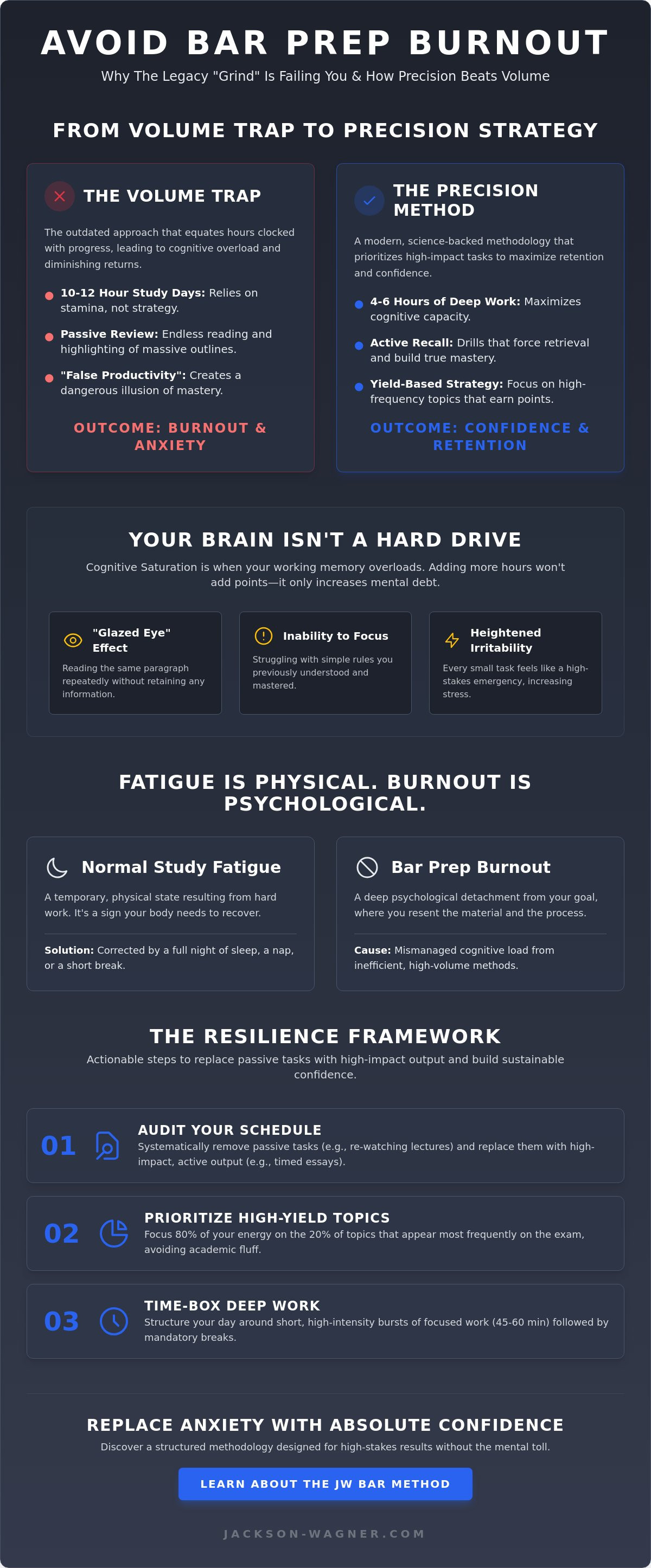
Many candidates treat bar preparation as a test of physical endurance. They believe that if they can just sit in a chair for twelve hours a day, they'll eventually absorb enough law to pass. This is the "Volume Trap." It's a dangerous misconception fueled by legacy bar review courses that equate progress with the number of pages turned rather than the mastery of concepts. In reality, occupational burnout in the legal field often begins during this very period, manifesting as cognitive saturation rather than simple physical exhaustion. When your brain reaches its limit, adding more hours doesn't add more points to your score; it only increases your mental debt.
The primary driver of this exhaustion is the pervasive fear that skipping a single footnote in a 200-page outline will lead to failure. Legacy providers exploit this anxiety by burying students in "False Productivity." They provide checklists of videos and readings that create a sense of accomplishment without actually building the skills needed for the California Bar Exam. True success in avoiding burnout during bar prep requires shifting from a high-volume mindset to a high-precision strategy. If you're measuring your success by the clock, you're already losing the battle against cognitive fatigue.
The Symptoms of Cognitive Saturation
Cognitive saturation occurs when your working memory is so overloaded that it ceases to function effectively. You might find yourself reading the same paragraph four times without retaining a single word, a phenomenon we call the "Glazed Eye" effect. Other signs include an inability to focus on simple rules you previously mastered and a growing sense of irritability where every task feels like a high-stakes emergency. These aren't signs that you need to study harder. They're signs that your current method is fundamentally broken and your brain is attempting to protect itself from further data overload.
Burnout vs. Normal Study Fatigue
It's vital to distinguish between standard tiredness and true burnout. Fatigue is a physical state that a solid night of sleep or a nap can fix. Burnout is a psychological detachment from your goal. Because the California Bar Exam has one of the most demanding difficulty curves in the nation, the pressure to maintain a high volume of study accelerates this detachment. You start to resent the material, the process, and the profession before you've even entered it. Burnout is the inevitable psychological consequence of mismanaged cognitive load caused by inefficient, high-volume study methods.
The Cognitive Science of Over-Studying: Why Legacy Courses Fail
Legacy bar prep providers sell you a 12-hour daily schedule because volume is easy to market. It looks like value on a brochure, but it ignores the fundamental law of diminishing returns in legal education. Your brain is not a hard drive with infinite write-speeds; it's a biological processor governed by Cognitive Load Theory. When you force your working memory to juggle massive, uncurated outlines for ten hours straight, you hit a wall where new information simply stops sticking. This is the primary obstacle to avoiding burnout during bar prep. You aren't failing the material; your methodology is failing your biology.
The science is clear: "Passive Review"—the act of endlessly reading and highlighting—is the least effective way to learn complex legal rules. It creates a dangerous psychological state called "Recognition Overdose." Because the text looks familiar, you mistake recognition for mastery. True retention requires "Active Recall" through high-stakes drills that force your brain to retrieve and apply information under pressure. Integrating a sustainable approach to studying isn't about working less; it's about working with higher intensity for shorter bursts. This leaves room for sleep, which is the only time your brain actually consolidates complex legal analysis into long-term memory.
The Myth of the 12-Hour Study Day
Human cognition is limited. Most experts agree that the brain can only sustain four to six hours of "deep work" daily. Beyond that, you're just performing "busy work." Watching three-hour lectures provides a false sense of security while draining the energy you need for actual essay writing. If you're spending more time watching videos than practicing rules, you're preparing to be a spectator, not a lawyer. Efficient candidates focus on high-intensity output and then stop. They understand that the 10th hour of study is worth a fraction of the first, yet it costs twice as much in mental fatigue.
Why California Bar Prep is Uniquely Taxing
The California Bar Exam is a different beast entirely. Between the nuanced Professional Responsibility requirements and the sheer breadth of tested subjects, the cognitive load is significantly higher than in UBE jurisdictions. Legacy courses try to solve this by adding more pages to the outline, which only compounds the problem. We take a different path. By using the JW Bar Method Prep - Full Exam California Bar, you replace overwhelming volume with surgical precision. We prune the academic fluff so you can focus your limited cognitive resources on the rules that actually appear on the exam. This structured focus ensures you walk into the testing center sharp, not shattered.
Yield-Based Study Strategy: The Ultimate Burnout Antidote
Yield-based studying is the definitive solution to the mental exhaustion plaguing modern candidates. Traditional courses demand that you memorize every obscure footnote, a strategy that virtually guarantees failure by attrition. Instead, you must apply the 80/20 rule to your preparation. In the context of the California Bar, roughly 20% of the legal rules account for 80% of the points awarded. By identifying these high-yield concepts, you transform your study sessions from a desperate marathon into a targeted strike. This shift is the most effective method for avoiding burnout during bar prep because it removes the crushing guilt of not knowing everything.
Distinguishing between "Black Letter Law" essentials and academic fluff is a skill that separates successful candidates from those who repeat the exam. Essentials are the core principles that form the backbone of every essay prompt; academic fluff includes historical rule evolutions or minority views that rarely appear. Precision is especially critical when navigating the California Attorney’s Exam requirements. Practicing lawyers don't have time for the filler content found in legacy outlines. They need a streamlined path that respects their professional experience while ensuring they meet the specific standards of the examiners.
Precision Over Volume
Stop trying to be a legal encyclopedia. Focus your energy on the sub-topics that appear year after year. By analyzing past exam patterns, you can predict with high accuracy which areas the examiners favor. When you "clear the deck" of low-value tasks, the psychological relief is immediate. You no longer feel like you're falling behind because you've stopped running a race that doesn't exist. This focused approach ensures that every hour spent studying translates directly into points on the page; it protects your mental bandwidth for the final weeks of the season.
Accelerated Prep for Professionals
Attorneys often face a unique challenge: they must "unlearn" the practical shortcuts of their daily practice to meet the rigid demands of the State of California State Bar. This process is cognitively taxing and prone to burnout. An accelerated prep track allows professionals to leverage their existing analytical skills while streamlining the memorization process. The JW Bar Method provides this bridge, ensuring that your limited time is spent on high-impact drills that directly correlate to a passing score. We prioritize the active application of rules over the passive consumption of lectures, allowing you to master the material without sacrificing your career or your sanity.
The 2026 Resilience Framework: Actionable Steps to Stay Sharp
The Resilience Framework isn't about wellness in the abstract; it's about optimizing your biological hardware for a high-stakes performance. To succeed in avoiding burnout during bar prep, you must treat your attention as a finite, high-value asset. This framework replaces vague intentions with a rigid, tactical structure designed for the current exam cycle. It ignores the legacy advice of "just keep grinding" and replaces it with five non-negotiable steps for cognitive preservation.
- Audit your schedule: Every task on your calendar must involve active output. If you're just "reading" for two hours, you're effectively wasting time. Remove any activity that doesn't force you to apply a rule.
- Implement Time-Boxing: Dedicate 90-minute blocks to high-intensity essay drills. When the timer stops, the work stops. This prevents the "marathon mindset" that leads to mental fatigue.
- Establish a Hard Stop: Choose a specific time every evening to close the laptop. No exceptions. This allows your brain to transition from "retrieval mode" to "consolidation mode."
- Use Interleaved Practice: Don't study a single subject all day. Mix in different topics to force your brain to switch gears. This cognitive friction strengthens neural pathways and prevents the boredom that mimics burnout.
- Schedule a Zero-Bar Day: You need one full day every week where you do not think about, talk about, or look at the law. This resets your nervous system and prevents long-term psychological detachment.
Mastering the "Hard Stop"
Studying past 8:00 PM is a vanity metric that results in zero net gain. Your brain requires downtime to move information from working memory to long-term storage. Without a hard stop, you're just spinning your wheels and increasing your baseline cortisol. Create a shutdown ritual: clear your desk, write down your top three priorities for tomorrow, and physically leave your study space. Engaging in non-legal hobbies during this time isn't a luxury. It's a requirement to prevent the mental loop of rules that keeps you awake at 2:00 AM. If you find yourself unable to step away, your study system is likely too disorganized.
Active Recall vs. Passive Reading
Effective preparation demands a 70/30 split: 70% of your time must be spent on practice questions and active writing, with only 30% dedicated to review. Many students avoid practice because they fear getting questions wrong, yet this discomfort is the only path to mastery. Getting an essay wrong today is a gift; it's a point you won't lose on exam day. Don't let administrative burdens like the Moral Character Application derail your focus. Handle those tasks in short, scheduled bursts so they don't bleed into your high-intensity study blocks. If you want a system that automates this level of precision and eliminates the guesswork, discover how the JW Bar Method Accelerated Prep - Full California Bar Exam can streamline your path to success.
The JW Bar Method: High-Stakes Results Without the Mental Toll
The JW Bar Method isn't just another study plan; it's a fundamental shift in how candidates approach the California Bar. While legacy providers focus on burying you in content to justify their fees, our approach is built on the reality that your time and mental energy are your most precious resources. By utilizing a curated, high-impact curriculum, we ensure that every hour you spend is an investment in a passing score. This focus on surgical precision is the ultimate tool for avoiding burnout during bar prep. We don't want you to "finish" a course; we want you to master the exam.
Our mentor-led model acts as a disruptive alternative to the automated, impersonal systems of the past. We understand that the high-stakes anxiety of professional licensing requires more than just videos; it requires a partner. Jackson-Wagner LLC is that partner. We are so confident in our pedagogical framework that we offer a binary performance guarantee. We assume the financial risk of your outcome so that you can dedicate 100% of your focus to the result. This bold reliability replaces the stress of high-pressure certification with a structured, modern, and reliable path to success.
Our Precision-First Philosophy
We've stripped away the "busy work" that traditional courses use to inflate their perceived value. Whether you're enrolled in the JW Bar Method Prep - Full Exam California Bar or the JW Bar Method Prep - Attorney’s Exam California Bar, you'll follow a path that prioritizes active output over passive consumption. This results-oriented mindset ensures you aren't exhausted by the time you reach the testing center. You'll walk in with the sharp, analytical edge required to dismantle the most complex essay prompts, confident that your preparation was built for efficiency, not just volume. Jackson-Wagner LLC replaces the "glazed eye" effect of legacy courses with a steady, structured progression toward licensure.
Take the Next Step Confidently
Transitioning from a legacy "volume-first" model to a precision method is the most important decision you'll make this season. Choosing the best bar exam preparation service means selecting a partner that respects your time and your mental health. Don't let another day of decision fatigue or "recognition overdose" drain your confidence. It's time to embrace a methodology that values your results as much as you do. Schedule a strategy call or explore our JW Bar Method programs today to see how Jackson-Wagner LLC can streamline your path to success.
Secure Your Future Without Sacrificing Your Sanity
The path to licensure shouldn't be a test of how much suffering you can endure. We've established that avoiding burnout during bar prep is entirely possible when you stop measuring success by the clock and start measuring it by precision. By shifting your focus to high-yield topics and implementing a tactical resilience framework, you preserve the cognitive energy required to perform at your peak on exam day. You've already done the hard work of law school; now you need a strategy that respects your expertise and your time.
Jackson-Wagner LLC is here to serve as your disruptive mentor. Our specialized California-only curriculum and accelerated tracks for practicing attorneys are designed to cut through the academic fluff of legacy courses. We are so confident in our results-oriented approach that we offer a binary performance guarantee, assuming the financial risk so you can focus entirely on your score. It's time to replace decision fatigue with absolute confidence in your preparation.
Master the California Bar with the JW Bar Method today. You have the talent to pass; Jackson-Wagner LLC has the method to get you there without the mental toll. Let's get started on your last bar exam.
Frequently Asked Questions
How many hours a day should I study for the California Bar Exam to avoid burnout?
You should aim for four to six hours of high-intensity "deep work" daily. Studying for ten or twelve hours often leads to diminishing returns and cognitive saturation, which are the primary drivers of exhaustion. By focusing on active output rather than passive reading, you can achieve better results in half the time. This targeted approach is essential for avoiding burnout during bar prep while maintaining the mental sharpness required for the California Bar Exam's rigorous essay requirements.
Is it normal to feel like I am forgetting everything I learned last week?
It is completely normal to feel like you are forgetting material because your brain prioritizes information it actually uses. This feeling often stems from passive review where you recognize the law but haven't practiced retrieving it under pressure. Shifting to active recall through practice questions will move that information into long-term memory. Don't panic; your brain is simply filtering out "static" that hasn't been reinforced through application.
Can I take a full day off from bar prep without falling behind?
You can and should take one full "Zero-Bar" day off every week to reset your nervous system. Taking a break does not put you behind; it actually prevents the psychological detachment that leads to failure. A day of rest allows for memory consolidation, meaning you'll return to your studies with significantly higher cognitive efficiency than if you had pushed through the weekend without a reset.
What should I do if I have a panic attack or major anxiety during study?
If you experience a panic attack, stop studying immediately and remove yourself from your study environment. Focus on grounding techniques, such as deep breathing or physical movement, to lower your cortisol levels. Anxiety is often a signal that your current methodology is overwhelming your working memory. Once you are calm, audit your schedule to remove low-value tasks and restore a sense of control over your preparation process.
How do I stop feeling guilty when I am not studying?
Stop viewing rest as "time lost" and start seeing it as a mandatory component of your professional preparation. Guilt is a byproduct of the "Volume Trap" promoted by legacy courses that equate hours with competence. When you use a precision-based method, you can be confident that your study time was effective. This certainty eliminates the need for performative over-studying and allows you to enjoy your downtime without the crushing weight of perceived failure.
Is burnout a sign that I am not cut out to be a lawyer?
Burnout is a sign of an inefficient study system, not a lack of legal aptitude. Many of the most successful attorneys faced extreme stress during their preparation because they were using outdated, high-volume models. Experiencing exhaustion simply means your current approach is unsustainable. Transitioning to a precision-first strategy will prove that you are more than capable of handling the demands of the profession without sacrificing your mental health.
How does the JW Bar Method differ from traditional high-volume courses?
The JW Bar Method replaces the 1,000-page legacy outlines with a curated, high-yield curriculum. While traditional courses focus on volume, we prioritize the 20% of the law that provides 80% of the points awarded on the exam. We also offer a binary performance guarantee and mentor-led support, assuming the risk of your outcome so you can focus on execution. This disruptive approach is specifically designed for the unique challenges of the California Bar Exam.
What are the first signs that I am pushing myself too hard?
The first signs of over-exertion include the "Glazed Eye" effect, where you read without retention, and a persistent feeling that every task is an emergency. You might also notice increased irritability or an inability to focus on rules you previously knew. Recognizing these symptoms early is the key to avoiding burnout during bar prep. When these signs appear, it's a clear signal from your brain to implement a "Hard Stop" and prioritize recovery.


