

With a first-time pass rate of only 43.9% for the February 2026 exam, the California Bar remains the most formidable gatekeeper in the legal profession. It's easy to feel buried under 14 subjects and the looming shadow of the 90-minute Performance Test. You've likely already realized that the passive study habits that got you through law school won't survive this high-stakes environment. To win, you need more than just effort. You need the specific first time bar taker tips california applicants use to bypass the noise and focus on the tactical execution that actually earns points.
We recognize the intense anxiety that comes with staring at a mountain of outlines while the clock ticks toward your exam date. You're looking for a way to replace information overload with a structured, modern approach to success. This article provides a strategic roadmap designed to help you master the California rubric, maximize your essay scores, and maintain total confidence during the MBE. We'll explore ten essential shifts that transform your preparation from a desperate scramble into a disciplined, results-oriented path to your law license.
Key Takeaways
- Avoid the "Volume Trap" by shifting your focus from passive memorization to the tactical execution required for the 2026 California Bar format.
- Master the art of engineering your essay and Performance Test responses to survive the 15-second "grader scan" used by examiners.
- Prioritize quality over quantity by deeply analyzing 1,500 strategic MBE questions to identify the complex distractors designed to trip up first-timers.
- Utilize these essential first time bar taker tips california candidates use to build a sustainable 40-hour study week that prevents burnout during the 10-week sprint.
- Transition from legacy, completion-based study models to a precision-engineered approach that prioritizes actual mastery of high-frequency subjects.
The 2026 California Bar Exam Reality: Why First-Timers Struggle
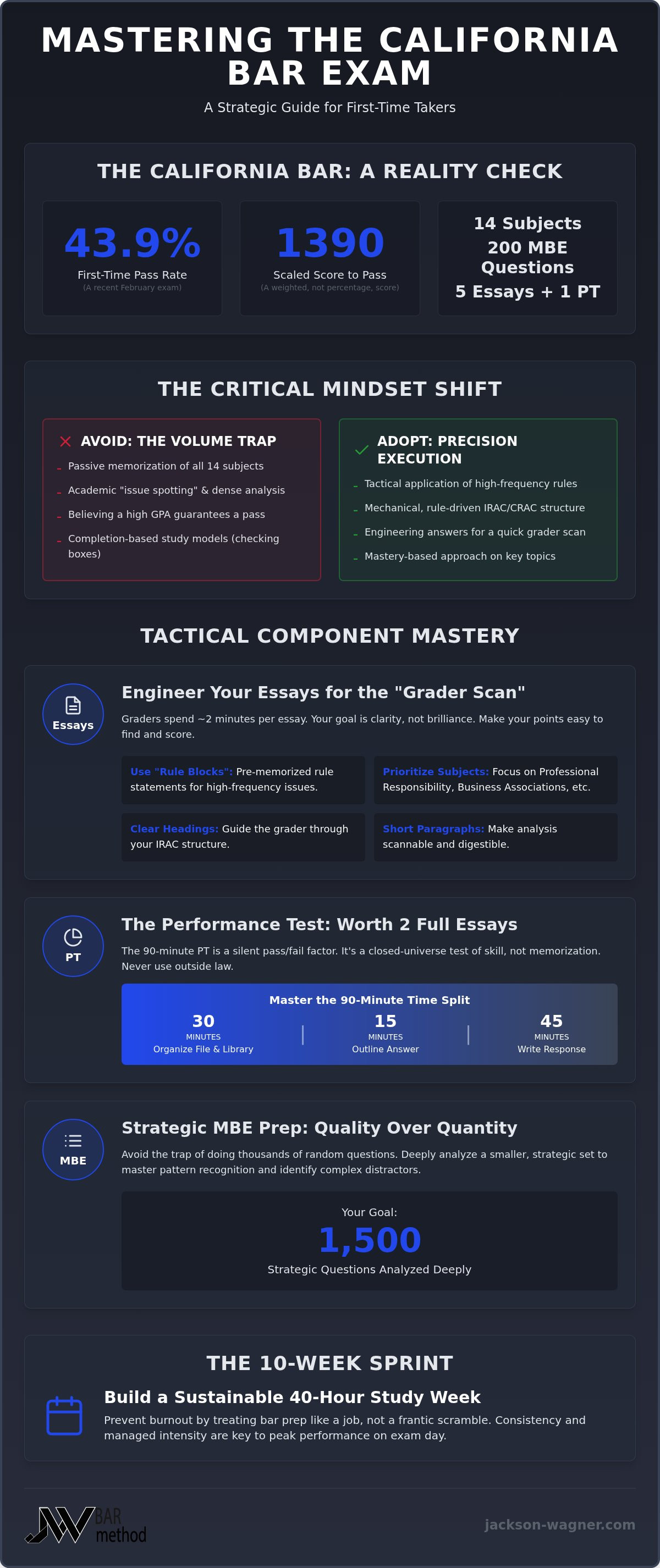
The 2026 California Bar Exam isn't just a test of legal knowledge. It's a high-stakes test of endurance and tactical precision. Over two grueling days, you'll tackle five one-hour essays, one 90-minute Performance Test (PT), and 200 Multistate Bar Examination (MBE) questions. Most applicants fall victim to the "Volume Trap." They believe that memorizing every nuance of the 14 tested subjects guarantees a pass. It doesn't. This approach leads to cognitive overload and prevents you from mastering the actual mechanics of the exam. To succeed, you must focus on the 1390 scaled score. This isn't a percentage; it's a weighted result that requires consistent, proficient performance across every single component.
Psychological barriers often trip up even the most dedicated students. Law school teaches you to "issue spot" and argue every possible angle. On the bar, this habit is a liability. The examiners aren't looking for a scholarly treatise. They want mechanical rule application. Transitioning from academic "maybe" to bar exam "because" is the most critical hurdle for any first-timer. Using strategic first time bar taker tips california applicants rely on means prioritizing the application of law over the mere storage of it.
The Myth of the 'Smartest Student' Success
Your JD grade point average is a poor predictor of your bar results. High-ranking graduates often fail because they over-analyze simple issues, wasting precious time on points that don't move the needle. The State Bar of California graders spend an average of two minutes per essay. They aren't looking for brilliance; they're looking for a clear IRAC or CRAC structure that they can check off quickly. Academic legal writing is often too dense for this format. If you can't deliver a punchy, rule-driven analysis, your GPA won't save you from a failing score.
Navigating the 2026 Licensure Landscape
The data from 2026 reveals the difficulty of the current environment. For the February 2026 administration, the first-time pass rate was only 43.9%. While the July 2025 rate reached 69.7%, the disparity shows that the margin for error is razor-thin. You must also stay vigilant regarding administrative deadlines. The timely filing deadline for the July 2026 exam is March 1, 2026. Missing these dates is a common, avoidable mistake that derails careers. For a comprehensive look at the logistics of your exam year, read our guide on How to Navigate the State Bar of California: A 2026 Guide to Licensure Success. Incorporating professional first time bar taker tips california candidates trust ensures you don't just study hard, but study with the surgical precision the 2026 landscape demands.
Mastering the California Essay and Performance Test (PT) Rubric
Conquering Day 1 requires a shift from academic curiosity to tactical execution. The official California Bar Exam structure demands five essays and one Performance Test, all within a single day. You don't have time to ponder deep legal theories. Instead, you must engineer your responses to satisfy a grader who likely spends less than two minutes on your paper. One of the most effective first time bar taker tips california candidates can implement is the use of "Rule Blocks." These are pre-memorized, punchy rule statements for high-frequency issues like Negligence, Hearsay, or Community Property. By automating the "Rule" portion of your IRAC, you buy yourself critical minutes for the "Analysis" section, where the actual points are won.
- Prioritize High-Frequency Subjects: Focus on the heavy hitters that appear in nearly every cycle, such as Professional Responsibility and Business Associations.
- Design for the "Grader Scan": Use clear headings and short paragraphs. Make your conclusions easy to find.
- Treat the PT as a Scavenger Hunt: It's a closed-universe test. Never use outside law; only use what's in the provided Library.
- Simulate Afternoon Fatigue: Practice your final essay of the day at 4:00 PM to build the stamina required for the actual event.
The 90-Minute Performance Test: The Silent Pass/Fail Factor
The PT is often the difference between a pass and a fail because it carries the weight of two full essays. You must master the "30-45-45" split. Spend no more than 30 minutes sorting the File and Library. Use the next 15 minutes to outline, and the final 45 minutes to draft. You aren't writing for a law professor; you're writing for a "Partner" or "Judge." If the prompt asks for a persuasive brief, don't deliver a neutral memo. Meeting the specific tone and audience requirements is just as important as the legal analysis itself. For those seeking a more streamlined approach, The JW Bar Method: Pass the California Bar Exam provides a specialized framework for mastering these 90-minute sprints.
California-Specific Essay Nuances
You can't rely on general "majority" rules for every subject. In Evidence and Civil Procedure, you must clearly distinguish between California rules and the Federal Rules of Evidence or Civil Procedure. Graders look for this specific distinction. Additionally, Professional Responsibility is a mandatory component of every exam, often appearing as a standalone essay or "crossed" with another subject. You must be prepared to identify ethical violations in every fact pattern you encounter. If you want to refine your precision, consider exploring how accelerated preparation tracks can help you isolate these CA-specific distinctions quickly.
Strategic MBE Preparation for First-Time Takers
Many applicants believe that success on the Multistate Bar Examination (MBE) is a simple game of volume. They click through 3,000 questions, chasing a completion percentage rather than actual mastery. This is a strategic error. Data suggests that 1,500 highly-analyzed questions are significantly more effective than 3,000 "click-through" questions. When you rush, you fail to internalize why a specific distractor was wrong. One of the most vital first time bar taker tips california students should follow is to treat every practice question as a diagnostic tool. Identifying the "Distractor" answers designed to trip up first-timers requires surgical focus, not just speed.
Time management is your secondary enemy. You have exactly 1.8 minutes per question to navigate 200 multiple-choice items. If you're spending three minutes on a complex Property question, you're stealing time from three easier Torts questions later. You must develop an internal clock that alerts you when it's time to make an educated guess and move on. Use your sub-topic data to find your specific "weakest link" subjects. If your Civil Procedure scores are consistently lower than your Contracts scores, pivot your energy immediately. Precision beats effort every time.
Active Review vs. Passive Reading
Passive reading of answer explanations won't raise your score. You need a "Wrong Answer Journal." Every time you miss a question, document the specific legal principle you misunderstood. This forces your brain to engage with the error rather than just nodding along with the correct answer. Start by reading the call of the question first. This allows you to filter the fact pattern for relevant details and ignore the "red herrings" that waste time. If you're stuck, use the process of elimination to narrow your choices to a 50/50 guess. At that point, the odds are in your favor.
The Role of MBE in the Total Score
The MBE acts as a critical buffer for your total scaled score. Because the written portion can be subjective, a strong MBE performance provides a safety net if a specific essay topic catches you off guard. Don't neglect the "Big 7" subjects in your final weeks. These core areas form the foundation of your score. Additionally, prepare for the digital testing environment. In 2026, the written sessions are completed using ExamSoft on a laptop. Practicing on a screen rather than paper is essential to simulate the actual conditions you'll face. These first time bar taker tips california applicants use ensure that Day 2 becomes a source of points rather than a source of panic.
Mental Conditioning and Schedule Management for the 10-Week Sprint
The 10-week lead-up to the California Bar is frequently described as a marathon, but most students treat it like a 70-day sprint. Legacy courses often demand an 80-hour weekly grind that ignores the law of diminishing returns. Burnout is real. It's also avoidable. By capping your study at 40 focused hours per week, you allow your brain the restorative sleep necessary to move legal rules from short-term to long-term storage. One of the most effective first time bar taker tips california candidates should follow is to prioritize cognitive freshness over total hours logged. A rested mind can apply the Hearsay rule with precision; an exhausted one will miss the obvious exception.
High cortisol levels actively block the neural pathways required for long-term memory retrieval. If you're constantly operating in a state of panic, you're sabotaging your ability to recall the law under the pressure of the 2026 exam environment. Managing "Bar Anxiety" isn't a luxury. It's a core component of your preparation strategy. Shifting your focus during the final 10 days from learning new law to maintaining your existing knowledge base ensures that you enter the testing center with confidence rather than desperation.
Building a Sustainable 2026 Study Calendar
Successful schedule management requires a phased approach that mirrors the actual testing requirements. Your calendar should be a living document that evolves as you move closer to the exam date.
- Phase 1 (Weeks 1-4): Focus on substantive review and the memorization of rule-blocks for high-frequency subjects.
- Phase 2 (Weeks 5-8): Transition to heavy practice, focusing on timing drills for both essays and the 90-minute Performance Test.
- Phase 3 (Weeks 9-10): Conduct a full "Simulated Bar" and focus on final refinements and maintenance.
The 'Accelerated Prep' Alternative
For many professionals, a dedicated 10-week full-time study window isn't feasible. If you're balancing a career with the 2026 licensure cycle, you need a strategy that compresses the "fluff" of traditional, legacy models. The Best Bar Exam Preparation Service 2026: Why Precision Beats Volume highlights how precision-based learning outperforms the generic, completion-based models of big-box competitors. By focusing on the high-yield topics that actually appear on the exam, you can achieve mastery without the 80-hour work week. If you're starting late or need maximum flexibility, the JW Bar Method Accelerated Prep - Full California Bar Exam provides a structured, modern path that respects your time while guaranteeing results.
Beyond Legacy Prep: The JW Bar Method Advantage
Legacy "big-box" courses prioritize completion percentages over actual mastery. They track how many hours of video lectures you've watched; however, watching a video isn't the same as earning points on a graded essay. The JW Bar Method is a disruptive alternative precision-engineered for the 2026 California Bar Exam. We've eliminated the fluff of traditional models to focus on the tactical shifts that drive pass rates. Unlike competitors who try to cover every state or the NextGen Uniform Bar Examination (UBE), we maintain an exclusive focus on California licensure. This allows us to provide the most granular first time bar taker tips california applicants need to navigate the state's unique rubric with absolute confidence.
We believe in professional empowerment through structured success. Most industry standards haven't evolved in fifty years. They still rely on one-size-fits-all massive books that lead to the cognitive overload we've discussed. Our approach is different. We act as a highly competent mentor, providing a modern path that replaces high-stakes anxiety with reliable results. By focusing exclusively on the California exam, we ensure every minute of your study time is spent on rules and formats that will actually appear on your testing day.
Precision Over Volume
Traditional courses often bury students under thousands of pages of outlines. This volume trap leads to the cognitive fatigue that causes first-time failure. The JW Bar Method utilizes a pedagogical shift toward active execution. Instead of passive reading, you engage with the law through structured rule-block application and timed drills. We provide customized feedback that generic platforms simply cannot match. By focusing on high-yield subjects and the specific mechanics of the California grader's scan, you're not just studying harder; you're studying with surgical precision. We've removed the three-hour video lectures that don't translate to points, replacing them with active learning modules designed for the modern professional.
Your Path to Licensure Starts Here
Whether you're a recent JD graduate or an experienced practitioner, our tracks are built for your specific needs. We offer the JW Bar Method Prep - Full Exam California Bar for those tackling the two-day gauntlet, as well as the JW Bar Method Prep - Attorney’s Exam California Bar for qualified professionals. Our most defining signature is the binary performance guarantee. We're so confident in our methodology that we assume the financial risk of your outcome. This bold reliability allows you to focus entirely on results rather than the fear of failure. It's time to move beyond legacy industry standards and embrace a result-oriented curriculum. Secure your 2026 California Bar success with the JW Bar Method today.
Secure Your Future in the California Legal Profession
Conquering the 2026 California Bar Exam requires a departure from the passive, high-volume study habits of the past. Success is found in the surgical application of rule blocks and the tactical mastery of the state's unique 90-minute Performance Test. By implementing these first time bar taker tips california applicants can replace information overload with a structured, execution-focused roadmap. You've learned that quality analysis on the MBE and engineering your essays for the grader scan are the true drivers of a passing scaled score.
Jackson-Wagner LLC provides the only curriculum exclusively dedicated to California licensure. Our proprietary pedagogy moves you beyond the fluff of legacy courses, focusing entirely on the active execution required to win. We're so certain of our methodology that we offer a binary performance guarantee; we assume the financial risk of your outcome so you can focus on results. It's time to trade anxiety for professional empowerment. Enroll in the JW Bar Method: The Precision Path to Passing the 2026 California Bar Exam and take the final step toward your law license. You have the tools, the strategy, and the drive to succeed on your first attempt.
Frequently Asked Questions
What is the pass rate for first-time takers of the California Bar Exam?
For the February 2026 General Bar Examination, the first-time pass rate was 43.9%. This is significantly higher than the repeat taker pass rate of 23.1% for the same period. Historically, the July administration sees higher success, with first-time takers reaching a 69.7% pass rate in July 2025. These statistics highlight the critical need for first time bar taker tips california applicants use to ensure they succeed on their very first attempt.
How many hours a day should I study for the California Bar?
You should prioritize 40 hours of high-quality, focused study per week rather than the 80-hour grind suggested by legacy courses. Effective preparation relies on cognitive freshness and the law of diminishing returns. Studying for eight hours a day with frequent breaks allows your brain to move rules from short-term to long-term memory. Overworking leads to burnout and high cortisol levels, which actively block neural pathways required for complex rule application.
Can I pass the California Bar Exam while working full-time?
Yes, passing the California Bar while working full-time is achievable with a precision-based approach. Professionals often struggle with the "volume trap" of traditional 10-week courses. Jackson-Wagner LLC offers the JW Bar Method Accelerated Prep specifically for candidates with limited bandwidth. This track focuses on high-yield subjects and active execution, eliminating the "fluff" of long video lectures to ensure you master the specific requirements of the 2026 exam without sacrificing your career.
What are the most heavily tested subjects on the California Bar Exam?
Professional Responsibility is a mandatory component of every exam and often appears in multiple formats. Other high-frequency subjects include Business Associations, Civil Procedure, Community Property, and Constitutional Law. On the MBE, the "Big 7" subjects, such as Contracts, Torts, and Real Property, form the foundation of your score. Focusing your energy on these core areas ensures that you are prepared for the topics most likely to appear on your testing day.
Is the California Performance Test (PT) different from the MPT?
Yes, the California Performance Test (PT) is a unique 90-minute task that differs from the 90-minute Multistate Performance Test (MPT) used in other jurisdictions. While both are closed-universe exercises, the California PT is graded according to a specific state rubric that emphasizes a "grader scan" format. You must master the ability to sort a File and Library in under 30 minutes while adopting the specific tone of a "Partner" or "Judge" to succeed.
When should I start studying for the July 2026 California Bar Exam?
Most students begin their 10-week study sprint in mid-May for the July 28-29, 2026 exam. However, you must manage administrative deadlines much earlier. The timely filing deadline for the July 2026 administration is March 1, 2026. Starting your substantive review early allows you to build "rule blocks" for high-frequency subjects, leaving the final weeks for heavy practice and timing drills that simulate the actual Day 1 afternoon fatigue.
What happens if I fail the California Bar Exam on my first try?
If you fail on your first attempt, you become a repeat taker, a group that faced a low 23.1% pass rate in February 2026. Failing often stems from inefficient study habits rather than a lack of intelligence. Jackson-Wagner LLC addresses this risk through a binary performance guarantee. We assume the financial risk of your outcome, providing a structured, modern path to ensure your next attempt is your final one by focusing on precision over volume.
Is the JW Bar Method compatible with other prep materials?
The JW Bar Method is a stand-alone, comprehensive system designed to replace legacy industry standards. While it's technically compatible with other outlines, our curriculum is precision-engineered to eliminate the information overload common in "big-box" courses. Most students find that our execution-focused pedagogy provides all the necessary first time bar taker tips california licensure requires. Our California-exclusive focus ensures you don't waste time on rules or formats that don't apply to this specific jurisdiction.


