
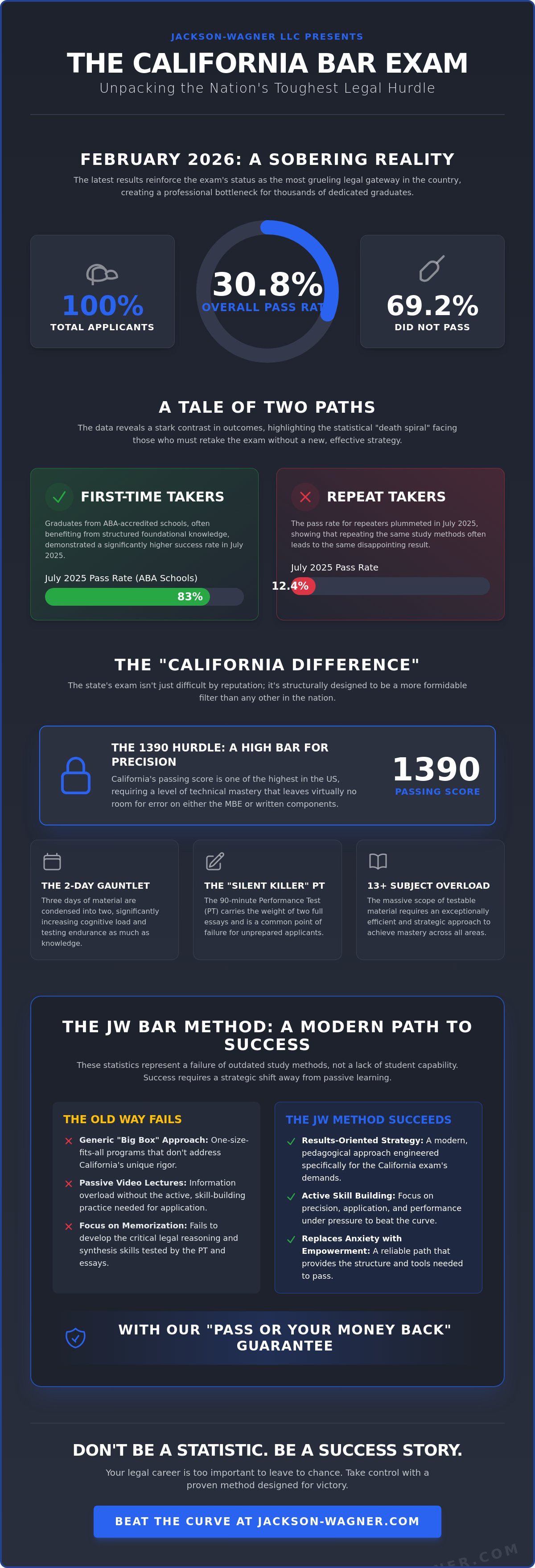
Only 30.8% of applicants passed the February 2026 General Bar Examination. This sobering figure reinforces why this remains the most grueling legal gateway in the country. This statistic highlights the reality of the lowest california bar pass rate and the structural barriers facing even the most dedicated law graduates. You've likely spent three years and a small fortune on your education, yet the fear of becoming a repeater statistic is enough to paralyze any candidate. It's a valid concern, especially since the pass rate for repeaters plummeted to a staggering 12.4% in July 2025.
At Jackson-Wagner LLC, we believe these numbers represent a failure of traditional, passive study methods rather than a lack of student capability. You don't have to be a victim of a system that fails to teach the precision required for the 1390 scale. This breakdown will analyze the 2026 trends, identify the specific factors that lead to failure, and provide a clear roadmap to ensure you don't become another data point in the state's declining pass rates. Discover how to strategically position yourself to beat the curve and secure your future in the legal profession.
Key Takeaways
- Understand the implications of the 1390 passing score and why it continues to drive the lowest california bar pass rate in the nation.
- Identify the structural differences of the two-day exam format and how specific weighting of the written component requires matchless precision.
- Learn how to avoid the statistical "death spiral" facing repeat examinees by adopting a modern, results-oriented study strategy.
- Discover why traditional "big box" prep courses often fail California candidates and how to pivot toward a more sophisticated, pedagogical approach.
- Explore the JW Bar Method’s unique "Pass or Your Money Back" guarantee, designed to replace exam anxiety with absolute professional empowerment.
The Reality of the Lowest California Bar Pass Rates in 2026
The February 2026 results confirm that the barrier to entry for the California legal profession is higher than ever. With an overall pass rate of just 30.8%, the data reinforces the state's reputation for maintaining the lowest california bar pass rate in the nation. This figure isn't just a number; it's a professional bottleneck that dictates the future of thousands of graduates. While jurisdictions using the Uniform Bar Exam (UBE) often see pass rates significantly higher, California’s 1390 passing score remains a formidable obstacle. This score requires a level of technical precision that leaves virtually no room for error on either the Multistate Bar Examination (MBE) or the written essays. The emotional impact of these statistics is profound, as years of law school investment hang in the balance of a single, high-stakes event.
Understanding the "1390" requirement is essential. Unlike other states where a "good" performance might suffice, California demands a level of mastery that is technically superior to the national average. This creates a high-stakes environment where candidates often feel like they are fighting a system designed to exclude them. The disparity between California and easier jurisdictions is jarring, and it often leads to a sense of professional isolation for those who find themselves on the wrong side of the curve. However, these statistics are a reflection of a specific grading rubric, not a lack of candidate intelligence.
Historical Trends vs. 2026 Projections
Since the 2020 decision to reduce the passing score from 1440 to 1390, we've seen various fluctuations in performance. However, 2026 projections indicate a tightening of grading standards, particularly in the written portion of the exam. We're observing a widening gap between ABA-accredited and unaccredited school performance. Graduates of ABA schools maintained an 83% pass rate for first-time takers in July 2025, while candidates from other backgrounds struggled to adapt to the evolving technical demands. This trend suggests that the exam is becoming increasingly specialized, requiring a more sophisticated pedagogical approach to bridge the gap.
The "Gatekeeping" Reputation of the State Bar
The State Bar of California maintains these high standards to ensure that only the most technically competent professionals enter the legal field. By acting as a rigorous gatekeeper, the State Bar ensures the integrity of the profession, but it also creates a significant barrier to entry. At Jackson-Wagner LLC, we recognize that this "low pass rate" is a structural challenge rather than an impossible hurdle. Success in 2026 requires moving beyond traditional, generic programs and embracing a structured, modern, and reliable path that accounts for the state’s unique rigor. You can navigate these professional barriers with the right method.
Why the California Bar Exam Consistently Ranks as the Nation’s Toughest
California isn't just difficult; it's structurally designed to be a filter. While Section 1 detailed the 1390 score requirement, the true challenge lies in the "California Difference": the condensation of three days of material into two high-intensity days. This increases the cognitive load significantly, forcing you to maintain peak mental performance for longer stretches without the luxury of recovery time. While the 50/50 weighting between the Multistate Bar Exam (MBE) and the written component seems balanced on paper, the written side is where candidates often fail to meet the mark, contributing to the lowest california bar pass rate in the nation. You aren't just fighting the clock; you're fighting a format that tests your endurance as much as your legal knowledge.
The Performance Test (PT) is the secret "silent killer" of California applicants. Graders use this 90-minute section to evaluate your ability to function as an attorney by synthesizing a "file" and "library" of unfamiliar law. Many students treat the PT as an afterthought, yet it carries the weight of two full essays. Combined with the psychological toll of the 200-question MBE marathon, it's clear why the state maintains such a daunting reputation. You need a strategy that accounts for this fatigue and provides the technical tools to handle complex synthesis under extreme pressure.
Subject Matter Overload: The 13+ Topics
The scope of the exam is massive, requiring mastery of over 13 distinct subjects, from Community Property to Professional Responsibility. Graders frequently utilize "crossover" essays where multiple subjects intersect in a single fact pattern. Generic templates from traditional bar review courses often fail here because they don't teach you how to navigate these intersections with the necessary depth. Memorization alone is a failing strategy; the grading rubric rewards the technical application of law to specific facts, not just a standard rule dump on the page.
The Grading Rubric: Why "Good" Isn’t Good Enough
California grading is notoriously stingy, and there's a profound difference between a score of 60 and a 65 on an essay. A 60 indicates you know the law, but a 65 demonstrates you can think like a lawyer. Graders look for "lawyerly" issue spotting and a nuanced discussion of facts. This level of precision is exactly what legacy programs often miss in their broad-brush approach. To move beyond the average and beat the lowest california bar pass rate, you need precision issue spotting that transforms your writing into a professional work product worthy of licensure.
Analyzing the Data: First-Time Takers vs. Repeaters and Attorneys
Raw data tells a story of extreme disparity. While first-time takers from ABA-approved schools often maintain respectable success rates, the aggregate numbers reveal the lowest california bar pass rate in the nation. This statistical gulf is most evident when you compare the July 2025 results. First-time examinees achieved a 69.7% pass rate, while repeaters plummeted to a devastating 12.4%. This isn't just a gap. It's a systemic failure of traditional preparation methods to help students bridge the divide between "almost passing" and actually earning a license. Reviewing historical California bar exam statistics shows that this trend is persistent and predictable.
The "death spiral" for repeat examinees is often fueled by the psychological weight of previous failure. However, the technical cause is usually more clinical. Most candidates who fail once simply double down on the same "big box" strategies that failed them initially. They watch the same lectures and use the same generic templates. This approach ignores the reality that California's 1390 scale requires a fundamental shift in technical execution, not just more hours of study. To beat the lowest california bar pass rate, you must change your methodology, not just your effort levels.
The Repeater Trap: Why Second-Timers Fail Again
The number one mistake repeaters make is using the same prep course twice. Traditional programs are structurally incapable of diagnosing specific writing weaknesses or identifying why your issue spotting lacks precision. They provide a "one size fits all" curriculum that fails to address the unique needs of a second-time taker. You don't need a refresher on the law. You need a pedagogical intervention that identifies exactly where your analysis is breaking down under the pressure of the clock.
Attorney Applicants: Experience vs. Exam Logic
Experienced attorneys often underestimate this exam. Even 20-year veterans find themselves humbled by the California Attorney’s Exam, which had a pass rate of only 43.4% in July 2025. The trap here is relying on "practicing law" instead of "exam logic." Graders aren't looking for how you handle a client in the real world; they're looking for a specific, technical application of California law. Jackson-Wagner LLC’s Attorney Prep is specifically designed to strip away practice-based habits and replace them with the matchless precision required for the written-only exam. Success for attorneys requires unlearning the nuances of daily practice to master the rigid expectations of the State Bar.
Strategic Shifts: Moving Beyond Generic Prep to Beat the Curve
Generic prep courses are structurally designed for the middle of the pack. In a state that consistently maintains the lowest california bar pass rate, being average is a recipe for failure. Many traditional bar prep programs rely on a passive consumption model that simply doesn't translate to the technical precision required for a 1390 score. You can't just watch hours of video lectures and hope for the best. Success in 2026 demands a pedagogical shift from mere consumption to active production. If your study plan looks like everyone else's, your results will likely follow the same downward trend.
The "1,000-hour study plan" is a relic of a different era. It suggests that raw volume can overcome a lack of technical strategy. For the modern candidate, especially working professionals, this approach is both impossible and ineffective. You need an accelerated, structured framework that prioritizes high-yield topics and technical execution over mindless outline reading. Efficiency is your most valuable asset. By focusing on how the law is actually tested rather than how it's written in a textbook, you position yourself to beat the curve.
Active vs. Passive Learning in Bar Prep
Traditional programs trap you in a cycle of passive learning. Watching a video lecture provides a false sense of security; it feels like progress, but it doesn't build the cognitive muscles needed for the Performance Test or complex crossover essays. We prioritize "Issue Spotting Drills" that force you to engage with the material under pressure. By utilizing automated feedback, you can identify exactly where your analysis falls short. This data-driven approach allows you to pivot your study time toward high-yield areas that actually move the needle on your score.
The Working Professional’s Advantage
You don't need to quit your job to pass this exam. Successful candidates often use an "Accelerated Track" that focuses on efficiency over raw volume. Mastering the most-tested sub-topics is the key to overcoming the lowest california bar pass rate without burning out. Use this California Bar Exam Practice checklist to focus your high-stakes drills on the concepts that appear most frequently. By narrowing your focus, you achieve a level of technical mastery that generic students simply can't match.
Ready to stop being a statistic? Explore our JW Bar Method Prep and secure your path to licensure with a modern, results-oriented strategy.
The JW Bar Method: Reversing the Statistics with Guaranteed Success
The statistics we’ve analyzed are grim, but they aren't your destiny. While the state continues to produce the lowest california bar pass rate in the nation, the JW Bar Method is designed to reverse that trend through a pedagogical shift toward "Matchless Precision." We don't just provide outlines. We provide a structured, modern, and reliable path to success that targets the specific technical demands of the California State Bar. Our team understands the specific nuances of the California Bar Exam that traditional, national programs consistently overlook. We've replaced the stress of the unknown with a methodology that treats the bar exam as a technical challenge rather than an academic one.
We're so confident in our methodology that we lead with a "Pass or Your Money Back" guarantee. This ultimatum isn't just a marketing hook; it's a reflection of our commitment to taking on the financial risk of your exam. By aligning our success with yours, we establish a sense of security and absolute trust that "big box" providers simply can't offer. This focus on a binary outcome, success or refund, is what makes us a disruptive force in legal education. We seek to replace the high-stakes anxiety of the 2026 cycle with professional empowerment.
Choosing the right program is critical for your 2026 timeline. Whether you need the JW Bar Method Prep or the JW Bar Method Accelerated Prep, our curriculum is engineered to handle the high-intensity pressure of the two-day marathon. We've moved beyond the outdated model of in-person classes to offer a paced format that works for first-time takers and seasoned attorneys alike. Our programs are categorized by your specific needs:
- JW Bar Method Prep - Full Exam California Bar
- JW Bar Method Prep - Attorney’s Exam California Bar
- JW Bar Method Accelerated Prep - Full California Bar Exam
- JW Bar Method Accelerated Prep - Attorney’s Exam California Bar
The Proprietary Learning Objectives
Our method breaks down the intimidating 1390 score into achievable, expert-led modules. Instead of drowning in 13 subjects at once, you’ll master specific learning objectives through interactive quizzes and progress tracking. This real-time data ensures you never waste a minute on topics you’ve already mastered. Automated feedback provides the granular detail needed to turn a failing 60 into a passing 65. This organized approach is why our students consistently beat the state’s lowest california bar pass rate and secure their licenses on the first attempt.
Your 2026 Success Plan
Enrolling is the first step toward reclaiming your career and moving past the fear of failure. Whether you are a first-time candidate from an ABA-approved school or an out-of-state veteran, your roadmap is clear. You can enroll in the JW Bar Method Prep today to begin your journey. Our anytime, anywhere digital platform provides the flexibility you need to study on your own terms. Don’t be a statistic; be a success story.
Secure Your Future in the California Legal Profession
The 30.8% pass rate from February 2026 is a sobering reminder that the path to licensure in this state is a technical marathon. You've seen how the 1390 scale and the condensed two-day format contribute to the lowest california bar pass rate in the country. This isn't a reflection of your potential as an attorney. It's a reflection of a system that demands matchless precision and a departure from generic, passive study habits. To succeed, you must adopt a strategy that prioritizes active issue spotting and technical execution over raw memorization.
Our expert-led pedagogy and specialized tracks are designed to replace your anxiety with absolute professional empowerment. We provide the structured modules and real-time feedback necessary to move you beyond the average and into the passing bracket. We are so confident in our results-oriented approach that we take the financial risk off your shoulders. Don't let a statistic define your career. Take control of your preparation and join the ranks of successful California attorneys.
Pass the California Bar or Your Money Back-Enroll in the JW Bar Method Today
Frequently Asked Questions
What is the current pass rate for the California Bar Exam in 2026?
The overall pass rate for the February 2026 General Bar Examination was 30.8%. This figure confirms the ongoing trend of the lowest california bar pass rate in the country; it represents a slight decline from the 33.9% recorded in February 2024. These statistics highlight the rigorous nature of the exam and the necessity for a structured, expert-led approach to avoid falling into the majority of unsuccessful candidates.
Why is California’s bar pass rate significantly lower than New York’s?
California’s lower pass rate is primarily driven by a higher passing score of 1390 and a more demanding exam structure. Unlike New York, which uses the Uniform Bar Exam (UBE), California requires candidates to master 13+ subjects and perform on a high-intensity, two-day schedule. This structural rigor creates a significant barrier to entry, ensuring only those who demonstrate matchless precision can join the state’s legal profession.
Can I pass the California Bar Exam if I graduated from a non-ABA law school?
You can certainly pass the exam as a graduate of a non-ABA law school, though the statistical path is more challenging. While graduates of ABA-approved schools saw an 83% pass rate for first-time takers in July 2025, those from unaccredited or out-of-state schools often face lower success rates. Success depends on moving beyond generic study habits and utilizing a pedagogical approach that targets the specific grading nuances of the State Bar.
How much does the California Bar Exam cost for first-time applicants in 2026?
The general registration fee for law students is $850, while attorneys must pay $1,500. Applicants should account for a proposed fee increase of at least $150 that was introduced in late 2025. These costs, combined with annual license fees of $598 for active attorneys, make the financial stakes of failure exceptionally high. Investing in a reliable prep method is essential to protect this significant investment.
What is a passing score on the California Bar Exam (1390 scale)?
A passing score on the California Bar Exam is a scaled total of 1390. This score is calculated by combining your performance on the Multistate Bar Examination (MBE) with your scores on the five essay questions and the Performance Test. Because the written component is weighted at 50%, achieving matchless precision in your analysis is the only way to ensure you reach this high threshold consistently.
Is the California Attorney’s Exam easier than the full Bar Exam?
The Attorney’s Exam is not easier; it simply has a different focus. While it is a written-only test that excludes the MBE, the July 2025 pass rate was only 43.4%. Many experienced practitioners fail because they rely on real-world practice habits instead of the specific exam logic required by California graders. Success requires unlearning daily practice nuances to master the rigid technical expectations of the written modules.
How many times can you take the California Bar Exam?
There is currently no limit on the number of times an applicant can sit for the California Bar Exam. However, the repeater "death spiral" is a real statistical threat; the pass rate for repeaters was only 12.4% in July 2025. Taking the exam multiple times without a fundamental shift in your study methodology often leads to the same unsuccessful outcome, reinforcing the state's reputation for the lowest california bar pass rate.
What is the "Pass or Your Money Back" guarantee offered by Jackson-Wagner?
The "Pass or Your Money Back" guarantee is our commitment to your success; if you complete our program and do not pass, we refund your enrollment fee. We take on the financial risk because we are certain of the efficacy of our structured and accelerated tracks. This ultimatum replaces the high-stakes anxiety of the exam with a sense of security, ensuring you feel motivated and professionally protected throughout your study process.


