
If you’re preparing for the nation’s most grueling legal exam in 2026, choosing the wrong study partner isn't just a mistake; it’s a liability. You already know that California demands far more than just general legal knowledge. You’re likely feeling the weight of information overload from legacy companies that prioritize generic multi-state topics over the specific nuances of California’s essay and Performance Test requirements. The fear of failing the hardest bar in the country is real, but it's often fueled by study plans that waste your time on irrelevant content. Selecting the right bar review courses requires a strategy that looks beyond the flashy marketing of massive, one-size-fits-all prep companies.
This guide provides a professional decision-making framework to evaluate prep options against the unique rigour of the 2026 California Bar Exam. We promise to help you streamline your study process and build absolute confidence in your California-specific performance. You’ll discover how to navigate the recent shifts in the testing landscape, such as Kaplan's new role in question development, while prioritizing high-yield topics. We will also preview how to select a path that offers a legitimate performance guarantee to protect your financial future and ensure your success on exam day.
Key Takeaways
- Identify the "California Trap" and understand why generic bar review courses often underperform by prioritizing national averages over the state's unique, high-standard rigour.
- Master the content checklist to ensure your prep includes California-specific essay grading rubrics and 90-minute Performance Test drills that mirror the actual exam environment.
- Evaluate pedagogical frameworks to ensure you're investing in active learning that prioritizes high-yield topics rather than wasting hours on passive, low-impact video lectures.
- Learn how to vet a provider's accountability by distinguishing between standard free repeats and bold financial performance guarantees that mitigate your risk.
- Streamline your final selection process by auditing your academic weak points and requesting a targeted demo of the JW Bar Method.
The California Trap: Why Generic Bar Review Courses Underperform
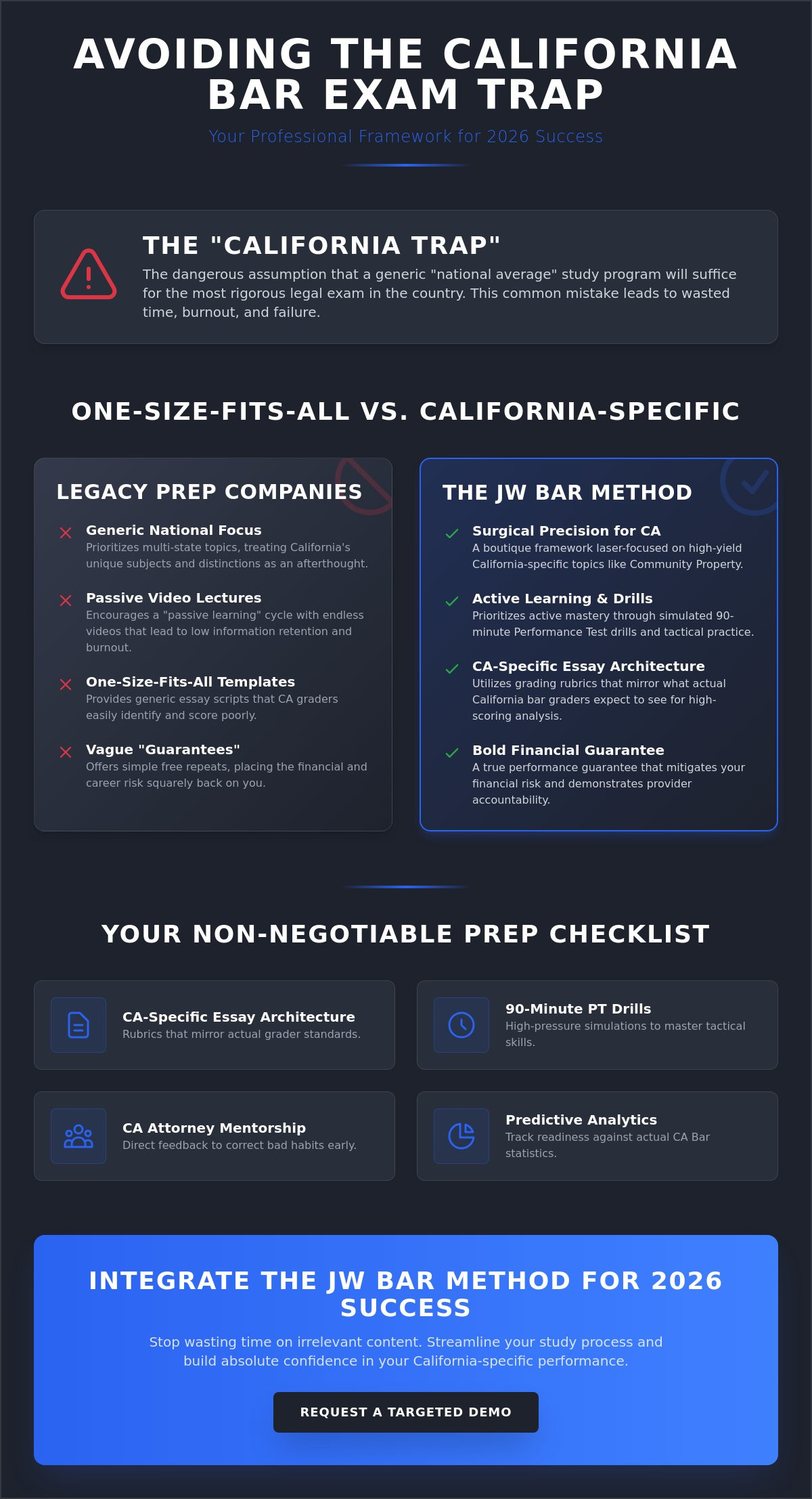
The "California Trap" is a silent career killer for aspiring attorneys. It’s the dangerous assumption that a study program designed for the "national average" will suffice for the most rigorous exam in the country. While the bar examination in the United States has trended toward the Uniform Bar Exam (UBE) in many jurisdictions, California remains a fortress of its own making. Generic bar review courses often fail because they treat California as a side note rather than the primary objective. This leads to a "passive learning" cycle where students watch endless videos without ever mastering the specific tactical demands of the California State Bar.
In 2026, the trend is shifting. Students are moving away from massive, high-volume prep companies that prioritize enrollment numbers over individual success. They’re choosing specialized, boutique frameworks that recognize California’s unique difficulty. You don't need more information; you need better precision.
The Failure of One-Size-Fits-All Pedagogy
Most legacy courses rely on generic essay templates. These scripts are designed to pass in dozens of different states, but California graders see through them immediately. They want sophisticated analysis, not a memorized outline. Large-scale bar review courses also tend to push students toward over-studying MBE topics at the expense of the written sections. While the multiple-choice section is vital, it shouldn't come at the expense of the Performance Test (PT). Spending the majority of your time on national law while ignoring the 90-minute high-pressure PT environment is a recipe for burnout and failure. Graders aren't looking for a regurgitated outline; they're looking for a lawyer.
California vs. The Rest of the Country
California tests subjects that national courses often gloss over, such as Community Property and specific California distinctions in Professional Responsibility. The scoring "curve" here is notoriously steep. Achieving a passing score on the 1390 scale requires surgical precision that generalist programs simply can't provide. Even popular legacy study keys may not be enough to bridge the gap between a "national" effort and a California-passing performance. To succeed in 2026, your preparation must be as specialized as the exam itself. You can't win a marathon by training for a sprint; you can't pass the world's hardest bar by studying for an average one.
The Content Checklist: Essential Features for California Bar Mastery
Passing the California Bar Exam requires more than just a high volume of practice questions. It demands a specialized toolkit designed to meet the exact standards of the Committee of Bar Examiners. Most bar review courses provide a general foundation, but they often stop where the real challenge begins. To secure your license in 2026, your prep must include these four non-negotiable features:
- California-Specific Essay Architecture: You need rubrics that mirror what graders actually look for, not just generic rule statements found in national outlines.
- Performance Test (PT) Drills: Simulation is everything. You must practice in the 90-minute high-pressure environment to master the tactical organization required by the State Bar.
- Attorney Mentorship: Direct feedback from CA-licensed mentors ensures you aren't reinforcing bad habits that lead to 60-range scores.
- Predictive Analytics: Your data should track your readiness against the California Bar Exam statistics to see where you sit on the curve before exam day.
Mastering the California Performance Test (PT)
The PT is the "silent killer" of many bar exam attempts. It accounts for a massive portion of your total score, yet many students treat it as a secondary task because it doesn't require substantive law memorization. Generic advice usually focuses on simple reading comprehension, but that isn't enough to pass. Successful candidates use strategic execution, beginning with a rigorous timing drill and a systematic library analysis. You must learn to organize the file and the library simultaneously to avoid drowning in the provided facts. If you're looking for a structured way to master this, the JW Bar Method Prep - Full Exam California Bar offers a specialized framework for these high-pressure tasks.
Essay Formatting for the State Bar Graders
Standard IRAC (Issue, Rule, Analysis, Conclusion) is the absolute floor for performance. To reach the 70+ score threshold, you have to aim for the "CA-Specific" ceiling. This involves identifying "crossover" topics, like Torts and Professional Responsibility, that generalist programs frequently miss. Generic prep often fails because it lacks the granularity required for the specific CA essay format. Your prep should force you to confront these complex hybrids early. You need to know exactly how to structure a Professional Responsibility crossover before you ever step into the exam room. Choosing among various bar review courses shouldn't be a guessing game; it should be a search for these specific, high-yield features.
Efficiency and Pedagogy: Evaluating Study Frameworks for Working Professionals
For the modern professional, time isn't just a resource; it's the primary constraint. If you're balancing a full-time legal career or family obligations, you can't afford the bloated schedules of legacy bar review courses that demand 10 hours of passive consumption every day. Success in 2026 requires a shift from high-volume content to high-yield precision. When choosing a bar prep course, you must audit the pedagogy to ensure it respects your schedule. A professional-grade framework should prioritize active output over passive watching, ensuring every minute spent studying translates directly into points on the California curve.
Efficiency also means having the flexibility to study anywhere. Legacy desktop platforms often tether you to a home office, but a mobile-first approach allows you to engage in high-stakes drills during a commute or between meetings. You need a system that identifies your specific weak points in California subjects and adjusts your path accordingly, rather than forcing you through a generic timeline designed for a recent graduate with zero external responsibilities.
Active vs. Passive Study Methods
Watching 40 hours of video lectures is arguably the least effective way to prepare for the California Bar. It creates a false sense of security called the "fluency illusion," where you feel like you understand the law because you've heard it explained, yet you can't apply it under pressure. The JW Method replaces this passive drain with immediate application through high-stakes drills. We focus on identifying filler content in national bar review courses, such as excessive lectures on minor UBE nuances that rarely appear on the California exam. You should spend your time writing, not watching.
The Accelerated Prep Checklist
Not every candidate needs a standard 10-week marathon. If you're an out-of-state attorney with years of practice, a 4-week or 8-week track may be more effective. The JW Bar Method Accelerated Prep - Attorney’s Exam California Bar is specifically designed for those who already understand the mechanics of law but need to master California’s unique grading expectations. When evaluating an accelerated track, check for these criteria:
- Subject Prioritization: Does the course focus on the 13-15 subjects most likely to appear in California?
- Skill-Based Feedback: Are you getting critiques on your writing style within 24 to 48 hours?
- Licensure Navigation: Does the provider help you how to navigate the State Bar of California requirements for 2026?
Choosing the right speed is just as important as choosing the right content. For those sitting for the Full Exam, the JW Bar Method Accelerated Prep - Full California Bar Exam provides the same rigorous focus on active learning within a condensed timeframe. Don't let a generic schedule dictate your success; choose a framework that matches your professional reality.
The Performance Guarantee: Vetting the Accountability of Your Prep Provider
Accountability is often the missing ingredient in legal education. Most bar review courses rely on a "repeat for free" policy, which is essentially a hedge against your success. If a provider's only penalty for your failure is giving you the same materials again, they don't have skin in the game. You need a binary performance guarantee. This serves as a marker of absolute pedagogical confidence. It shifts the financial risk from the student to the mentor, ensuring the curriculum is surgically aligned with 2026 California standards. Before you sign, vet the fine print. Does the guarantee require you to complete a realistic amount of work, or is it designed to be impossible to trigger?
Skin in the Game: Why Guarantees Matter
A guarantee isn't just a refund policy; it's a psychological anchor. For high-anxiety examinees, knowing a provider assumes the financial risk of their performance outcome replaces stress with professional empowerment. This commitment forces a provider to keep their curriculum updated in real-time. In a year like 2026, where the testing landscape is shifting, you can't afford a static study plan. Discover the best bar exam preparation service 2026 to see why precision is the only path to licensure. Jackson-Wagner LLC assumes this risk because the methodology is built on measurable results, not just enrollment volume.
Transparency in Pass Rates
Interpret "90% pass rate" claims with extreme caution. These numbers often hide restrictive qualifiers, such as only counting first-time takers who finished a vast majority of the curriculum. While top-performing students in California often reach pass rates in the low 80s, you must demand data that reflects the specific difficulty of the California curve. As major legacy providers exit the California market or shift their focus toward question development for the state, a massive void has opened for students seeking specialized support. Some national providers try to fill this with generic multi-state data that doesn't apply to you. Ask an enrollment advisor for CA-specific results for the Attorney’s Exam or the Full Bar before committing. If they can't provide localized data, they aren't a partner; they're a vendor.
Ready to work with a partner who has skin in the game? Secure your future with the JW Bar Method Prep - Full Exam California Bar.
Final Selection: Integrating the JW Bar Method for 2026 Success
The transition from a law student to a licensed attorney in California requires a final, decisive pivot. You have vetted the market, identified the limitations of generic bar review courses, and understood the necessity of a performance guarantee. Now, you must integrate a specialized framework into your daily routine. Success in 2026 isn't about how much you study; it's about the precision of your output. Moving forward requires a commitment to a California-first methodology that rejects the "one-size-fits-all" comfort of national brands in favor of surgical accuracy.
- Step 1: Performance Audit. Review your law school transcripts and practice MBE scores to identify weak CA subjects. Don't hide from your struggle areas; target them immediately.
- Step 2: Tactical Demo. Request a demo of the JW Bar Method specifically for the CA Performance Test. Understanding how we deconstruct a 90-minute task will change your entire approach to the exam.
- Step 3: Track Selection. Compare the JW Bar Method Prep - Full Exam California Bar with our Accelerated tracks. Your choice should depend on whether you have a standard 10-week window or a condensed 4-to-8-week professional schedule.
- Step 4: Strategic Commitment. Stop browsing and start drilling. Once you commit to a specialized mentor, you stop being a consumer of content and start being a producer of passing answers.
The 30-Day Pre-Bar Readiness Audit
Before the official study period begins, conduct a self-assessment of your current skills. Can you maintain a 65% accuracy rate on mixed MBE sets? Can you outline a complex Torts essay in 15 minutes? A specialized mentor provides the external perspective necessary to bridge the gap between law school knowledge and licensure. While massive video libraries offer a graveyard of information, the JW Bar Method offers immediate application through high-stakes drills. We ensure you are hitting 60-minute essay milestones long before you enter the testing center.
Your 2026 California Bar Strategy
Your final decision framework should rest on three pillars: Precision, Accountability, and Specialization. Jackson-Wagner provides a "Bold Reliability" promise that traditional providers simply can't match. We assume the financial risk of your performance because we are certain of our methodology's efficacy. As you prepare for the February or July 2026 cycles, remember that the California Bar Exam doesn't reward generalists. It rewards those who have mastered the specific rigour of the state's unique format. It's time to stop studying for a national average and start preparing for the career you've earned.
The next step is yours. Secure your spot in the next JW Bar Method cohort and take control of your professional future.
Secure Your Path to 2026 Licensure
The era of passive learning and national-average prep is over. To succeed on the 2026 California Bar Exam, you must reject the "one-size-fits-all" model in favor of surgical precision and active application. We have explored how identifying the "California Trap," auditing study frameworks for professional efficiency, and vetting providers for true accountability can transform your preparation from a source of anxiety into a structured path to success. Choosing among various bar review courses shouldn't feel like a gamble with your career; it should be a strategic investment in a partner with skin in the game.
The proprietary JW Bar Method provides the exact architecture needed for California essay and Performance Test mastery. Whether you require our standard curriculum or one of our accelerated tracks for working professionals, our binary performance guarantee ensures that we are as committed to your success as you are. Don't settle for a legacy program that treats the nation's hardest exam as a side note. It's time to leverage a modern, results-driven framework that replaces stress with professional empowerment.
Master the California Bar with the JW Bar Method
Your future as a California attorney is within reach. Take the first step toward a confident exam day today.
Frequently Asked Questions
Are generic bar review courses like Barbri or Kaplan sufficient for California?
Generic bar review courses often fall short because they are designed for national UBE standards rather than California’s specific rigour. While they cover the MBE well, they frequently gloss over the unique essay architecture and 90-minute Performance Test requirements that define the California experience. Success here requires a specialized focus that legacy, high-volume companies no longer provide, particularly as some major providers have exited the California-specific market entirely.
What makes the California Bar Exam harder than other states?
The California Bar Exam is notoriously difficult due to its unique 1390-point scoring scale and its status as a non-UBE jurisdiction. Graders expect a level of analytical sophistication in essays that exceeds the standard IRAC floor found in other states. Additionally, the 90-minute Performance Test acts as a high-pressure hurdle that requires a specific tactical approach rather than just general legal knowledge or reading comprehension.
Do I need a separate course for the California Attorney’s Exam?
Yes, because sitting for the Attorney’s Exam means you are only graded on the written portions, making essay and PT mastery your only path to success. A general course that forces you to sit through hundreds of hours of MBE lectures is a waste of your professional time. You need a targeted framework like the JW Bar Method Prep - Attorney’s Exam California Bar to focus exclusively on the skills that determine your specific outcome.
How much time should I realistically spend on bar prep for California?
Most students require 400 to 600 hours of study, typically spread over 8 to 10 weeks. However, the quality of your hours matters more than the quantity. If you use a high-yield, active learning framework, you can achieve better results in a shorter window. Working professionals often find that an accelerated track of 4 to 8 weeks is sufficient when they prioritize high-stakes drills over passive video consumption.
What is the "JW Bar Method" and how does it differ from traditional prep?
The JW Bar Method is a disruptive, results-oriented pedagogy that replaces passive video lectures with immediate, high-stakes application. Unlike traditional bar review courses that focus on volume, we prioritize the specific tactical demands of the California State Bar. Our approach includes a binary performance guarantee, assuming the financial risk of your outcome to ensure our curriculum remains surgically aligned with current exam standards.
Can I pass the California Bar while working a full-time job?
Passing while working is entirely possible if you choose a study framework designed for efficiency rather than exhaustion. You must avoid the "passive learning" trap of legacy courses that demand 10 hours of daily consumption. By focusing on high-yield California topics and using mobile-first tools, you can integrate rigorous practice into a professional schedule without sacrificing the depth of your preparation.
What happens if I fail the bar exam after taking a review course?
Most legacy providers offer a "repeat for free" policy, which essentially offers you the same failed materials a second time. We believe this lack of accountability is unacceptable for high-stakes professional licensing. Our model includes a financial performance guarantee that mitigates your risk. This ensures that we are financially incentivized to provide a curriculum that works the first time rather than planning for your return.
How do I choose between a full prep course and an accelerated one?
Your choice depends on your previous academic performance and your current work schedule. Recent graduates or those with significant gaps in their legal knowledge should opt for the JW Bar Method Prep - Full Exam California Bar. Conversely, practicing attorneys or those with a strong grasp of the law should consider an accelerated track to focus specifically on mastering the California-specific written components in a condensed timeframe.


