

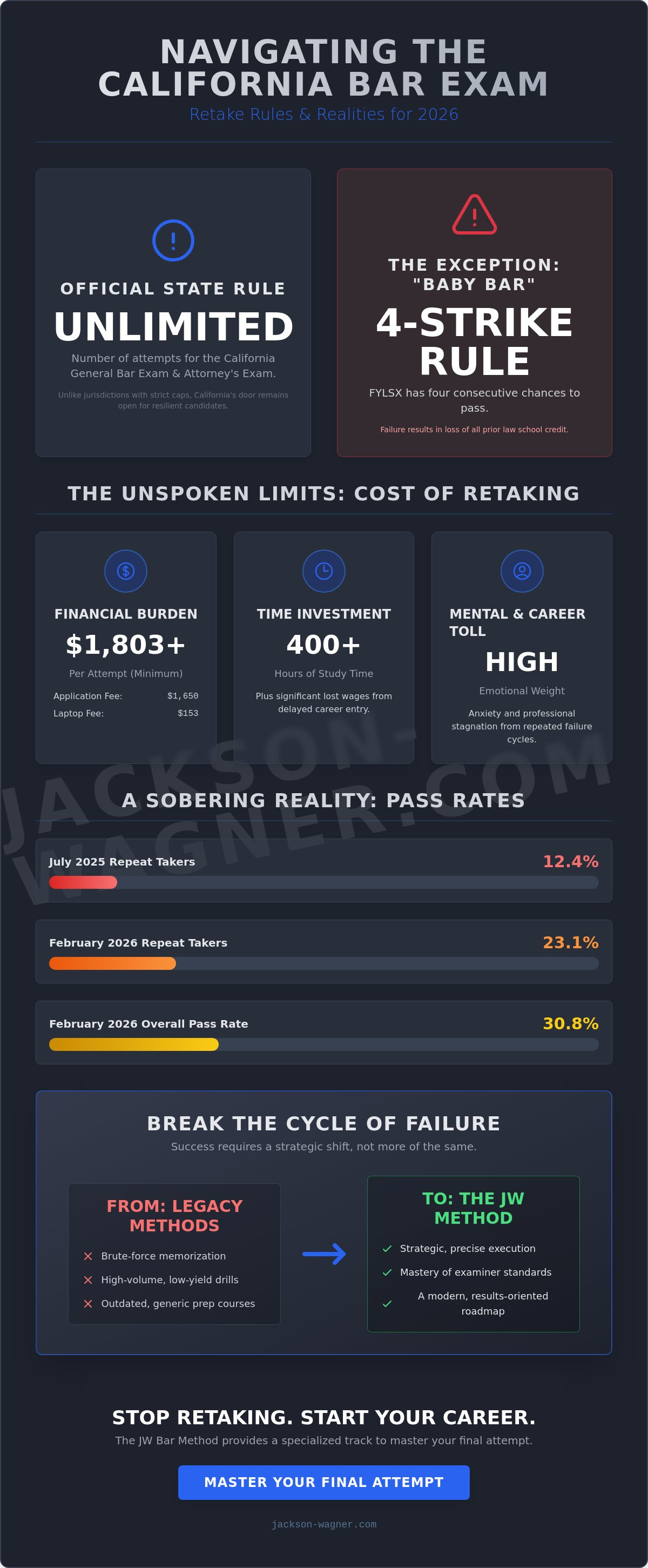
In July 2025, the pass rate for repeat takers on the California Bar plummeted to a staggering 12.4%. This data point makes the question of how many times can you take the california bar feel like a matter of professional survival rather than a simple administrative query. While California officially allows unlimited attempts as of 2026, the real limit is often defined by your bank account and your mental health. With application fees set at $1,650 and laptop fees adding another $153, the financial strain of repeated attempts can quickly eclipse the potential wages of your first year in practice.
It's frustrating to feel like your career is on hold while you're trapped in a cycle of expensive, legacy prep courses that failed to move the needle. We promise to show you exactly how to break that cycle by shifting your focus from brute-force memorization to strategic execution. This article clarifies the current 2026 retake rules, compares them to other jurisdictions, and outlines a roadmap to replace your anxiety with a results-oriented study plan. You'll gain the clarity needed to stop retaking the exam and finally start your career as a licensed attorney.
Key Takeaways
- California remains a "no-limit" jurisdiction in 2026, allowing you to sit for the General Bar Exam as many times as necessary to pass.
- While there's no official cap on how many times can you take the california bar, the compounding financial costs and lost associate wages create a significant professional burden.
- Success for repeat takers requires a strategic shift from high-volume memorization to the precise writing and execution standards demanded by California examiners.
- The JW Bar Method provides specialized tracks for both the Full Exam and the Attorney’s Exam to address the unique pressures faced by different applicant profiles.
- Breaking the cycle of failure involves replacing legacy study drills with a modern, results-oriented roadmap designed for the 2026 testing environment.
Understanding the California Bar Exam Attempt Limit in 2026
The State Bar of California currently imposes no limit on the number of times an applicant can sit for the General Bar Exam. This policy remains unchanged for the 2026 cycle. While jurisdictions like Virginia or Kansas enforce strict caps that can permanently bar an applicant from practice after a set number of failures, California operates on a different philosophy. The State Bar of California maintains public protection through rigorous standards rather than arbitrary exclusion. If you have the resilience and the resources, the door remains open. However, asking how many times can you take the california bar is often a signal that your current preparation model is broken. In February 2026, the overall pass rate was just 30.8%; a figure that highlights the exam's gatekeeping function.
California's approach is a marathon, not a sprint. In states with absolute limits, the pressure is a ticking clock. In California, the pressure is a mounting financial and emotional weight. Every attempt costs $1,650 in registration fees alone. When you factor in the 400+ hours of study time required for each cycle, the "unlimited" rule starts to feel like a trap for those using legacy study methods. The decision to permit unlimited attempts is rooted in the belief that competence can be acquired over time. It recognizes that life circumstances or poor initial instruction can impede performance. By focusing on the final score rather than the number of tries, the state ensures every licensed attorney has met the same high bar of entry. It makes the state accessible for persistent candidates, but it also demands a high degree of self-awareness. You don't want to become a permanent student of the bar; you want to be a practitioner.
The 'Baby Bar' Exception: When Limits Do Apply
There is one critical exception to the "unlimited" rule. Students at unaccredited law schools or those without two years of college work must pass the First-Year Law Students’ Examination (FYLSX), commonly known as the "Baby Bar." Unlike the General Bar, the FYLSX has a strict "four strike" rule. You have four consecutive opportunities to pass after becoming eligible. If you fail to pass within these four attempts, you lose all credit for law school study completed up to that point. It's a high-stakes bottleneck that requires immediate, strategic intervention to avoid a total academic reset. While there is technically no cap on how many times can you take the california bar, the Baby Bar creates a definitive wall for a specific subset of applicants.
2026 Administrative Updates and Exam Frequency
The 2026 calendar follows the traditional February and July cycles. The July 2026 General Bar Exam is set for July 28 and 29. Administrative shifts continue to move toward modernized testing platforms, emphasizing the need for technical proficiency alongside legal knowledge. While you can technically sit for every administration, the burnout risk is real. Repeat takers in February 2026 saw a pass rate of only 23.1%. This suggests that rushing into the next cycle without a fundamental change in strategy is a recipe for professional stagnation. You must balance the "unlimited" nature of the rules with the finite nature of your own endurance and capital.
Specific Retake Rules for the General Bar vs. the Attorney's Exam
Licensure in California is not a one-size-fits-all process. When analyzing how many times can you take the california bar, you must first identify which version of the exam you are actually sitting for. The General Bar Exam is the standard two day ordeal consisting of the Multistate Bar Examination (MBE), five essay questions, and one Performance Test. In contrast, the Attorney's Exam is a condensed version available to those already licensed in another U.S. jurisdiction for at least four years. While the "unlimited attempts" rule applies to both, the strategic demands of a retake differ significantly between a recent law graduate and a seasoned practitioner. For the most current logistical details on these formats, you should consult the official California Bar Examination information provided by the State Bar.
The JW Bar Method recognizes that licensed attorneys face entirely different pressures than law students. You aren't just fighting a test; you're fighting years of "practice logic" that often contradicts the rigid, pedantic requirements of bar graders. If you are retaking the General Bar, your failure likely stems from a weakness in the MBE or a failure to master the specific IRAC structure California demands. If you're an attorney applicant, the lack of an MBE component means your entire future rests on your writing. Our JW Bar Method Prep - Attorney’s Exam California Bar is specifically engineered to bridge this gap by stripping away bad habits and replacing them with exam-centric precision.
The Attorney’s Exam: A Different Kind of Retake
Seasoned lawyers often fail the California Bar because they rely too heavily on their real world experience. The graders don't care how you'd handle a case in a real courtroom; they care how you apply California's specific rubrics. For a deep dive into eligibility and the specific hurdles for practitioners, see our guide on California Attorney's Exam Requirements: The 2026 Guide to Licensure for Out-of-State Lawyers. Understanding these nuances is vital because the question of how many times can you take the california bar often masks a deeper need for a total tactical overhaul.
Character, Fitness, and Multiple Failures
There's a persistent myth that failing the bar multiple times suggests a lack of "Moral Character." This is false. The State Bar does not penalize you for persistence. However, you must handle prior failures with absolute transparency. If you are worried about your history, review our strategy for the california bar exam moral character application. Honesty during the re-application process is the only way to protect your future licensure. The committee values your ability to disclose setbacks more than they care about the number of attempts it took to reach the finish line.
Opportunity Costs: The Financial and Professional Reality of Repeat Attempts
While the technical answer to how many times can you take the california bar is "as many as you need," the economic reality is far more restrictive. Every failed attempt is not just a blow to your confidence; it's a massive financial drain that compounds over time. The State Bar of California currently charges a $1,650 registration fee for each application. When you add the $153 laptop fee and the $318 certification fee, you're looking at over $2,100 in direct administrative costs per cycle. This doesn't even account for travel, lodging, or the psychological tax of returning to a testing center for another two day ordeal.
The most damaging expense is often the "prep course loop." Many students find themselves trapped in a cycle of paying for legacy programs that didn't work the first time. Re-enrolling in the same volume-based drills from national corporate prep providers is often a losing investment for repeaters. These programs are designed for the masses, not for the high stakes needs of someone who has already faced the low pass rates of previous cycles and needs a surgical approach to their weaknesses. You don't need more drills; you need a different methodology that prioritizes precision over sheer volume.
The Financial Breakdown of a Retake
Beyond the immediate checks you write to the State Bar, you must consider the "hidden" costs of failure. Every six month study cycle requires roughly 400 to 500 hours of intense focus. For most, this means reduced hours at work or total unemployment. In the context of a law graduate, opportunity cost is the loss of six months of billable potential and career advancement for every cycle spent in unpaid study. This financial strain often leads to "Bar Exam PTSD," where the fear of another expensive failure creates a paralyzing anxiety that actively sabotages performance on the 3rd or 4th attempt.
The Career Impact of Multiple Attempts
Professional stagnation is the silent killer of legal careers. Many law firms extend "contingent" job offers that vanish the moment a "Fail" result appears on the State Bar website. While you can technically keep trying, your resume begins to show a widening gap that becomes harder to explain to recruiters. Our JW Bar Method Accelerated Prep - Full California Bar Exam is designed specifically for these high stakes scenarios. It allows you to balance work and study, minimizing the professional fallout of a retake. By using a more efficient, results-oriented track, you can position your eventual pass as a testament to your professional resilience. It's time to stop asking how many times can you take the california bar and start asking how you can make this attempt your last.
Breaking the Cycle: Why 'More Studying' Is Not the Answer
Repeating the same legacy drills from a standardized prep factory is the clinical definition of insanity. If you are researching how many times can you take the california bar, you likely feel like you're running on a treadmill. You're working hard, but you aren't moving forward. The problem isn't your work ethic; it's your methodology. Traditional courses prioritize volume, burying you in thousands of MBE questions and hundreds of pages of outlines. This "grind" mentality might work for some first-time takers, but it fails repeaters who need to address specific execution gaps. You don't need to know more law; you need to know how to deploy the law you already have under the precise rubrics of the California examiners.
Seasoned practitioners from jurisdictions like New York or Texas often fall into the "Attorney Trap." After a decade of practice, your writing becomes nuanced, practical, and efficient. Unfortunately, California bar graders don't reward practical lawyering. They reward a very specific, pedantic style of academic drafting. This is why we see high failure rates among experienced out-of-state lawyers who assume their professional pedigree will carry them through. To pass, you must unlearn your professional habits and adopt the rigid IRAC standards required by the State Bar. This strategic pivot is the only way to stop asking how many times can you take the california bar and finally secure your license.
Diagnostic Analysis: Why Did You Fail?
Your score report is a roadmap, not just an autopsy. A scaled score of 1390 is the passing threshold in California. If you landed at a 1350 or a 1370, you don't have a knowledge problem; you have a precision problem. You must identify where you are bleeding points:
- The MBE: Are you falling for "distractor" answers because you're reading too fast or failing to spot the specific legal nuance?
- The Essays: Is your analysis too thin, or are you missing the sub-issues that trigger extra points on the grading rubric?
- The Performance Test: This is the most common area where repeaters leave points on the table. It carries the weight of two full essays, yet many treat it as an afterthought.
Success requires shifting from passive reading to active drafting under high-pressure drills. You must be able to produce a passing answer in your sleep.
The JW Bar Method Advantage for Repeaters
We position ourselves as the disruptive mentor you actually need. Unlike legacy industry standards that treat every student as a number, the JW Bar Method focuses on the pedagogical nuances that move the needle for repeaters. This is the Best Bar Exam Preparation Service 2026: Why Precision Beats Volume. We are so confident in our results-oriented approach that we offer a performance guarantee, assuming the financial risk of your outcome. Secure your professional future by enrolling in the JW Bar Method Prep - Full Exam California Bar and make this attempt your last.
Mastering Your Final Attempt with the JW Bar Method
It's time to stop treating the bar exam as a recurring event in your life. While the State Bar of California doesn't limit how many times can you take the california bar, your professional timeline certainly does. Every cycle you spend in study mode is a cycle you aren't spending in a courtroom or a law firm. The JW Bar Method Prep - Full Exam California Bar offers a structured, modern path to licensure that eliminates the guesswork of legacy prep. We don't teach a generalized curriculum designed for a national audience. Instead, we focus exclusively on California's specific requirements, ensuring total immersion in the rubrics that actually move your score.
Many repeaters face the "Full Time" challenge, balancing a 40 hour work week with rigorous study. Our accelerated tracks are engineered for this exact scenario. We provide a streamlined curriculum that prioritizes high impact execution over the busy work found in corporate prep factories. By focusing on how to write for the California Bar rather than just what to know, we help you reclaim your time and your confidence. Our approach is disruptive and results-driven, acting as a competent mentor for those who require flexibility without sacrificing standards.
We are so certain of our methodology that we assume the financial risk of your outcome. Our binary performance guarantee serves as a signature of our bold reliability. We aren't just a content provider; we are a partner in your career. This commitment to your success replaces the high stakes anxiety of the exam with a steady, structured progression toward your license. Don't let the "unlimited" rule lull you into a cycle of stagnation. Make the 2026 administration your final and successful attempt.
Choosing the Right Program for Your 2026 Attempt
Selecting the correct track is the first step toward breaking the retake cycle. Our "Full Exam" prep is designed for those tackling all three components of the General Bar, while our "Attorney’s Exam" track focuses specifically on the writing portions for out of state practitioners. In the first 30 days of the JW Bar Method curriculum, you'll undergo a rigorous diagnostic phase to identify and bridge your specific execution gaps. You can begin this transformation today by enrolling in the JW Bar Method Prep - Full Exam California Bar.
Your Strategic Timeline to Success
Success requires a hard stop on your past failures. You must decide that 2026 is the year you finally join the bar in California confidently. Managing the 2026 application deadlines is critical; remember that immediate repeaters for the July exam must file by May 15, 2026, to avoid late fees. Align your study start dates with these administrative milestones to ensure a seamless transition from applicant to attorney. Stop counting how many times can you take the california bar and start counting your billable hours. Your career is waiting.
Secure Your Professional Future in 2026
The technical answer to how many times can you take the california bar may be unlimited, but your career cannot afford another cycle of stagnation. We've established that the path to licensure in 2026 isn't about studying more; it's about studying with surgical precision. By moving away from legacy volume based drills and focusing on the State Bar's specific drafting requirements, you transform the bar exam from a professional bottleneck into a final hurdle. Whether you are a recent graduate or a seasoned practitioner, your strategy must evolve to match the high standards of the California examiners.
The JW Bar Method provides the structured environment you need to succeed. Our programs are exclusively focused on California licensure and offer accelerated prep options for working professionals who need to balance their studies with a career. We are so confident in our results driven methodology that we provide a Binary Performance Guarantee, effectively assuming the financial risk of your outcome. It's time to stop researching retake limits and start preparing for your first day as a licensed attorney. Enroll in the JW Bar Method and Pass the California Bar Confidently. You have the resilience to reach the finish line, and we have the modern roadmap to get you there.
Frequently Asked Questions
Is there a limit to how many times you can take the bar exam in California in 2026?
There is currently no limit on the number of times an applicant can sit for the General Bar Exam in California. Unlike states that impose a hard cap after three or five attempts, California allows you to retake the test indefinitely. This policy ensures that entry into the legal profession is based on meeting high standards rather than the frequency of attempts. However, the mounting financial and professional costs often create a practical limit for many candidates.
Does failing the California Bar multiple times affect my Moral Character application?
Multiple failures don't negatively impact your Moral Character application as long as you are honest about your history. The State Bar of California values transparency and persistence over a perfect testing record. You must disclose all prior attempts truthfully, but failing the exam is viewed as an academic setback rather than a reflection of your ethical standing or fitness to practice law. Your ability to persist can even be framed as a professional asset.
How much does it cost to retake the California Bar Exam?
The base registration fee for the California Bar Exam is $1,650 per attempt. Additional costs include a $153 laptop fee and a $318 certification application fee. These administrative expenses don't include the heavy investment required for prep materials or the lost wages incurred during the study period. This is why many candidates ask how many times can you take the california bar before searching for a more efficient, results-oriented preparation method.
Can I take the Attorney's Exam if I failed the General Bar Exam previously?
You can sit for the Attorney's Exam even if you previously failed the General Bar Exam, provided you meet the specific eligibility requirements. You must be an active member in good standing of another U.S. jurisdiction for at least four years. This shorter exam focuses on essays and the performance test, allowing seasoned practitioners to bypass the MBE portion of the general test and focus on their specific writing strengths.
What is the pass rate for repeat test-takers in California?
The pass rate for repeat test-takers is consistently lower than the rate for first-time applicants. In the February 2026 administration, the repeat taker pass rate was 23.1%, while first-time takers passed at a rate of 43.9%. In July 2025, the pass rate for repeaters was even lower at 12.4%. These statistics underscore the necessity of a strategic shift in study habits for those who have been previously unsuccessful in their attempts.
What happens if I fail the California 'Baby Bar' (FYLSX) four times?
Failing the First-Year Law Students’ Examination (FYLSX) four times results in the loss of all law school credit earned up to that point. You have exactly four consecutive opportunities to pass the "Baby Bar" once you become eligible. If you miss this window, you must restart your legal education from the beginning to remain eligible for eventual licensure. This is the only major exception to California's otherwise unlimited testing policy.
How many times did Kim Kardashian take the bar exam?
Kim Kardashian passed the First-Year Law Students’ Examination, or Baby Bar, on her fourth attempt. Her highly publicized journey highlighted the difficulty of the California system and the strict "four strike" rule applicable to the FYLSX. Her persistence brought mainstream attention to the question of how many times can you take the california bar and the reality of repeat testing for those entering the profession through non-traditional paths.
Is the California Bar Exam harder for out-of-state attorneys?
The California Bar is often more difficult for out-of-state attorneys because it requires unlearning years of "practice logic" in favor of rigid academic rubrics. Seasoned lawyers frequently struggle with the pedantic IRAC structure demanded by California graders. Success requires a total tactical overhaul rather than relying on the professional experience that might serve you well in a real courtroom. You must master the specific style that California graders expect to see.


