

In the July 2025 General Bar Examination, the pass rate for repeat takers plummeted to just 12.4%. If you're feeling the weight of that statistic, you aren't alone. You've already sacrificed months of your life and thousands of dollars to legacy prep courses that treat you like a first-time student. It's exhausting to balance a full-time career while staring at score reports that feel like an undecipherable code. This guide introduces a definitive california bar exam retaker strategy designed to break that cycle once and for all.
We're moving past the myth that more volume equals success. Instead, you'll learn how to transform your approach from passive study to surgical precision with a data-driven methodology. This article provides a clear, diagnostic roadmap to identify your specific performance gaps and build a high-efficiency study plan. We'll explore how to decode your metrics and implement a modern, results-oriented system that replaces high-stakes anxiety with the absolute certainty of passing the California Bar.
Key Takeaways
- Break the "Volume Trap" by shifting from passive lecture consumption to the active recall techniques required for the 2026 exams.
- Learn to decode your State Bar score report to pinpoint the specific performance gaps holding you back from a passing scaled score.
- Adopt a surgical california bar exam retaker strategy that utilizes the JW Bar Method to bridge the gap between your previous attempts and licensure.
- Build a structured study timeline for the 2026 February or July administrations that respects your professional schedule and prevents burnout.
- Discover the security of a binary performance guarantee where your prep provider assumes the financial risk of your exam outcome.
Why Traditional Bar Prep Fails California Retakers
Traditional bar prep is built for mass consumption, not individual mastery. If you are a repeat candidate, you've likely realized that the big-box approach relies on a one-size-fits-all model that prioritizes passive volume over surgical precision. This Volume Trap forces you to sit through 100 hours of lectures you've already heard, wasting your most valuable resource. To build a successful california bar exam retaker strategy, you must move beyond the student mindset of merely absorbing information and adopt the exam-taker mindset of scoring points through active application.
Legacy providers fail because their feedback is inherently generic. When you submit an essay to a massive, national course, you often receive templated comments from graders who spend only minutes on your work. This lack of specificity is why high-achieving attorneys often struggle. They write like practitioners, but the California Bar requires a formulaic rubric that traditional courses fail to teach with necessary depth. You don't need another summary of the law; you need a breakdown of why your specific analysis didn't earn the points required for licensure.
The Myth of 'Studying Harder'
Success isn't found in repeating the same 60-hour work weeks that led to a fail notice. Re-enrolling in the exact course that failed you is a strategic error. You've already reached the law of diminishing returns with passive review. For 2026, your focus must shift toward active mastery. You don't need more law; you need better execution. It's about how you use your time, not how much time you use. Transitioning to a results-oriented mindset means stopping the cycle of re-learning and starting the process of performing.
California's Unique Grading Nuances
The California Bar is notoriously difficult, as documented in this California Bar Examination overview. The State Bar expects lawyer-like analysis, but they want it delivered in a specific format that legacy courses often gloss over. Recent scoring trends show a stark reality for repeaters, suggesting that the current california bar exam retaker strategy used by most candidates is fundamentally broken. You cannot rely on generic formatting if you want to bridge the performance gap between your current score and a passing one. You must master the nuances of the California rubric to ensure your analysis matches exactly what the graders want to see on the page.
Diagnosing Your Score Report: Data-Driven Retake Strategy
Receiving a fail notice is an emotional event, but your path to 2026 success requires you to set emotion aside and treat your score report as a diagnostic blueprint. The State Bar provides a breakdown of your performance for a reason. To build an effective california bar exam retaker strategy, you must understand the difference between raw scores and scaled scores. Your raw score is simply the points you earned; your scaled score is that number adjusted for the relative difficulty of that specific exam administration. You can find detailed updates on the scoring process via the Official California Bar Examination Information page.
A passing score in California is 1390. If you fell short, you likely have a "Performance Gap" between your MBE and written scores. Many candidates rely on a strong MBE to carry a weak written score, but with repeater pass rates as low as 12.4% in July 2025, this lopsided approach is increasingly dangerous. You need a balanced performance. Spotting consistent weaknesses requires looking at your percentile rank in each of the seven core MBE subjects and comparing that against your essay scores. If your Torts MBE is in the 80th percentile but your Torts essay is a 55, you don't have a law problem; you have an application problem.
MBE Analysis: Beyond the Percentile
Don't just look at the total. Analyze your performance in the core subjects. A 140+ MBE used to be considered a "safe" harbor, but the current grading environment is less forgiving. You must distinguish between knowledge gaps and timing issues. If you consistently miss questions in the final 10 of a block, your problem is pacing. If you miss questions across the board in Property, you have a substantive knowledge gap. A data-driven approach means attacking these specific deficiencies rather than doing 2,000 random questions.
The Written Diagnostic: Essays and the PT
The Performance Test (PT) is the most overlooked strategic lever in the exam. It's worth 200 points, exactly double a standard essay. Scoring a 55 or 60 on a PT is often the difference between passing and failing. These scores usually signal a lack of depth or a failure to follow the specific instructions in the task memo, rather than a lack of legal knowledge. For the essays, identify whether your low scores stem from poor issue-spotting or weak rule-application. Most repeaters know the law but fail to "lawyer" on the page. If you want to move from 60s to 70s, you need to refine your analytical structure. To see how a professional diagnostic can change your trajectory, consider how the JW Bar Method identifies these precise failures before they happen again.
The Precision Pivot: Moving from Passive Review to Active Mastery
Stop reading your outlines. If passive reading were enough to secure a license, the official State Bar of California exam results for February 2026 wouldn't show a repeat taker pass rate of only 23.1%. Most candidates fail a second or third time because they mistake familiarity for mastery. They recognize the rules, but they can't deploy them under pressure. A successful california bar exam retaker strategy requires a "Precision Pivot." You must move away from the comfort of highlighted pages and toward the discomfort of active recall and surgical application.
The JW Bar Method is built on this pedagogical shift. We don't ask you to re-learn the law; we train you to weaponize it. This involves a transition to "Attorney-Style" writing, where you stop acting like a student summarizing a textbook and start acting like a lawyer arguing a case. By prioritizing california bar exam practice through high-stakes drills, you bridge the gap between substantive knowledge and the points required for a passing scaled score. You need to build the mental muscle memory that allows you to identify issues and rules automatically, leaving your cognitive energy for the analysis that actually earns points.
Writing for the Rubric
California examiners aren't looking for a law review article. They're looking for a specific set of markers in your analysis. Your california bar exam retaker strategy must focus on "point-grabbing" by structuring essays that mirror the examiner's rubric. This means prioritizing factual integration over abstract rule statements. You win or lose on your analysis. The JW Method emphasizes the quality of your arguments, specifically the inclusion of robust counter-arguments. Graders want to see that you can anticipate and dismantle opposing views. It's not about your word count; it's about the density of your analytical hits. One well-reasoned paragraph using every fact in the prompt is worth more than three pages of generic rule-dumping.
MBE Precision Drills
The MBE is a game of distractors. To score a 145 or higher in 2026, you have to move past simply "doing questions" and start "understanding why the wrong answers are wrong." Our precision drills force you to identify the specific distractor type, whether it's a misstatement of law or a factually irrelevant trap. You must master the "call of the question" before you even look at the answer choices. This is especially critical for handling experimental items and the increasingly complex civil procedure questions. When you understand the mechanics of the question, the difficulty of the subject matter becomes secondary to your diagnostic process.
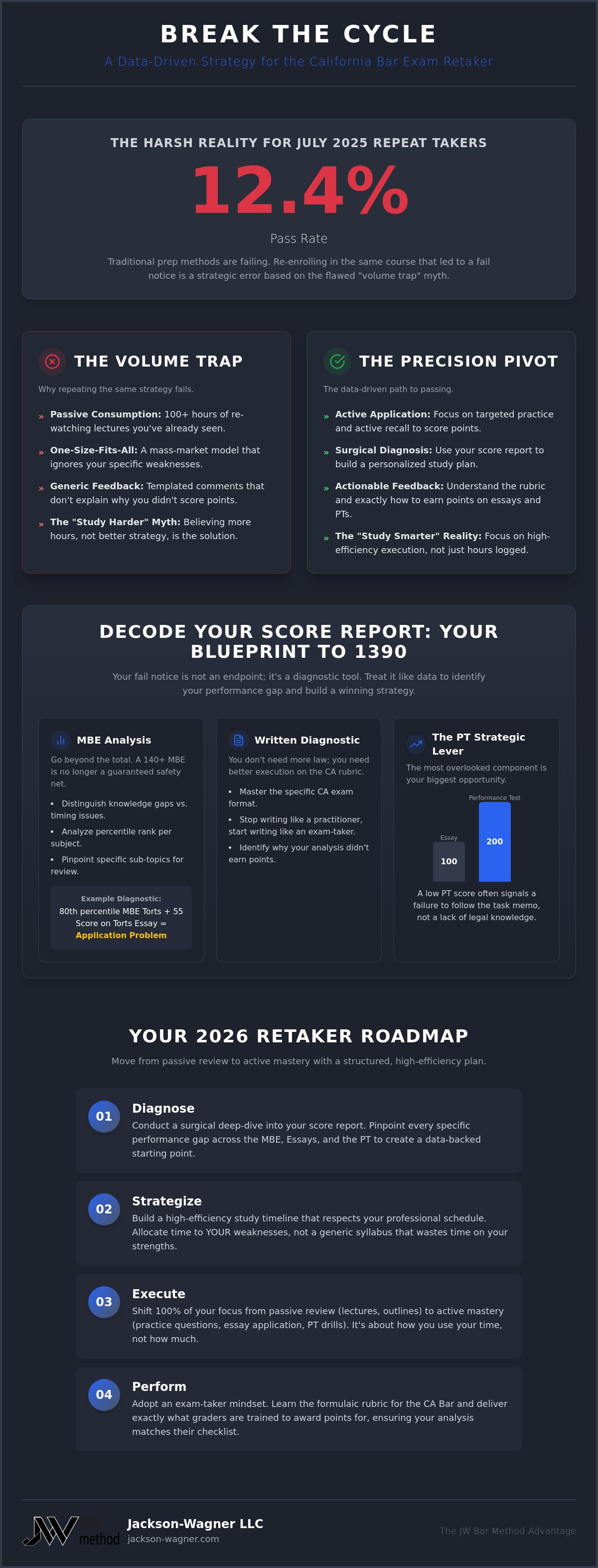
The 2026 California Bar Exam Retaker Roadmap
The July 2026 California Bar Exam is set for July 28 and 29. If you're looking ahead to the winter cycle, the February 2027 dates are February 23 and 24. For a repeat candidate, the standard 10-week calendar is often a recipe for burnout and diminishing returns. Your california bar exam retaker strategy must prioritize a condensed, high-intensity timeline that builds momentum toward these specific dates. Success in 2026 isn't about how many months you study; it's about the quality of your execution in the final 30 days. This accelerated philosophy focuses on peak performance rather than endless review.
Maintaining cognitive stamina is the greatest challenge during a retake cycle. You're likely balancing this effort with a professional career or family obligations. You don't need to quit your job to pass. You need a roadmap that integrates study sessions into your existing life without sacrificing your mental health. By focusing on surgical drills and diagnostic review, you can achieve in two hours what legacy courses attempt in eight. This efficiency allows you to stay fresh for the two-day marathon in July or February.
Strategic Scheduling for Working Professionals
Working attorneys and professionals must abandon the idea of an eight-hour study day. Instead, utilize "Early Bird" or "Night Owl" blocks of 90 to 120 minutes. These sessions should be reserved for active recall and essay drafting. Use your weekends for high-intensity passing the California Bar Exam simulations that replicate the fatigue of the actual test environment. Communication is vital. Clearly state your study needs to your firm or employer. Most organizations value the investment in your licensure and will respect the boundaries required for you to secure that passing score. To implement this roadmap with professional guidance, view our JW Bar Method Accelerated Prep options today.
The Final Push: 14 Days to Success
The final two weeks before the exam are for execution, not learning. This is the period where you transition from understanding the law to mastering the exam's mechanics. You must complete full-length, timed mock exams to ensure your pacing is perfect. Focus on finalizing your "Attack Outlines" for the most frequently tested subjects like Professional Responsibility, Torts, and Community Property. These outlines should be one-page summaries of rule clusters and headers that you can mental-map during the test. Your goal is to enter the testing center with the absolute certainty that no prompt can surprise you.
Securing Your License: The JW Bar Method Advantage
Choosing the right partner is the final, most critical step in your california bar exam retaker strategy. Traditional prep programs often offer a free retake if you fail, but this is a hollow promise. A free seat in the same curriculum that didn't work the first time isn't a solution; it's a repetition of the same errors. The JW Bar Method positions itself as a modern evolution, functioning as the best bar exam preparation service for those who demand surgical precision over passive volume. We don't just provide content; we provide a structured, results-oriented environment where your success is the only acceptable outcome.
Our model is disruptive because we assume the financial risk of your performance. While other providers distance themselves from your results, our binary performance guarantee ensures we're fully invested in your licensure. This level of bold reliability is especially vital for those navigating california attorney's exam requirements or balancing the Full Bar Exam with a demanding legal career. We offer accelerated tracks that strip away the fluff of traditional prep, focusing exclusively on the high-impact drills that translate to points on the page.
The Guaranteed Path to Licensure
Our binary performance guarantee establishes a sense of absolute trust that legacy providers cannot match. We don't offer vague support or generic encouragement. We offer a commitment to your specific result. This pedagogical approach has empowered repeat candidates to break the cycle of failure. By replacing the stress of high-pressure certification with a reliable, data-driven path, we act as a mentor rather than a mere content library. You aren't just another enrollment number; you're a future colleague whose success is our primary objective.
Next Steps: Reclaiming Your Career
Don't let another exam cycle pass with a strategy that has already proven insufficient. You can enroll in the JW Bar Method Accelerated Prep today and begin the process of diagnostic mastery. While you wait for your results or prepare for the next administration, it's also the ideal time to finalize your california bar exam moral character application to ensure no administrative delays stand between you and your license. The path to the 2026 bar is narrow, but with the right methodology, your success is certain. It's time to stop studying and start passing.
Join the JW Bar Method and Pass the California Bar
Reclaim Your Professional Future
Breaking the cycle of failed attempts requires more than just grit; it requires a fundamental shift in how you engage with the material. By diagnosing your specific score report gaps and pivoting toward active mastery, you transform from a passive student into a high-performing exam taker. This 2026 california bar exam retaker strategy is designed to maximize your efficiency, ensuring that every hour of study translates directly into points on the page.
You don't have to navigate this high-stakes environment alone. With our California-exclusive expertise and accelerated prep tracks tailored for working attorneys, we provide the structure you need to succeed. We are so confident in our methodology that we offer a binary performance guarantee; we assume the financial risk so you can focus entirely on your performance. End the retake cycle—enroll in the JW Bar Method today. Your journey to licensure ends here. You've already done the hard work of law school. It's time to secure the results you deserve and move forward with your career.
Frequently Asked Questions
How many hours should a retaker study for the California Bar Exam?
You should focus on 20 to 30 hours of high-intensity, active study per week rather than the standard 60-hour passive model. Success for repeaters comes from surgical precision, not sheer volume. If you're working, these hours must be dedicated to active recall and essay drafting. This ensures you maintain cognitive stamina without succumbing to the burnout that often plagues traditional study schedules.
What is the pass rate for California Bar Exam retakers in 2026?
The repeat taker pass rate for the February 2026 General Bar Examination was 23.1%. This is significantly lower than the 43.9% rate for first-time takers during the same period. These statistics highlight why a specialized california bar exam retaker strategy is essential. You can't rely on generic methods when the data shows that repeaters face a much steeper uphill climb toward licensure.
Should I use the same prep course I used the first time?
No, you shouldn't reuse a prep course that has already failed to produce a passing result. Continuing with the same legacy provider often leads to the "Volume Trap" of re-watching lectures you've already seen. A retake requires a pedagogical shift toward active mastery. You need a modern alternative that diagnoses your specific performance gaps rather than offering a one-size-fits-all curriculum.
Can I pass the California Bar while working full-time?
You can absolutely pass the California Bar while working full-time if you utilize an accelerated, high-efficiency study track. Most successful repeaters aren't those with the most free time, but those with the most disciplined schedules. By focusing on two-hour blocks of high-impact drills, you can achieve the necessary mastery without resigning from your firm or sacrificing your professional obligations.
What is the most important subject to focus on for a retake?
Professional Responsibility is the most critical subject to master because it's tested in some capacity on almost every exam. Beyond that, you must focus on the subjects where your MBE percentiles were lowest. A successful california bar exam retaker strategy prioritizes these high-yield areas to bridge the gap between your previous score and the 1390 required for a license.
How do I interpret my California Bar Exam score report?
You should interpret your score report by comparing your scaled scores in the MBE and written sections against the 1390 passing benchmark. Identify whether your failure was due to a substantive knowledge gap or a lack of analytical depth in the essays. If your MBE is strong but your essays are in the 50s or 60s, your focus must shift toward "Attorney-Style" writing and rubric-specific formatting.
What happens if I fail the California Bar Exam multiple times?
There is no limit to how many times you can sit for the California Bar, but each failure increases the risk of burnout and financial strain. The State Bar allows unlimited attempts, yet the data suggests that pass rates often decline for those who don't change their study methodology. Breaking the cycle requires a disruptive approach that addresses the root causes of your previous performance gaps.
Is the California Attorney's Exam easier than the full Bar Exam?
The Attorney's Exam isn't "easier" than the full Bar Exam; it's simply different because it eliminates the MBE. While you only sit for one day of essays and the Performance Test, the pressure is higher because there are no multiple-choice points to offset a weak writing performance. You must demonstrate exceptional analytical proficiency to meet the State Bar's standards for experienced practitioners.


