
The California Bar Exam isn't just a test of legal knowledge; it's an administrative gauntlet that begins months before you ever open a MBE workbook. You've spent years mastering the law, yet the complexity of the 2026 california bar exam requirements can feel more daunting than a complex Property essay. It's a high-stakes environment where a single missed deadline or a misunderstood eligibility rule can delay your career by six months. We believe that administrative hurdles shouldn't be the reason you aren't practicing law in the nation's most competitive jurisdiction.
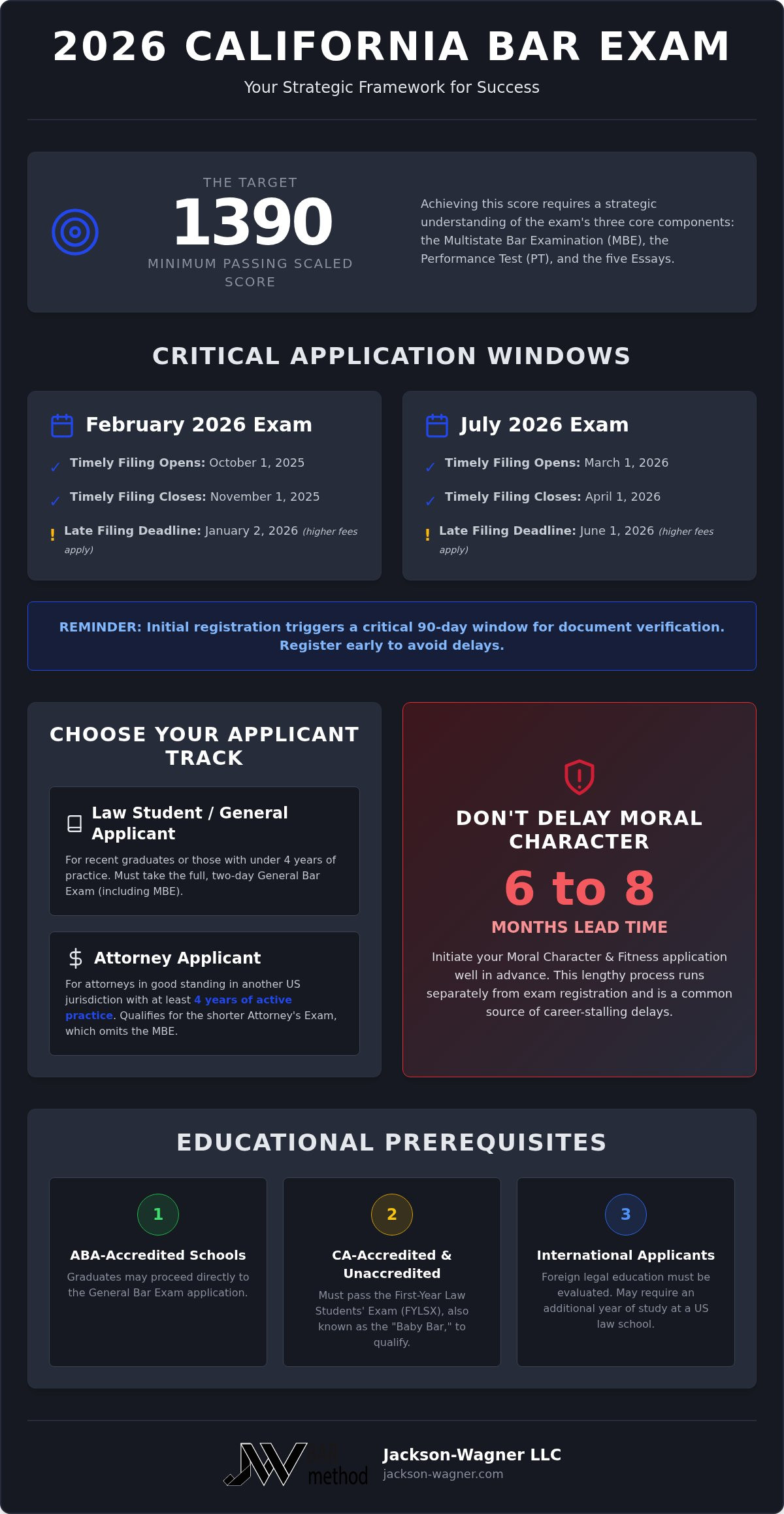
This strategic guide is designed to replace that stress with a reliable, results-oriented framework. You'll master every eligibility, educational, and administrative requirement for the 2026 cycle with our authoritative breakdown. We'll provide a definitive checklist of all 2026 requirements, offer absolute clarity on the six to eight month Moral Character application window, and explain the differing demands for law students and attorney applicants. This is about more than just compliance; it's about building the confidence to meet every standard while you prepare to achieve that 1390 passing score.
Key Takeaways
- Distinguish between the Law Student and Attorney applicant tracks to secure your registration within the critical 90-day window for 2026.
- Confirm whether your specific law school accreditation requires passing the First-Year Law Students' Exam (FYLSX) before you can sit for the general bar.
- Master the 2026 california bar exam requirements for moral character by initiating your application at least eight months early to avoid career-stalling delays.
- Target the 1390 scaled score by understanding the strategic breakdown of the MBE, Performance Test, and essay components.
- Replace high-volume, legacy study models with a modern, results-oriented prep system designed for professional efficiency and absolute confidence.
Eligibility and Registration: The Foundation of Your 2026 Application
Precision starts here. The State Bar of California manages a network of nearly 270,000 licensed attorneys, and your entry into this group begins with a formal registration that many applicants treat as an afterthought. This is a mistake. Meeting the california bar exam requirements for 2026 demands a methodical approach to the Admissions portal long before you open a casebook. You must finalize your registration as a law student or attorney applicant before you can even access the specific exam application. This initial step triggers a critical 90-day window for document verification that must be cleared before the exam cycle begins.
International applicants often encounter friction regarding Social Security Number (SSN) requirements. If you don't have an SSN, you're required to submit a Request for Social Security Number Exemption during the registration phase. Don't wait for the state bar to find the omission. Once your account is active, your "Status Screen" becomes your primary source of truth. Monitor this screen weekly to ensure all initial fees are processed and no documentation is flagged. Administrative silence is not an indicator of success; it's often a sign of a pending hurdle that could delay your licensure by half a year.
Attorney vs. Student Applicant Tracks
The path you choose depends entirely on your current professional standing. If you're an attorney in good standing from another US jurisdiction with at least four years of active practice, you qualify for the shorter Attorney's Exam. This version omits the Multistate Bar Examination (MBE) entirely. If you have less than four years of practice, you must take the full two day exam. This distinction is vital because it dictates whether you need the JW Bar Method Prep - Full Exam California Bar or the JW Bar Method Prep - Attorney’s Exam California Bar. We've built these tracks to address the specific pedagogical needs of each group, ensuring you don't waste time on sections you aren't required to take.
The Registration Logistics Checklist
Success requires a structured approach to the Admissions portal. Follow these steps to secure your spot for the 2026 cycles:
- Create your account: Register as a law student or attorney and pay the required registration fee.
- Upload documentation: Provide certified transcripts or certificates of good standing, including mandatory documentation for any name changes.
- February 2026 Deadlines: The timely filing window opens October 1, 2025, and closes November 1, 2025.
- July 2026 Deadlines: The timely filing window opens March 1, 2026, and closes April 1, 2026.
Late filing is possible until January 2 for the February exam and June 1 for the July exam, but the fees increase significantly. Secure your seat early to clear your mental runway for actual study.
Educational Standards: ABA, California-Accredited, and Law Office Study
California is famously flexible regarding where you earn your legal education, but don't mistake that flexibility for a lower bar. The california bar exam requirements stipulate that you must complete at least three or four years of law study to qualify for licensure. While graduates from ABA-accredited schools move directly to the general bar application, students from California-accredited or unaccredited schools face a more complex administrative path. International practitioners must have their foreign legal education evaluated by a credential evaluation service to determine if they meet the equivalency standards. If the degree is not deemed sufficient, the State Bar of California admission requirements may mandate an additional year of study at a US law school, specifically focusing on subjects tested on the bar exam.
Your educational background does more than just determine your eligibility; it dictates your strategic approach to prep. Traditional prep courses often assume a standardized ABA-level foundation that doesn't always align with the diverse educational paths California allows. Understanding the specific gaps in your background is the first step toward a successful 2026 application.
Managing the First-Year Law Students’ Examination (FYLSX)
The First-Year Law Students’ Examination, commonly known as the "Baby Bar," serves as a mandatory gatekeeper for certain applicants. If you're attending an unaccredited law school or participating in the Law Office Study Program, you must pass this one-day test to receive credit for your further studies. The exam consists of four essays and 100 multiple-choice questions focusing exclusively on Contracts, Torts, and Criminal Law. You generally have three opportunities to pass the FYLSX after becoming eligible. If you fail to pass within this window, you'll only receive credit for your first year of law study, effectively resetting your progress regardless of how many advanced courses you've completed.
The Law Office Study Program (LOSP) Path
The Law Office Study Program (LOSP) is a unique alternative for those who prefer practical mentorship over a traditional classroom. This path requires you to study under the supervision of a judge or an attorney in good standing for four years, dedicating at least 18 hours per week to legal study. You must submit semi-annual reports to the State Bar and pass the FYLSX to remain in the program. Because LOSP candidates lack the structured curriculum and institutional support of a law school, they often struggle with the transition from practical office work to bar-level academic analysis. Success on this path requires a highly structured, results-oriented system like the JW Bar Method Prep - Full Exam California Bar to bridge the gap between real-world practice and the rigorous standards of the 2026 exam.
Exam Components and the MPRE: Testing Requirements for 2026
The 2026 california bar exam requirements center on a rigorous two-day assessment designed to measure minimum competence through a mix of analytical writing and rapid-fire recall. Your target is a scaled score of 1390 out of 2000. This number is non-negotiable; it represents the threshold between licensure and another six months of study. Understanding the California Bar Examination components is essential for building a study schedule that prioritizes high-yield subjects over low-impact volume. If you require testing accommodations for the 2026 cycle, you must be proactive. The State Bar requires exhaustive medical documentation and typically demands these petitions be submitted well in advance of the final filing deadline to ensure administrative processing.
The General Bar Exam vs. The Attorney's Exam
The General Bar Exam is a two-day marathon. Day one consists of five one-hour essays and one 90-minute Performance Test (PT) designed to simulate real-world legal tasks. Day two is dedicated to the Multistate Bar Examination (MBE), which features 200 multiple-choice questions. In contrast, the Attorney's Exam is a one-day event that omits the MBE entirely, focusing solely on the five essays and the PT. While the one-day track sounds less taxing, pass rates for attorney applicants often fluctuate because the scoring is weighted entirely on writing. Whether you are tackling the full gauntlet with JW Bar Method Prep - Full Exam California Bar or the condensed version with JW Bar Method Prep - Attorney’s Exam California Bar, your success depends on mastering the specific rubric the graders use to award points.
The MPRE: The Ethics Prerequisite
You cannot be sworn in without a passing score on the Multistate Professional Responsibility Examination (MPRE). California requires a scaled score of 86 or higher. We recommend taking the MPRE during your final year of law school or immediately after the bar exam to keep the material fresh. For the 2026 administrations, the registration fee is $185, and deadlines usually fall two months before the test dates in March, August, and November. Once you receive your score, you must ensure the National Conference of Bar Examiners (NCBE) reports it directly to the State Bar of California. An MPRE score in California generally remains valid indefinitely for your first admission, but it's best to clear this hurdle early so it doesn't stall your final licensure after you pass the bar.
Moral Character and Administrative Compliance
Clearing the academic hurdle is only the first phase of licensure. The california bar exam requirements include a rigorous background investigation that tests your integrity as much as the exam tests your knowledge. While the State Bar suggests this process takes six months, we advocate for the "Strategic Early Filing" method. Submit your application at least eight months before your intended swearing-in date to account for any investigative bottlenecks. The most critical rule here is "Complete and Candid" disclosure. Investigators are often less concerned with a past mistake than they are with an attempt to hide it. Any omission, no matter how minor, is viewed as a lack of candor, which can trigger a formal hearing and years of professional delays.
The Moral Character Application Process
This administrative gauntlet involves live-scan fingerprinting, exhaustive employment history, and professional references who can attest to your honesty. Accuracy is your best defense against administrative delays. If an investigator finds a discrepancy in your dates of previous employment or a forgotten traffic citation, your file will be moved to the bottom of the stack for manual review. This manual process can extend the timeline significantly. For a deeper dive into navigating this specific obstacle, read our comprehensive guide on Decoding the California Bar Exam Moral Character Application: A 2026 Strategic Guide.
Statutory Requirements: Family Support and SSN
Your eligibility also hinges on your status with other state agencies. California law requires the State Bar to deny licensure to any applicant with outstanding child support arrears or significant tax non-compliance. These statutory requirements are non-negotiable. Your Social Security Number serves as the primary key for this enforcement; it allows the Board of Trustees to verify your standing with the Department of Child Support Services and the Franchise Tax Board. Once these checks are cleared and the Board approves your file, you'll receive your official invitation to take the Oath of Allegiance and pay your initial licensing fees.
Don't let a paperwork error derail your career after you've already conquered the MBE. Master your prep and administrative runway simultaneously with the JW Bar Method Prep - Full Exam California Bar.
Executing Your Strategy: Prep for the 2026 California Bar
Meeting the administrative california bar exam requirements is merely the price of admission. It secures your seat in the exam room, but it doesn't guarantee your exit with a license. The 2026 cycle demands more than just checking boxes; it requires a surgical approach to the material. Many applicants fail because they confuse volume with mastery. They drown in thousands of generic multiple-choice questions while ignoring the specific rubric that California graders use to evaluate essays and performance tests. Success on this exam is about precision, not just persistence.
We provide the JW Bar Method as a modern, disruptive alternative to legacy industry standards. High-volume legacy providers rely on an outdated, one-size-fits-all strategy that assumes every student has sixty hours a week to spare. This conventional approach is inefficient and often fails the modern learner who requires flexibility and targeted instruction. We focus on a structured learning environment that targets high-yield areas of the law, ensuring your study hours translate directly into points on the 1390 scale. We're so certain of our system's efficacy that we're willing to assume the financial risk of your performance outcome through our binary performance guarantee.
Precision Over Volume: The JW Bar Method Advantage
Our programs are built to mirror the exact standards of the 2026 California rubric. For first-time takers, the JW Bar Method Prep - Full Exam California Bar provides a steady, methodical progression from foundational concepts to advanced exam-day execution. We replace the stress of high-pressure certification with a reliable path to success. Our pedagogical approach isn't about memorizing every possible rule; it's about mastering the specific rules that appear most frequently and learning how to apply them with the depth the State Bar expects.
The Professional’s Path: Accelerated Preparation
Practicing attorneys face a different set of challenges. Balancing a full-time career with rigorous bar prep requires an accelerated, high-efficiency track that respects your time. Our JW Bar Method Accelerated Prep - Attorney’s Exam California Bar is specifically designed for this demographic. It strips away the unnecessary filler of legacy courses and focuses exclusively on the analytical writing skills needed to conquer the one-day exam. Efficiency is the ultimate competitive advantage for a practicing professional. For a deeper look at the specific tactics required for this cycle, consult our guide on Passing the California Bar Exam in 2026: The Definitive Strategic Guide.
You've already cleared the administrative gauntlet. You've navigated the california bar exam requirements and secured your eligibility. Now, it's time to execute the strategy that ensures you only have to take this test once. Replace the high-stakes anxiety of the unknown with the structured confidence of the JW Bar Method.
Secure Your Professional Future in 2026
Navigating the california bar exam requirements is your first professional test in this jurisdiction. Success isn't just about the law; it's about mastering the administrative timeline and the moral character gauntlet with surgical precision. By filing your moral character application eight months early and choosing the correct applicant track, you remove the friction that stalls so many talented legal minds. Don't let legacy study models or administrative oversights delay your career.
You've done the hard work of completing your education. Now, it's time to execute a prep strategy that matches your ambition. We offer California's only results-guaranteed prep method, featuring proprietary accelerated tracks for attorneys and a curriculum focused exclusively on California licensure. We assume the financial risk of your performance so you can focus on mastery. Secure Your 2026 Success with the JW Bar Method. You have the skills to succeed. We provide the structure to prove it.
Frequently Asked Questions
Can I take the California Bar Exam without a law degree in 2026?
Yes, you can qualify for licensure through the Law Office Study Program (LOSP). This apprenticeship model requires four years of supervised study under a judge or attorney in good standing. You must dedicate at least 18 hours per week to legal study and pass the First-Year Law Students’ Exam (FYLSX) to receive credit. While most applicants hold a JD, the LOSP remains a valid path to meeting the california bar exam requirements in 2026.
What is the passing score for the California Bar Exam in 2026?
The minimum passing score remains a scaled score of 1390 out of 2000. This score is a composite of your performance across five essays, one 90-minute Performance Test, and the 200 multiple-choice questions of the MBE. California does not use a "raw score" for final determination; instead, it utilizes a complex scaling process to ensure consistency across different exam administrations. Your goal is to demonstrate minimum competence across all tested subjects.
How long is a California Bar Exam Moral Character determination valid?
Once you receive a positive Moral Character determination, it's valid for 36 months from the date of issuance. If you aren't admitted to the bar within this three-year window, you'll need to submit an extension application or a full new application depending on the elapsed time. Because the initial investigation often takes eight months, we recommend starting the process early to ensure your clearance is active when your exam results are released.
Can out-of-state attorneys skip the MBE in California?
Attorneys who have been in good standing in another US jurisdiction for at least four years can opt for the Attorney's Exam. This track omits the Multistate Bar Examination (MBE) entirely, focusing solely on the written components. If you've practiced for less than four years, you're required to take the full two-day General Bar Exam. Regardless of the track, all attorney applicants must still meet the same moral character and MPRE standards as law student applicants.
What are the deadlines for the July 2026 California Bar Exam?
The timely filing window for the July 2026 cycle opens on March 1, 2026, and closes on April 1, 2026. If you miss this window, late filing is available until June 1, 2026, though it carries significantly higher fees. We suggest finalizing your registration by mid-March to clear your administrative runway. This allows you to focus entirely on your study curriculum without the stress of pending documentation or increased financial penalties.
Is the California Bar Exam moving to the NextGen format in 2026?
California is not adopting the NextGen format for the 2026 administrations. The State Bar is instead transitioning to a proprietary exam model designed to focus more heavily on jurisdiction-specific legal principles while maintaining the traditional two-day structure. This means your study plan should still prioritize the existing essay, performance test, and multiple-choice formats. Meeting the california bar exam requirements in 2026 will continue to revolve around the established 1390 scaled score threshold.
How much does it cost to take the California Bar Exam in 2026?
Registration fees for the 2026 exams are $677 for law students and $983 for attorney applicants. You should also budget for the $153 laptop fee if you intend to use your own computer for the written portions. These figures don't include the costs for the MPRE or the Moral Character application, which is roughly $900. Total administrative costs for a first-time applicant often exceed $1,800 when all mandatory fees and background checks are included.
Can I take the California Bar Exam online in 2026?
No, the 2026 California Bar Exam will be administered in person at designated testing centers. While you'll use a laptop with specialized software for the essays and performance tests, you must be physically present at a proctored site. The State Bar does not currently offer a remote or online testing option for either the General Bar or the Attorney's Exam. You'll receive your specific site assignment several weeks before the February or July test dates.


