

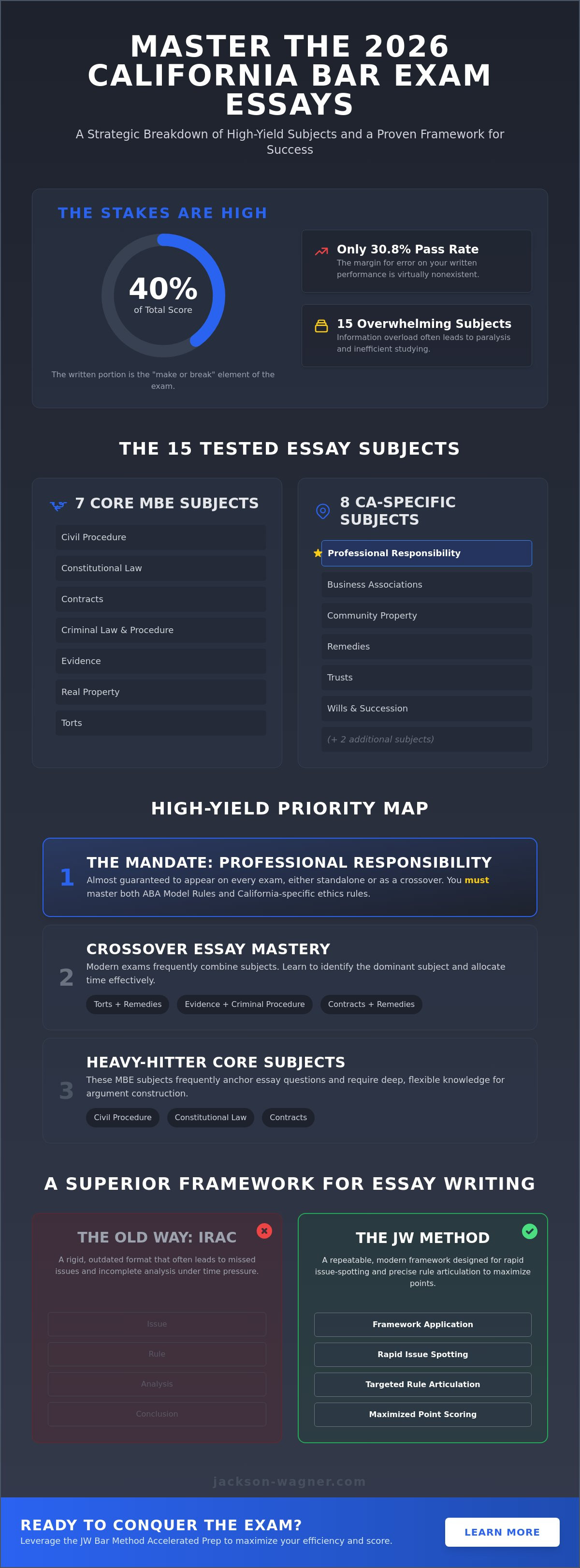
With a February 2026 General Bar Examination pass rate of just 30.8%, the margin for error on your written performance is virtually nonexistent. You're likely feeling the crushing weight of the 15 potential california bar exam essay topics, struggling to distinguish between California-specific rules and general law while the written portion stands as a massive 40% of your total score. It's a high-stakes environment where information overload often leads to paralysis and unnecessary fear.
We believe that the stress of high-pressure certification should be replaced by a structured, modern, and reliable path to success that ignores legacy industry standards. This guide will provide you with a clear hierarchy of high-yield subjects and a repeatable writing framework designed to conquer the 2026 exam with absolute confidence. We'll break down the strategic mastery required to handle complex crossover questions and focus your energy on the specific subjects that actually move the needle on your final results.
Key Takeaways
- Identify the 15 tested subjects and distinguish between Multistate Bar Examination (MBE) core topics and California-specific additions.
- Prioritize your study time by mastering high-yield california bar exam essay topics and the recurring Professional Responsibility mandate.
- Learn exactly when to apply California-specific standards versus general law to avoid common traps in Evidence and Civil Procedure.
- Replace the outdated IRAC format with a superior, repeatable framework for rapid issue spotting and rule articulation.
- Leverage the JW Bar Method Accelerated Prep to maximize efficiency whether you are sitting for the Full Bar or the Attorney's Exam.
The 15 Subjects of the 2026 California Bar Exam Essay Portion
The written section of the 2026 California Bar Exam demands a comprehensive mastery of 15 distinct subjects across five one-hour essays and a 90-minute Performance Test, representing 40% of the total scaled score. This portion is widely considered the "make or break" element for candidates. While the Multistate Bar Examination (MBE) allows for some level of recognition, the essays require you to articulate rules from memory and apply them to complex fact patterns with surgical precision. The State Bar of California does not provide a prioritized list, which often leads to information overload. You can't afford to treat every subject with equal weight when your license is on the line.
Success requires a clear understanding of the california bar exam essay topics and how they are categorized. You are essentially preparing for two different types of law: the 7 subjects tested on the MBE and the 8 subjects that are specific to the California essay portion. Mastering the interplay between these two groups is what separates passing scores from repeat attempts.
Core MBE Subjects Tested in Essays
The seven subjects you study for the multiple-choice portion will also appear in the essay section. Civil Procedure, Constitutional Law, and Contracts are the heavy hitters that frequently anchor the morning and afternoon sessions. Criminal Law and Procedure, Evidence, Real Property, and Torts round out this group. For students aspiring to practice in high-stakes fields like personal injury with the Law Offices of Michael D. Payne, mastering the nuances of Torts is essential for both the exam and their future careers. The challenge here isn't just knowing the law; it's the shift in format. In an essay, you aren't just picking the "best" answer. You're building a logical argument. For subjects like Evidence and Civil Procedure, you must also be prepared to pivot between Federal rules and California-specific standards if the prompt demands it. This requires a level of mental agility that traditional study methods often ignore.
California-Specific Essay Subjects
The remaining california bar exam essay topics focus on law unique to the jurisdiction or subjects not covered by the MBE. Professional Responsibility is the most critical subject here, as it's almost guaranteed to appear every single year, often as a standalone essay or a major crossover component. Business Associations covers Agency, Partnership, and Corporations, while Community Property addresses the unique marital asset laws of the state. You must also master Remedies, Trusts, Wills, and Succession. These subjects are often where candidates lose the most points because they treat them as "minor" topics. In reality, these are the subjects that allow you to demonstrate the localized expertise the examiners are looking for. To see how these principles are applied in professional practice in other states, check out Massingill Attorneys & Counselors at Law.
Subject Frequency and High-Yield Priority Mapping
Mapping out the california bar exam essay topics requires more than a glance at historical charts. It demands a strategic understanding of how the examiners cycle through subjects to test your mental stamina and legal breadth. While every subject in the 15-subject pool is fair game, some are mathematically more likely to appear than others. For 2026, candidates must move beyond passive review and adopt a prioritization model that focuses on high-yield mastery. You can find official California Bar Examination information regarding the full scope of the test, but the true strategy lies in knowing where to point your heaviest artillery.
The Professional Responsibility Lock
Professional Responsibility isn't just a subject; it's a mandate. You'll almost certainly encounter a PR question on every exam. Sometimes it stands alone. More often, it appears as a "stealth" issue tucked into a Business Associations or Evidence prompt. Mastery here requires a binary approach. You must know the ABA Model Rules and the California-specific ethics rules with equal clarity. If you fail to distinguish between the two, you're leaving easy points on the table. For those seeking a streamlined way to memorize these distinctions, the JW Bar Method Prep - Full Exam California Bar offers a focused framework for ethics mastery.
Crossover Essay Preparation
Modern exams have seen a sharp rise in crossover essays. These questions force you to juggle multiple subjects, such as Torts and Remedies or Evidence and Criminal Procedure, within a single 60-minute window. Identifying the dominant subject is your first priority. If the prompt asks for "what damages are available," you're in a Remedies crossover. If it asks "what crimes were committed," it's a Criminal Law anchor. You must allocate your time based on the complexity of the issues, not just a 50/50 split. Precision in issue spotting during these crossovers is what separates a mediocre answer from a passing one.
Candidates in 2026 should place a high priority on Constitutional Law and Business Associations. The examiners frequently cycle "minor" subjects like Wills and Trusts, but the core subjects remain the bedrock of the written score. When Wills or Trusts do appear, they often follow a predictable pattern of testing basic formation or fiduciary duties. Don't let the fear of a minor subject distract you from the high-yield topics that determine your final scaled score. Focus your energy on the subjects with the highest probability of appearance to maximize your study ROI.
Applying California Law vs. General Law Standards
Mastering the california bar exam essay topics requires a surgical understanding of when to apply general common law and when to pivot to California-specific statutes. Many candidates fail because they over-apply local law or ignore it in subjects where it is mandatory. This is a trap. Unless the prompt explicitly directs you to apply California law or the subject is inherently local, the default standard is general law. This jurisdictional boundary is the primary filter examiners use to determine if a candidate is truly prepared for the rigors of California practice. You must treat this distinction as a non-negotiable rule of engagement.
The Big Three: Evidence, Civ Pro, and Ethics
In Evidence, Civil Procedure, and Professional Responsibility, the distinction is critical. For Evidence, you must navigate the nuances between the California Evidence Code (CEC) and the Federal Rules of Evidence (FRE). This includes understanding how Proposition 8 impacts hearsay and character evidence in criminal cases. CEC distinctions often involve the "Truth in Evidence" amendment, which requires a deeper analysis of whether certain evidence is admissible despite traditional hearsay barriers. Civil Procedure presents similar hurdles. You must distinguish between the Federal Rules and California's unique approaches to service of process and discovery. Professional Responsibility is perhaps the most dangerous area. Applying an ABA Model Rule where the California Rules of Professional Conduct differ is a guaranteed way to secure a below-pass score. You aren't just being tested on rules. You're being tested on your ability to recognize jurisdictional boundaries under pressure.
Community Property and Wills/Trusts
Community Property stands as a purely California-centric pillar. You cannot rely on general law here. The entire subject is built on the state's specific marital asset regime. Success depends on your ability to handle characterization, valuation, and distribution with absolute precision. You must also master the "tracing" and "commingling" rules that frequently appear in high-scoring model answers. Similarly, Wills and Trusts require a firm grasp of California-specific formalities. This includes the specific requirements for holographic wills or the creation of valid trusts under the Probate Code. To understand how these requirements fit into the broader licensing process, you can learn how to navigate the State Bar of California: a 2026 guide to licensure success.
Unless the call of the question specifies otherwise, you should apply general law to all california bar exam essay topics except for those subjects that are inherently local or have mandated state-specific distinctions.
The JW Method: A How-To Guide for Essay Mastery
The traditional IRAC method is a legacy standard that often fails candidates under the intense 60-minute time constraint of the California Bar. While IRAC provides a basic structure, it lacks the tactical speed required to address complex, multi-layered california bar exam essay topics effectively. High-stakes candidates need a methodology that prioritizes rapid issue spotting and rule articulation without the fluff of academic writing. Our approach replaces passive review with precision drilling, ensuring you spend your energy on the analysis that actually generates points. It's about working smarter, not just harder.
The 60-Minute Essay Execution Plan
Success on the written portion is a matter of strict time management. You must spend the first 15 minutes of every essay reading the prompt and outlining a "skeleton" that captures every call of the question. This phase is about mapping your path before you start the heavy lifting. The next 40 minutes are dedicated to the draft. You'll focus on high-impact rule statements and deep, fact-heavy analysis that connects the law to the specific details of the prompt. Finally, leave exactly 5 minutes for a cold review. This ensures you haven't missed a sub-issue or a "stealth" PR requirement that could cost you a passing grade. If you need a more detailed roadmap, explore our guide on passing the California Bar Exam in 2026: the definitive strategic guide.
Resilience and Mental Health in Bar Prep
Preparing for the 15 california bar exam essay topics is a mental marathon. You must recognize the early signs of burnout, such as chronic fatigue or a sharp drop in issue-spotting accuracy, before they sabotage your performance. We encourage a "disruptive mentor" approach to stress. Don't view the exam as a burden; see it as a tactical hunt where you are the predator and the points are the prey. This shift in perspective builds the psychological resilience needed for a two-day examination. To gain the competitive edge required for this high-stakes environment, consider enrolling in the JW Bar Method Prep - Full Exam California Bar to streamline your study process and secure your professional future.
Accelerated Preparation for Full and Attorney’s Exams
While the General Bar Examination requires a split focus between multiple-choice and written performance, the Attorney’s Examination is a pure test of your ability to master california bar exam essay topics and the Performance Test. The February 2026 Attorneys' Examination pass rate of 57.0% shows a significantly higher success rate than the general exam, yet many seasoned practitioners still fail by falling into "practice traps." They often write like lawyers instead of bar examinees, relying on nuance and professional experience rather than the rigid rule articulation the examiners demand. To succeed, you must strip away the habits of your daily practice and adopt a tactical, exam-centric mindset.
Strategic Focus for the Attorney’s Examination
If you're an out-of-state lawyer taking the Attorney's Exam, you can ignore the MBE entirely. This allows you to dedicate 100% of your energy to the written portion, but it also means there's no safety net if your essay scores falter. You must be able to pivot between the 15 tested subjects with absolute precision. Professional experience is often a double-edged sword; it helps with issue spotting but can lead to "over-lawyering" where you argue the facts without clearly stating the underlying rules. For a complete breakdown of what's required, see our California Attorney’s Exam requirements: the 2026 guide to licensure for out-of-state lawyers.
Choosing Your Track: Standard vs. Accelerated
The path you choose depends on your current professional bandwidth and your familiarity with the california bar exam essay topics. We offer two primary tracks to ensure your success in 2026:
- JW Bar Method Prep - Attorney’s Exam California Bar: A comprehensive deep dive for those who want a steady, methodical progression through every potential subject.
- JW Bar Method Accelerated Prep - Attorney’s Exam California Bar: A high-intensity, efficiency-first program designed for working professionals who need to maximize their limited study hours.
In the final 30 days of your preparation, the focus shifts from learning rules to rapid-fire execution. Whether you choose the full prep or the accelerated track, our methodology is built on a binary performance guarantee. We're so confident in our results-oriented approach that we assume the financial risk of your outcome. This isn't just another legacy prep course; it's a modern, disruptive partnership designed to get you licensed in California with the least amount of wasted effort. Take the next step toward licensure with a methodology that respects your time and demands your success.
Secure Your Professional Future in 2026
Mastering the california bar exam essay topics requires more than just hours of passive reading; it demands a strategic prioritization of high-yield subjects and a surgical approach to California-specific law. You've learned that moving beyond the traditional IRAC method is essential for managing the intense 60-minute time constraint. By focusing on the Professional Responsibility mandate and distinguishing between federal and local standards in Evidence and Civil Procedure, you position yourself far ahead of the average candidate. Precision in your study process is the only way to ensure your performance meets the State Bar's rigorous standards.
The path to licensure shouldn't be defined by anxiety or legacy study habits that don't produce results. Our proprietary JW Bar Method pedagogy provides a structured, modern learning environment designed to replace stress with absolute certainty. We offer accelerated tracks for working attorneys and stand behind our curriculum with a bold binary performance guarantee. You don't have to navigate this high-stakes hurdle alone; we're here to act as your disruptive and highly competent mentor. Secure your 2026 success with the JW Bar Method Prep Program and transform your bar prep experience into a tactical victory. We look forward to seeing you on the pass list.
Frequently Asked Questions
How many subjects are tested on the California Bar Exam essays?
There are 15 potential subjects that can appear on the written portion of the exam. These include the seven core Multistate Bar Examination (MBE) topics and eight subjects specific to California. While the examiners have a broad pool to choose from, they typically focus on a mix that tests both general legal principles and localized statutes. Understanding the full scope of these 15 subjects is the first step toward strategic mastery.
What are the most commonly tested essay topics on the CA Bar?
Professional Responsibility is the most frequent of all california bar exam essay topics, appearing on nearly every administration. Other high-yield subjects include Contracts, Torts, and Civil Procedure. While the State Bar cycles through "minor" topics like Wills and Trusts, you should prioritize the core subjects that appear with the highest mathematical frequency. Mastery of these anchors ensures you aren't caught off guard by the examiners' selection.
Does the California Bar Exam test California-specific law on all essay subjects?
No, California-specific law is only required for certain subjects. You must apply local standards for Evidence, Civil Procedure, and Professional Responsibility. Additionally, Community Property is entirely California-centric. For other subjects, the default is general common law unless the prompt explicitly directs you otherwise. Misapplying these standards is a common error that can significantly lower your score and impact your overall performance.
How long do I have to answer each essay question on the California Bar?
You are allotted exactly 60 minutes to complete each of the five essay questions. This time must be managed with surgical precision to ensure you address every issue raised in the fact pattern. We recommend spending the first 15 minutes outlining your answer and the remaining 45 minutes on rule articulation and analysis. Effective time management is often the difference between a passing grade and a repeat attempt.
What is a "crossover" essay on the California Bar Exam?
A crossover essay is a single question that incorporates two or more distinct california bar exam essay topics. Common examples include pairings like Contracts and Remedies or Evidence and Criminal Procedure. These questions test your ability to synthesize different areas of law under a single fact pattern. Success requires identifying the dominant subject while ensuring you don't ignore the secondary issues that carry significant point value.
Can I pass the California Bar Exam if I fail one essay?
Yes, it's entirely possible to pass the exam even if you perform poorly on a single essay. The California Bar Exam uses a scaled scoring system where your total performance across all five essays, the Performance Test, and the MBE determines your result. While a low score on one essay requires a stronger performance elsewhere, it's not an automatic failure. Consistency across all sections is the most reliable path to success.
Is Professional Responsibility tested on every California Bar Exam?
Professional Responsibility is effectively a mandatory subject and is tested on virtually every exam. It often appears as a standalone 60-minute essay, but it can also be tucked into other subjects as a crossover issue. Because of its near 100% frequency rate, you must master both the ABA Model Rules and the California Rules of Professional Conduct. Treating this subject as an afterthought is a high-risk strategy that rarely pays off.
How is the written portion of the California Bar Exam scored?
The written portion accounts for 40% of your total scaled score. This includes five essay questions and one 90-minute Performance Test. Each essay is typically graded on a raw scale, which is then converted into a scaled score to ensure fairness across different exam administrations. Because the written section carries such significant weight, your ability to articulate rules and apply facts is just as important as your multiple-choice performance.


