

What if your years of successful legal practice are actually the biggest hurdle to passing the California Bar? It's a frustrating reality for many out-of-state practitioners who find that the "one-day" format is less of a shortcut and more of a high-pressure gauntlet. You're likely juggling a full caseload while staring down a massive syllabus of 13 core california attorney's exam subjects, fearing that a single day of testing could derail your expansion into the Golden State. We agree that the traditional study method is broken for working professionals who don't have the luxury of returning to a law school library for months on end.
At Jackson-Wagner LLC, we replace that high-stakes anxiety with professional empowerment through a structured, modern path to success. This guide promises to master the complexities of the syllabus with an expert breakdown of high-yield topics and strategic study priorities. We'll preview the specific "California" distinctions you need to know, show you how to navigate the 5-essay gauntlet, and provide a study method that respects your professional schedule. You don't have to choose between your practice and your licensure.
Key Takeaways
- Understand the unique structure of the one-day exam, which eliminates the 200-question MBE to focus entirely on written proficiency.
- Identify the specific california attorney's exam subjects divided between the "Big Seven" multistate topics and the "California Six" state-specific requirements.
- Learn how to navigate the five-essay gauntlet and the 90-minute Performance Test by prioritizing analytical skills over raw memorization.
- Discover which high-yield subjects appear on 80% of exams, allowing you to focus your limited study time on the topics that offer the highest return.
- Explore an accelerated study methodology designed to master the full syllabus in half the time required by traditional bar prep programs.
The Scope of the California Attorney’s Exam: 13 Subjects, Zero MBE
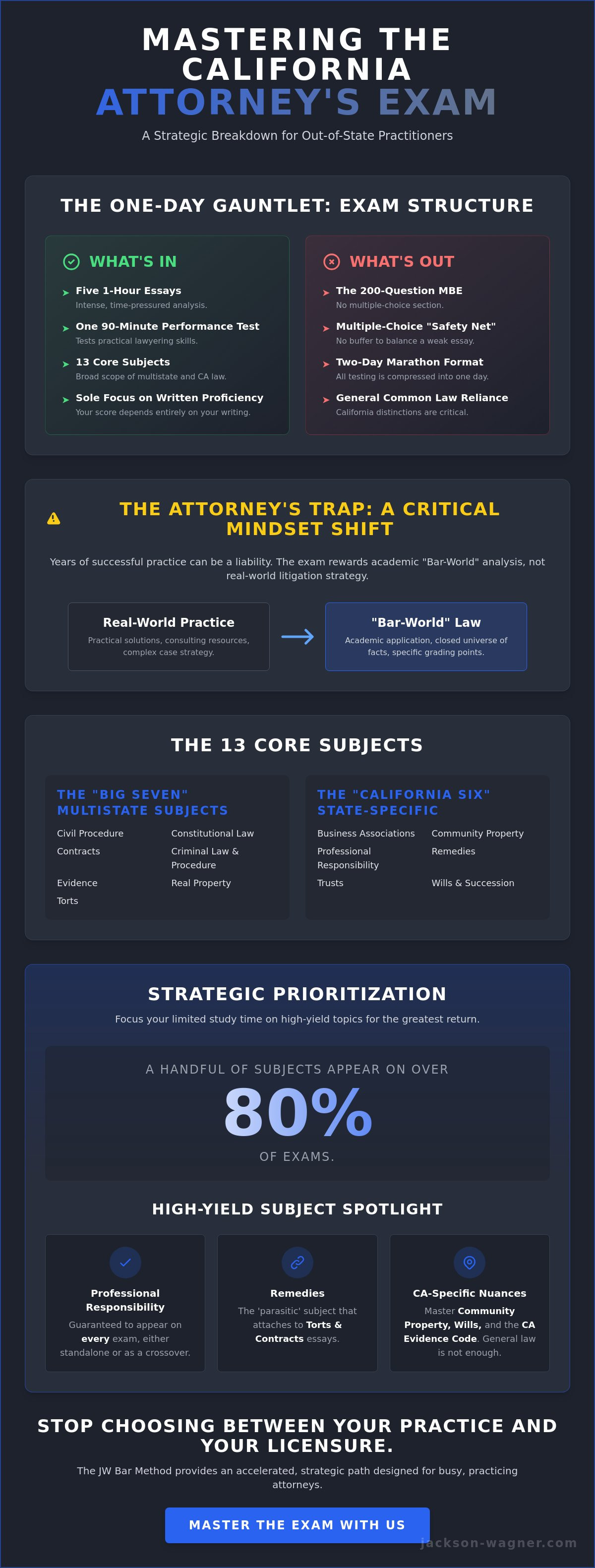
The California Attorney’s Exam is a specialized one-day written assessment administered by the State Bar of California. While general applicants face a two-day ordeal, you navigate a concentrated gauntlet that excludes the 200-question Multistate Bar Examination (MBE). This exclusion isn't just a reduction in time; it's a fundamental shift in how the california attorney's exam subjects are weighted. Without the multiple-choice safety net to bolster your scaled score, your written proficiency becomes the sole determinant of your success. In 2026, the State Bar continues to demand high-level analysis that fits within strict one-hour windows, requiring you to be faster and more precise than a standard examinee.
Eligibility and the One-Day Advantage
To qualify for this shortened format, you must have been in active good standing in another U.S. jurisdiction for at least four years. At Jackson-Wagner LLC, we've observed that many seasoned lawyers underestimate the intensity of this "one-day advantage." Moving from a two-day marathon to a one-day sprint requires a psychological shift in how you allocate your mental energy. You're covering the same breadth of material as the general bar, but you have half the opportunities to gain points. This means every paragraph you write in your five essays and your Performance Test carries double the weight toward your final scaled score.
The Attorney's Trap: Practice vs. Academic Law
Years of successful practice often create a practitioner's bias that can be fatal on exam day. In your daily work, you look for practical solutions and consult resources; on the exam, you're trapped in a vacuum where the examiners want to see a very specific, academic application of the law. Over-thinking a simple essay prompt by applying complex real-world litigation strategies is the fastest way to run out of time. You must train yourself to operate within "Bar-world" law to succeed. The exam tests your ability to apply specific California law distinctions rather than general legal principles or common sense. If you try to lawyer the facts like you do in court, you'll likely miss the specific grading points the examiners are looking for.
The 13 Core Subjects Tested on the California Attorney’s Exam
Success requires a surgical understanding of the 13 california attorney's exam subjects. These are not 13 separate silos; they are an interconnected web of legal principles that you must navigate with precision. The examiners divide these into the 'Big Seven' Multistate subjects and the 'California Six' state-specific subjects. The Big Seven include Civil Procedure, Constitutional Law, Contracts, Criminal Law and Procedure, Evidence, Real Property, and Torts. These form the foundation of the exam. The 'California Six' add layers of complexity through Business Associations, Community Property, Professional Responsibility, Remedies, Trusts, and Wills and Succession. This comprehensive list reflects the standards set for all California Bar Examinations, but for the Attorney's Exam, the written application is your only path to victory.
Professional Responsibility stands alone as the only subject guaranteed to appear on every single exam. You must be prepared to address it either as a standalone essay or as a crossover topic. Similarly, you must understand the "parasitic" nature of Remedies. This subject rarely appears in a vacuum. Instead, it attaches itself to Contracts or Torts, requiring you to analyze not just the breach or the harm, but the specific legal and equitable relief available under California law. If you miss the Remedies component of a Torts essay, you've already lost a significant portion of the available points.
The 'California-Specific' Distinction
You cannot rely on general common law for the state-specific portion of the syllabus. Community Property is a prime example; you must master the unique California system for marital assets, including the nuances of quasi-community property and the various presumptions that apply at death or divorce. Wills and Succession also requires deep knowledge of California’s specific probate code nuances rather than general testamentary principles. Perhaps most critically, you must distinguish between the California Evidence Code and the Federal Rules of Evidence. Small differences in hearsay exceptions or character evidence rules can be the difference between a passing and failing score.
Business Associations and Professional Responsibility
Business Associations covers Agency, Partnerships, and Corporations. You'll need to demonstrate how these entities operate and dissolve under California law. Professional Responsibility is even more demanding, as it requires you to navigate the intersection of the ABA Model Rules and the California Rules of Professional Conduct. Because ethics is a non-negotiable priority for the State Bar, this is the most critical subject for any out-of-state lawyer to master. If you are struggling to balance these 13 areas with your current practice, consider the JW Bar Method Prep - Attorney’s Exam California Bar for a streamlined, expert-led approach that focuses on what truly matters.
Essays vs. Performance Tests: How Subjects Manifest in 2026
Knowing the rules is only half the battle. To pass the one-day gauntlet, you must understand how the State Bar presents the california attorney's exam subjects in a high-pressure environment. You face five one-hour essay windows and a single 90-minute Performance Test (PT). This structure demands a level of mental agility that traditional bar prep often fails to address. You don't just need to know the law; you need to know how to deploy it within sixty minutes while maintaining the analytical depth of a seasoned practitioner. According to The State Bar of California's guide to examinations, these written tasks are designed to measure your ability to analyze legal issues and communicate your conclusions effectively.
The most dangerous element of the essay portion is the "Crossover Essay." The State Bar frequently blends two or three subjects into a single one-hour prompt. If you've only studied subjects in isolation, these crossovers will blindside you. You might start a Torts essay only to find that the second half of the prompt requires a sophisticated Remedies analysis. These combinations are intentional. They test whether you can spot the intersection of different legal doctrines under the same set of facts, a skill that is vital for any attorney licensed in California.
Common Subject Crossovers to Watch For
Preparation for the california attorney's exam subjects must include practicing these high-frequency pairings. Torts and Remedies are the most common duo, usually requiring you to analyze liability before pivoting to specific damages or injunctive relief. Professional Responsibility and Business Associations often appear together to test the ethical obligations of corporate counsel or the conflicts inherent in partnership disputes. Another classic is the "Death and Divorce" crossover, where Wills and Community Property collide. You'll need to determine what property is separate or community before you can even begin to distribute it under a contested will.
The Performance Test: Subject-Agnostic Success
The 90-minute Performance Test is the only part of the exam where your memorization of the 13 subjects takes a backseat. This is a "closed-universe" task. The examiners provide you with a "File" containing the facts and a "Library" containing the law. Your job isn't to bring in outside knowledge. Instead, you're testing your "Attorney Skills" by drafting memos, briefs, or client letters based strictly on the provided materials. Success here depends on task management and precision. You earn maximum points by following the instructions in the partner's memo to the letter, ensuring you don't waste time on legal theories that aren't in your provided Library. It's a test of professional competence, not rote memory.
Strategic Prioritization: High-Yield vs. Low-Yield Exam Subjects
Strategic triage is the difference between passing and a generic "fail" notice. You don't have the luxury of time to treat all 13 california attorney's exam subjects as equals. Data from the last decade reveals a clear hierarchy of frequency that you must exploit to maximize your score. Professional Responsibility is the only subject with a 100% appearance rate; it's a non-negotiable priority. Following closely in the "Must-Know" tier are Constitutional Law and Civil Procedure, which have appeared on roughly 80% of exams over the last ten years. If you master these three, you've secured a massive portion of the available points before even looking at the more obscure topics.
The "Wildcard" tier includes subjects like Remedies and Business Associations. These often serve as the secondary component in crossover essays, as we discussed in the previous section. Then there are "Niche" subjects like Wills and Trusts. These are dangerous because they are detail-heavy but appear less frequently. Don't get bogged down in the minutiae of spendthrift clauses or holographic codicils at the expense of your core subjects. Learn the high-level rules, practice the most common fact patterns, and move on. Your goal is a scaled score of 1390, not a perfect academic transcript.
The Professional Responsibility Factor
Professional Responsibility is so vital that you should dedicate at least 25% of your total study time to it. This isn't the MPRE; the California Bar's standards are significantly more rigorous and require you to cite specific state distinctions. California PR is a hybrid of the Model Rules and state-specific ethical codes. You must be able to toggle between these two frameworks instantly. If you can't articulate the difference between California's duty of confidentiality and the ABA's version, you're leaving points on the table. This subject is the bedrock of your professional identity in the eyes of the State Bar.
Efficiency for Working Lawyers
We recommend the "Rule of Three" for managing your workload. For every subject, master the three most common sub-topics first. In Torts, that's Negligence, Strict Liability, and Defamation. In Contracts, focus on Formation, Breach, and Remedies. Remember that the examiners value the IRAC (Issue, Rule, Analysis, Conclusion) structure over perfect rule memorization. A clear, logical application of a slightly imperfect rule will always outscore a perfect rule followed by a messy analysis. You can use the JW Bar Method to filter out low-yield academic fluff and focus on the california attorney's exam subjects that actually appear on the exam. Our approach is built for the modern learner who requires flexibility without sacrificing results.
Ready to stop wasting time on low-yield topics? Upgrade your study plan with the JW Bar Method Prep - Attorney’s Exam California Bar and focus on the subjects that guarantee results.
Mastering the Subjects with the JW Bar Method for Attorneys
The JW Bar Method at Jackson-Wagner LLC is the only study system engineered specifically for the unique demands of the one-day Attorney's Exam. We recognize that you aren't a law student with unlimited time; you're a professional with a practice to run. Traditional programs force you into a rigid, months-long schedule designed for the general bar, but our approach is different. We focus exclusively on the california attorney's exam subjects through a lens of high-yield efficiency. By stripping away the multiple-choice-centric fluff that dominates other courses, we allow you to master the required syllabus in a fraction of the time. Our methodology is so effective that we offer a bold ultimatum: PASS OR YOUR MONEY BACK. Jackson-Wagner LLC puts our financial interests on the line because we believe in our results-driven framework.
Transitioning from a seasoned lawyer back into a high-stakes examinee requires a specific psychological shift. In court, you have the luxury of time and research; on the exam, you have sixty minutes to prove your competence. Our expert-led pedagogical coaching helps you shed the "practitioner's bias" and adopt the "examinee's precision." We teach you to stop lawyering the facts and start hitting the specific grading points that the State Bar demands. This isn't just about learning the law; it's about mastering the art of the California essay under the pressure of a one-day sprint.
Beyond Traditional Bar Prep
Legacy bar prep providers often fail the modern practicing attorney because they are built on an outdated "one size fits all" model. They overwhelm you with thousands of pages of outlines that aren't tailored to the written-only format of the Attorney's Exam. Jackson-Wagner LLC provides a precision-focused curriculum that teaches only what the State Bar of California actually tests. You won't waste hours on obscure theories that haven't appeared on an exam in decades. Instead, you'll receive personalized, automated feedback and expert critiques that refine your writing style, ensuring your analysis of the california attorney's exam subjects is as sharp as it is accurate.
Next Steps: Your 2026 Success Plan
Success on the July 2026 exam requires a schedule that respects your billable hours. You don't need to quit your job to pass; you just need a better plan. Start by Mastering the California Bar Examination through our strategic planning guide, which outlines the exact timeline you need for a 1390 scaled score. Once you have your roadmap, it's time to commit to a method that guarantees your admission to the California Bar. Don't leave your career to chance with an outdated course that doesn't understand your needs as a professional. Secure your spot in the next JW Bar Method Attorney’s Exam Prep Course today and take the first step toward professional empowerment in the Golden State.
Secure Your California Licensure with Precision
You've worked too hard for your career to let a one-day exam stand in your way. Success in 2026 demands more than just general legal knowledge; it requires a surgical focus on the high-yield topics that actually appear on the page. By prioritizing Professional Responsibility and mastering the specific nuances of the 13 california attorney's exam subjects, you replace anxiety with a structured path to victory. You don't need to waste months in a generic classroom. Instead, you can leverage a system built specifically for the practicing professional who needs results without the traditional bar prep burnout.
Jackson-Wagner LLC provides the only curriculum exclusively focused on California licensure. With our accelerated 30-day and 60-day tracks, you can fit your study schedule around your billable hours while receiving the expert-led feedback you need to refine your analysis. We're so confident in our methodology that we offer a Pass or Your Money Back guarantee. It's time to stop studying like a law student and start preparing like the professional you already are.
Pass the California Attorney's Exam with the JW Bar Method: Guaranteed
Your future in the California Bar is within reach. We're ready to help you claim it.
Frequently Asked Questions
What subjects are on the California Attorney's Exam?
There are 13 core california attorney's exam subjects that you must master for the written portion. These include Business Associations, Civil Procedure, Community Property, Constitutional Law, Contracts, Criminal Law and Procedure, Evidence, Professional Responsibility, Real Property, Remedies, Torts, Trusts, and Wills and Succession. Each subject requires a deep understanding of California-specific distinctions and general legal principles.
Is the California Attorney's Exam easier than the full Bar Exam?
The Attorney's Exam is shorter but not necessarily easier. You lose the objective Multistate Bar Examination (MBE) portion, which means your entire score depends on five essays and one Performance Test. This format requires extreme precision and a high-level analytical style that many practicing lawyers find challenging without specialized, expert-led preparation.
Do I have to take the MBE for the California Attorney's Exam?
No, you don't take the MBE. The Attorney's Exam is specifically designed to bypass the 200-question multiple-choice section. This allows you to spend your entire study period focusing on the written application of the california attorney's exam subjects rather than rote memorization of MBE distractors and academic fluff.
How many days is the California Attorney's Exam in 2026?
The Attorney's Exam is a one-day event. For the July 2026 cycle, this occurs on Tuesday, July 28. You'll complete five one-hour essays during the morning and afternoon sessions, followed by a final 90-minute Performance Test to conclude your testing day.
Which subject is most frequently tested on the California Bar?
Professional Responsibility is the only subject that is guaranteed to appear on every single California Bar Examination. It often appears as a standalone essay or is integrated into other subjects as a crossover. Constitutional Law and Civil Procedure also maintain exceptionally high appearance rates in the essay rotation.
Can I take the Attorney's Exam if I've been practicing for 3 years?
You cannot take the Attorney's Exam with only three years of practice. The State Bar requires at least four years of active good standing in another U.S. jurisdiction to qualify for this specific format. If you don't meet this four-year threshold, you must sit for the full two-day General Bar Exam.
What is a passing score for the California Attorney's Exam?
The passing score is a total scaled score of 1390 out of 2000. This is a rigorous standard that requires consistent performance across all written tasks. Because you don't have the MBE to balance a weak essay, your writing must be sharp and technically accurate from the very first prompt.
How do I study for the California Performance Test (PT)?
Success on the PT depends on your ability to process the provided "File" and "Library" quickly. Don't bring in outside law; everything you need is in the packet. Focus your practice on organization and following the partner's instructions to ensure you draft a cohesive, professional work product within the 90-minute limit.


