

What if the secret to passing the nation's most grueling legal exam isn't found in the sheer volume of your library hours, but in the surgical precision of your schedule? Most candidates obsess over how many hours to study for california bar success, yet the consistently low 30 to 40 percent pass rate suggests that legacy industry standards are failing the modern applicant. You're likely feeling the pressure of balancing an overwhelming mountain of material with your existing professional or family obligations. It's exhausting to wonder if the time you're investing will actually translate into a passing score on game day.
This 2026 efficiency guide cuts through the noise to provide a structured, results-oriented roadmap built on modern pedagogical standards. We'll replace the anxiety of the unknown with a clear path to professional empowerment. You'll discover the definitive hourly benchmarks required for your specific background, a strategic framework that prioritizes high-yield topics, and the absolute confidence you need to conquer the nation's most rigorous bar exam without burning out.
Key Takeaways
- Learn why the 400 to 500 hour range is the essential benchmark for the nation's most difficult exam and how to exceed baseline expectations.
- Identify the three critical variables, including your work status and past academic performance, that dictate your personal study clock.
- Discover the 50/50 Rule and why understanding how many hours to study for california bar success requires a shift from passive reading to active production.
- Master the 2026 study calendar. Focus on high-yield topics and the critical final two-week push to maximize your performance.
- Optimize your schedule with the JW Bar Method Accelerated Prep. We eliminate educational fluff to focus on surgical precision and reliable results.
The 400-Hour Benchmark: Why the California Bar Requires a Strategic Timeline
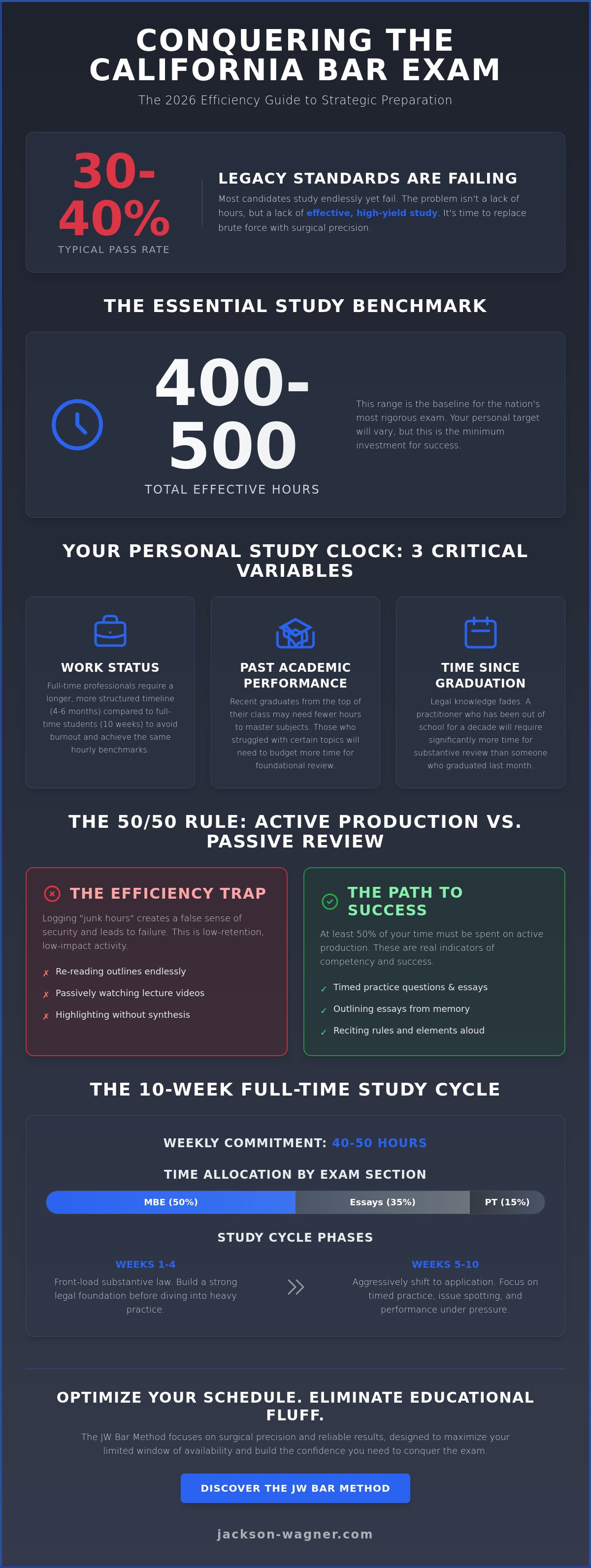
Standard bar preparation advice often centers on a single number: 400. While most national prep courses suggest this as a safe baseline, determining exactly how many hours to study for california bar success requires a more nuanced calculation. The California exam is notoriously rigorous, maintaining some of the lowest pass rates in the country. This isn't just about the volume of law; it's about the depth of analysis required. A quick California Bar Examination overview reveals a structure that demands mastery over complex state-specific subjects alongside the Multistate Bar Examination (MBE).
The 2026 exam climate demands a shift in how we view preparation. High-stakes testing has evolved, and the California examiners are increasingly focused on testing your ability to perform under pressure with realistic legal tasks. You must distinguish between total hours and effective study hours. Sitting in a library for twelve hours means nothing if eight of those were spent in a state of passive exhaustion. We prioritize surgical precision over brute force. Your timeline must account for the mental fatigue that sets in during the final weeks, ensuring you're peaking at the exact moment you walk into the exam room.
Breaking Down the Traditional 10-Week Study Cycle
Most full-time studiers commit to a 10-week cycle, treating bar prep like a 40 to 50 hour work week. This isn't just a suggestion; it's a professional necessity. You should allocate approximately 50% of your time to the MBE, 35% to Essays, and 15% to the Performance Test (PT). The first four weeks are critical for front-loading substantive law. If you don't secure your foundation early, you'll find yourself drowning in practice questions without the legal framework to answer them correctly. By week five, the focus must shift aggressively toward application and timed practice.
Why 'Logging Hours' is a Dangerous Metric for Success
Logging hours is a dangerous metric because it creates a false sense of security. You might feel productive after reading 100 pages of an outline, but if you can't recite the elements of a hearsay exception, you've logged junk hours. When calculating how many hours to study for california bar requirements, remember that passive reading is the enemy of retention. Instead of counting minutes, set milestone-based goals. Can you outline a Torts essay in 15 minutes? Can you hit 70% on a mixed MBE set? These are the real indicators of success. Success isn't a chronological achievement; it's a competency-based one.
Variables That Dictate Your Personal Study Clock
A static number like 400 hours is a helpful starting point, but it's rarely the final answer for every applicant. Your background determines your efficiency. When calculating how many hours to study for california bar success, three primary factors dictate your timeline: your past law school performance, the amount of time that has passed since your graduation, and your current work status. A student who graduated at the top of their class last month requires a different intensity than a practitioner who hasn't seen a Constitutional Law outline in a decade.
The 2026 testing environment adds another layer of complexity. With the shift toward modern official exam components and the potential for hybrid or remote testing logistics, your study environment matters as much as your clock. For the working professional balancing a 40-hour job, the traditional 10-week sprint is often impossible. This is where accelerated tracks become essential. Instead of dragging out preparation over six months and risking burnout, modern candidates use high-yield, structured programs to condense their learning into manageable, high-impact sessions. If you're managing a full-time career, the JW Bar Method Accelerated Prep - Full California Bar Exam is designed to maximize your limited window of availability.
The Attorney's Exam Exception: Shorter Exam, Higher Density
Out-of-state lawyers often assume the one-day Attorney's Exam is a light version of the bar. This is a dangerous misconception. While you skip the MBE, the density of information required for the five essays and the Performance Test is immense. Seasoned practitioners frequently struggle because they rely on practical experience rather than the specific, rigid writing style the California examiners demand. You can review the specific California Attorney's Exam requirements to understand how your hourly commitment must pivot from broad review to intense writing drills.
Recent Grads vs. Long-Term Repeaters
Recent graduates have a distinct advantage: fresh law school knowledge. They can often reduce their substantive review time compared to those who have been away from the law for five or more years. However, repeaters face a different challenge. Simply repeating the same number of hours using a legacy prep course won't change the outcome. Repeaters need a reset strategy. This involves identifying specific pedagogical gaps rather than just logging more time. If you're returning to the exam after a hiatus, your clock must prioritize rebuilding a foundational knowledge base before diving into timed simulations. Precision matters more than repetition.
The Efficiency Trap: Why 600 Passive Hours Still Lead to Failure
Many applicants believe that sheer volume is the antidote to the California Bar's difficulty. They aim for 600 or even 700 hours, thinking that more time spent with a book open equals a higher probability of success. This is a dangerous fallacy. In reality, logging hundreds of hours of passive review, such as rereading outlines or watching endless lecture videos, often leads to failure. When you calculate how many hours to study for california bar requirements, you must distinguish between being busy and being productive. The California Bar graders don't reward you for what you've read; they reward you for what you can produce under pressure.
We advocate for the 50/50 Rule: at least half of your total study hours must be spent in active testing conditions. This means moving away from the comfort of your notes and into the discomfort of practice. The JW Bar Method focuses on surgical precision, teaching you to identify the specific triggers in a fact pattern that legacy programs often miss. If you spend ten hours reading about Torts but never write a timed essay, those ten hours are largely wasted. High-yield preparation requires you to struggle with the material, forcing your brain to retrieve information rather than just recognizing it on a page.
You must also respect the Law of Diminishing Returns. Pushing into hour 12 of a study day is often counterproductive. Your brain's ability to synthesize complex legal theories drops significantly after eight hours of intense cognitive labor. Success isn't about who can suffer the longest in a library; it's about who can maintain the highest level of focus during their active windows. Quality always beats quantity in professional licensing.
Active Recall and Spaced Repetition in Bar Prep
Active recall is the most effective way to cut your total study time by approximately 20%. Instead of passive review, use high-intensity drills to force information retrieval. This builds the "muscle memory" required to execute complex rule statements automatically. For a deeper look at how to structure these sessions, consult our California Bar Exam practice guide. Practice essays are not just for testing your knowledge; they are your primary learning tool.
Mastering the Performance Test (PT) Efficiency
The Performance Test is the most hour-efficient section of the exam. It doesn't require you to memorize substantive law, yet it accounts for a massive portion of your written score. Many students ignore the PT until the final weeks, which is a strategic error. You can maximize your score impact by dedicating specific hours to simulating the 90-minute pressure. Learn to navigate the file and library with speed, ensuring every minute spent on the PT translates directly into points on the page.
Sample 2026 Study Calendars: Mapping Your Hours
Success on the California Bar isn't an accident; it's a logistical achievement. When mapping out how many hours to study for california bar exams, your calendar must be a rigid but realistic document. We divide the preparation process into two distinct stages. Phase 1 is the Learning Phase, where you build the substantive legal framework and memorize rules. Phase 2 is the Execution Phase, where the focus shifts entirely to performance, timing, and stress management. For 2026 candidates, you must also account for the mental stamina required for modern testing formats by integrating strategic rest days. Without a full day of rest every seven to ten days, your cognitive retention will plummet before you reach the final stretch.
The final 14 days represent the highest-intensity period of your entire journey. This is the "red zone" where you consolidate every high-yield topic and refine your essay templates. During this window, your daily commitment will likely peak as you transition from reviewing material to pure, unadulterated execution. Precision during these final hours is what separates those who pass from those who fall just short of the 1390 cut score.
The 10-Week Standard Track (400-500 Hours)
This is the traditional path for most full-time studiers. It allows for a steady progression of difficulty and prevents early burnout. Your hours should scale as the exam approaches:
- Weeks 1-4: Substantive mastery and rule memorization. Commit to 25 hours per week focusing on the "Big Seven" MBE subjects and California-specific law.
- Weeks 5-8: Heavy practice and feedback loops. Increase to 40 hours per week. Half of this time must be spent writing essays and answering MBE questions under timed conditions.
- Weeks 9-10: Simulated exams and refining weak subjects. This is the 50 plus hour per week push. You'll perform full-length simulations to build the physical and mental endurance required for the actual exam days.
The 6-Week Accelerated Sprint (250-300 Hours)
Not everyone has the luxury of a 10-week window. This track is designed for practicing attorneys from other jurisdictions or top-tier recent graduates who possess strong baseline legal knowledge. This sprint focuses exclusively on high-yield, highly-tested subjects to maximize your return on investment. You'll skip the "fluff" of legacy prep courses and dive immediately into active production. If you're working with a compressed timeline, the JW Bar Method Accelerated Prep - Full California Bar Exam provides the surgical precision needed to pass without the standard 500-hour burden.
Secure your 2026 success by choosing a framework that respects your time and your professional goals. Whether you're on the standard or accelerated path, the goal remains the same: absolute mastery of the California Bar's unique demands.
Strategic Preparation: How the JW Bar Method Optimizes Your Study Hours
The traditional bar prep model is fundamentally outdated. It relies on a brute-force approach that demands hundreds of hours of passive consumption, leaving students exhausted and underprepared for the actual rigors of the exam. We reject this legacy standard. The JW Bar Method is built on the principle of precision over volume. When you are calculating how many hours to study for california bar success, you shouldn't be looking for the highest number possible. You should be looking for the most effective use of every single minute. We act as a disruptive and highly competent mentor, replacing high-stakes anxiety with a structured, modern, and reliable path to licensure.
Our methodology is specifically designed for the professional who requires flexibility and results. We don't just provide materials; we provide a performance-driven environment. This focus on a specific, measurable outcome is why we offer a binary performance guarantee. Jackson-Wagner LLC is so certain of our pedagogical efficacy that we assume the financial risk of your performance. This bold reliability establishes a sense of security and absolute trust, allowing you to focus entirely on mastering the law rather than worrying about the validity of your study plan. Whether you enroll in a full prep course or an accelerated track, you're choosing a partner dedicated to your success.
Eliminating the 'Busywork' of Legacy Bar Prep
Legacy prep courses often overwhelm students with three-hour video lectures and 2,000-page outlines. This is an inefficient use of your study clock. Passive listening does not translate to the active production required on game day. The JW approach utilizes condensed, high-impact rule statements and surgical drills that target the specific patterns examiners use to trick applicants. By using the best bar exam preparation services, you eliminate the fluff and focus exclusively on the concepts that actually appear on the test. This reduction in junk hours allows you to achieve mastery in a fraction of the time required by conventional programs.
Your Path to Licensure: Final Steps for 2026
As you approach the 2026 exam, stop counting the hours on your stopwatch and start measuring your mastery of the material. Deciding how many hours to study for california bar requirements is a personal calculation, but it must always be rooted in active recall and timed execution. Your goal is professional empowerment. Once you can consistently produce passing answers under timed pressure, you've reached the benchmark that matters. For those seeking comprehensive licensure success guidance, the time to transition from passive review to strategic action is now. Secure your future with Jackson-Wagner LLC by choosing a method that respects your time and guarantees your results.
Secure Your California Licensure with Surgical Precision
Passing the nation's most rigorous exam requires more than just endurance. It demands a surgical approach to every hour logged. We've explored why the 400 hour benchmark is a baseline, not a guarantee, and how your personal background dictates your specific timeline. Shifting from passive review to active production is the only way to ensure your efforts translate into a passing score of 1390 or higher. You don't need more hours; you need better ones. It's about the quality of the struggle, not the quantity of the pages turned.
Determining how many hours to study for california bar success depends on your ability to eliminate educational fluff. The proprietary JW Bar Method focuses exclusively on California licensure, providing an accelerated learning framework that respects your professional obligations. We're so confident in our results that we offer a performance based financial guarantee; we assume the risk so you can focus on the reward. Our curriculum is built for the modern learner who values efficiency over legacy busywork.
Master the California Bar with the JW Bar Method; Guaranteed.
You have the ambition to join the California bar. Now, you've got the roadmap to reach that goal with confidence and clarity. Your future as a licensed attorney starts with a smarter schedule.
Frequently Asked Questions
Is 300 hours enough to pass the California Bar Exam?
300 hours is rarely sufficient for a first-time applicant using legacy prep methods. While top-tier graduates or out-of-state attorneys might succeed with this condensed timeline, the average candidate needs the 400 to 500 hour range to master the depth of California law. Success with fewer hours requires a surgical focus on high-yield topics and the total elimination of passive review in favor of active production.
How many hours a day should I study for the California Bar while working full-time?
Working professionals should aim for approximately 20 to 25 hours per week. This usually involves three hours of high-intensity study on weeknights and eight to ten hours on both Saturday and Sunday. Because you have limited daily capacity, you must extend your preparation window to 16 or 20 weeks. This ensures you log the necessary total hours without reaching a state of cognitive exhaustion before the exam date.
Can I pass the California Bar Exam in 6 weeks?
You can pass in six weeks if you commit to a full-time, 50-hour weekly schedule and use a modern, accelerated curriculum. This sprint approach is highly effective for candidates who can leverage recent law school knowledge or significant legal experience. It requires you to bypass the fluff of conventional courses and dive immediately into active production and timed simulations from the very first day of your schedule.
Does the California Attorney's Exam require fewer study hours?
The Attorney's Exam technically requires fewer hours because you aren't preparing for the 200-question MBE portion. However, the intensity of the five essays and the Performance Test remains exceptionally high. You should still plan for at least 200 to 250 hours of dedicated preparation. Many seasoned lawyers fail because they underestimate the specific, rigid writing style required by the California examiners and rely too heavily on practice experience.
What happens if I study too many hours for the bar exam?
Studying too many hours leads to the Law of Diminishing Returns and eventual burnout. When you push past eight or ten hours of intense cognitive labor in a single day, your brain loses the ability to effectively synthesize and retain complex information. This results in junk hours where you are physically present but mentally stagnant. Quality of focus is always superior to the sheer quantity of time spent in a library.
How should I distribute my hours between MBE and Essays?
A balanced distribution for the full exam is 50% for the MBE, 35% for Essays, and 15% for the Performance Test. This allocation ensures you master the foundational law while developing the specific writing skills needed for the written portion. If you are struggling with a specific area, adjust your clock to prioritize those weaknesses. Never neglect the PT, as it offers the highest point-per-hour return on your investment.
Is it better to study in long blocks or short bursts for the bar?
High-intensity blocks of 90 to 120 minutes are the most effective for legal synthesis and deep learning. These sessions should be followed by a short break to allow for cognitive recovery. Short bursts are excellent for rule memorization or flashcards, but the complex analysis required for the California Bar demands sustained focus. Use your peak mental hours for difficult essay drafting and save administrative tasks for when your energy dips.
How many practice essays should I write during my study hours?
You should aim to draft or extensively outline at least 35 to 50 practice essays during your preparation. This builds the muscle memory needed to identify issue triggers and execute rule statements under pressure. When determining how many hours to study for california bar success, ensure a significant portion of that time is dedicated to writing. Reading a model answer is never a substitute for the act of writing one yourself.


