
Your years of successful practice are your greatest liability when facing the California Bar. While you've mastered the art of law, the State Bar of California demands a specific, academic performance that often contradicts professional intuition. We understand the frustration of facing a $1,650 exam fee and a grueling study schedule after you've already proven your worth in other jurisdictions. The california bar exam for out of state attorneys doesn't have to be a career-stalling hurdle. You deserve a path that acknowledges your expertise while providing the precise, modern tools required to succeed.
In this 2026 strategic guide, you'll discover the specific pathways to the one-day Attorney's Exam and the accelerated study strategies designed for busy professionals. We'll examine the latest pass rates, which dipped as low as 43.4% in recent administrations, and provide a clear blueprint to ensure you land on the right side of those statistics. From MPRE requirements to 2026 filing deadlines, we're covering everything you need to pass on your first attempt without sacrificing your professional life.
Key Takeaways
- Understand why California's lack of reciprocity means even veteran lawyers must master the specific 2026 eligibility criteria for the one-day Attorneys' Examination.
- Navigate the california bar exam for out of state attorneys by identifying if you qualify for the modified one-day written format or must sit for the full two-day General Bar Exam.
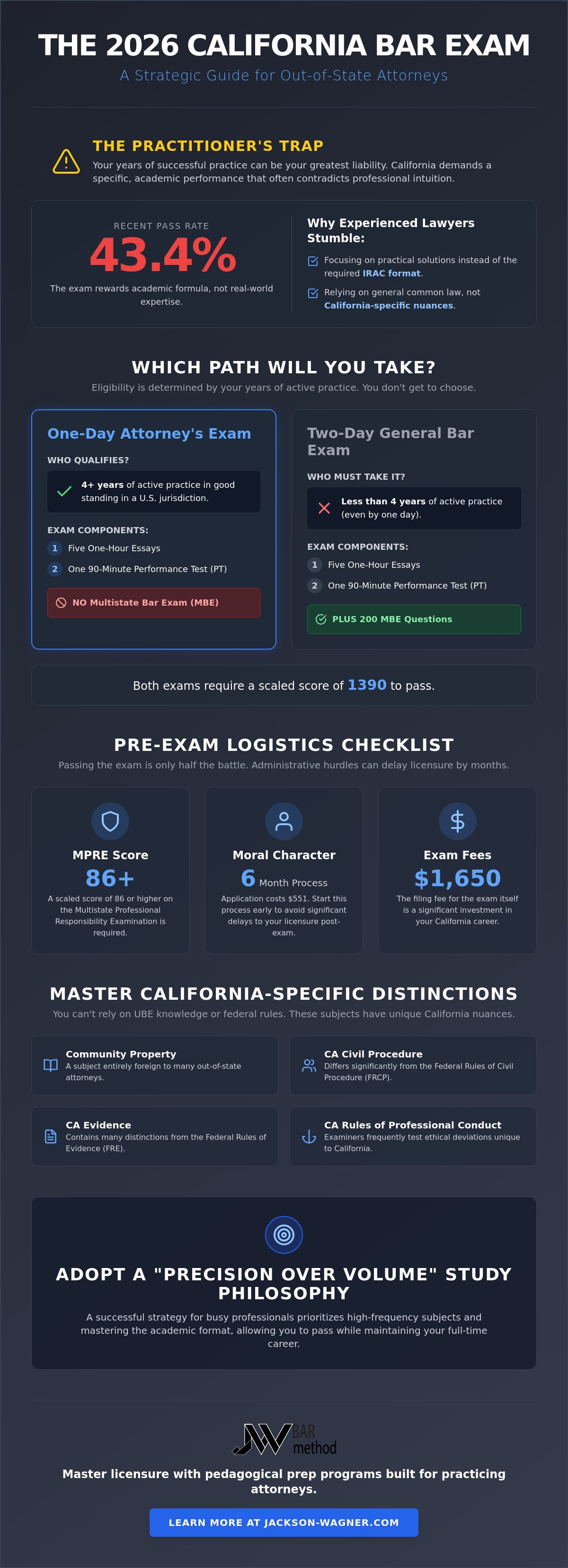
- Learn to avoid the "Practitioner's Trap" by shifting your focus from real-world legal practice to the strict academic rubrics and IRAC formatting the Bar examiners demand.
- Discover a "Precision over Volume" study philosophy that allows you to prioritize high-frequency subjects and pass while maintaining a full-time legal career.
- Explore how the JW Bar Method Prep programs provide a pedagogical approach built specifically for the needs and time constraints of practicing attorneys.
Navigating the 2026 California Bar Requirements for Out-of-State Attorneys
California doesn't bend for experience. If you're planning to practice here, you must accept that the State Bar of California operates as an island, rejecting the reciprocity agreements common in other jurisdictions. For 2026, eligibility for the california bar exam for out of state attorneys hinges on two distinct paths. You'll either sit for the full two-day General Bar Exam or, if you've been actively licensed and in good standing in another U.S. jurisdiction for at least four years immediately preceding your application, you'll qualify for the one-day Attorneys' Examination.
Logistics are often where high-performing practitioners stumble. Beyond the exam itself, you must secure a scaled score of 86 or higher on the Multistate Professional Responsibility Examination (MPRE). Simultaneously, you need to initiate your Moral Character Determination early. With a $551 application fee and a typical processing time of six months, waiting until you've passed the exam to start this paperwork can delay your licensure by half a year or more. Success requires managing these administrative milestones with the same precision you apply to your caseload.
The No-Reciprocity Reality in California
California remains one of the few "exam-only" jurisdictions in the country. This means there's no admission on motion, regardless of whether you're a junior associate or a senior partner with decades of trial experience. This policy creates a significant bottleneck for lateral hires and relocating partners who expect a seamless transition. For the 2026 cycle, an Attorney Applicant is defined as any person who has been admitted to practice law in any United States jurisdiction and is currently a member in good standing of the bar of that jurisdiction.
For relocating partners who are also looking to re-establish their professional and social networks, it can be beneficial to explore Golf Club Memberships for Sale as a way to secure exclusive access to premier networking venues through the secondary market.
California-Specific Law Distinctions for 2026
The 2026 written portion of the exam covers 17 potential subjects, many of which contain nuances that don't exist in the UBE or other state exams. You can't rely on general common law principles. You'll need to master specific distinctions in Community Property, a subject entirely foreign to many out-of-state lawyers. Additionally, California's Evidence and Civil Procedure codes differ significantly from the Federal Rules you likely use in daily practice. Mastering the California Rules of Professional Conduct is also non-negotiable, as the examiners frequently test the specific ethical deviations unique to this state. Taking the california bar exam for out of state attorneys means unlearning your "autopilot" legal instincts to adopt the specific academic rubric required for a passing score.
The One-Day Attorney’s Examination vs. The General Bar Exam
You don't get to choose your exam format based on personal preference. The State Bar mandate is clear: only those who have been actively licensed and in good standing for the four years immediately preceding the exam qualify for the one-day Attorneys' Examination. If you've been practicing for three years and 364 days, you're required to sit for the full two-day General Bar Exam alongside law students. Both paths require a scaled score of 1390 to pass, but the journey to that number looks vastly different depending on your eligibility. Success on the california bar exam for out of state attorneys requires knowing exactly which hurdles you're expected to clear before you open a single book.
Qualifying for the Abbreviated One-Day Format
To meet the official requirements for out-of-state attorneys, your status must be "active" for the entire four-year window. Gaps in practice, such as moving to an inactive status during a career break or relocation, can reset your clock and force you into the two-day General Bar Exam. It's vital to audit your standing with your current state board before committing to a study schedule. For a deeper dive into these nuances, consult our California Attorney's Exam Requirements: The 2026 Guide to Licensure for Out-of-State Lawyers.
Why the MBE is Excluded (And Why that Matters)
The most significant distinction for eligible attorneys is the total exclusion of the Multistate Bar Examination (MBE). While avoiding 200 multiple-choice questions sounds like a reprieve, it creates a high-stakes environment where your written performance is the sole metric of success. The california bar exam for out of state attorneys then becomes a test of pure analytical endurance. Without the MBE to pad your score, the 90-minute Performance Test and five one-hour essays carry 100% of the weight. This format favors the practitioner who can synthesize facts quickly, but it punishes those who have forgotten the rigid IRAC structure required by the examiners.
Mastering this written-only format requires more than just reading outlines; you need a strategy that mirrors the examiner's rubric. If you're ready to move beyond student-grade prep, the JW Bar Method Prep - Attorney’s Exam California Bar provides the practitioner-focused framework necessary to hit that 1390 target on your first attempt.
Experience often breeds a dangerous level of confidence. Many practitioners believe that because they've successfully litigated complex cases for a decade, they don't need to return to the basics of IRAC. This is the "Practitioner's Trap." The Bar is not a measure of how well you can practice law; it's a measure of how well you can follow a specific, academic rubric. You must be willing to simplify your thoughts and write for a grader who is looking for a checklist of points rather than a brilliant legal argument.
The IRAC vs. Real-World Analysis Conflict
In your daily practice, mechanical writing is a sign of a junior associate. On the exam, it's your ticket to licensure. Graders typically spend less than two minutes reviewing each essay. They are scanning for headers, rule statements, and specific keywords. If your analysis is buried in eloquent prose, they will miss it. You must unlearn the habit of deep-dive research and embrace a simplified, rigid structure. This challenge is similar to the hurdles discussed in insights from foreign-educated attorneys, who must also pivot from their established legal instincts to meet California's unique demands. Senior partners often struggle the most here, as their instinct to provide comprehensive counsel conflicts with the need to provide a "good enough" answer within 60 minutes.
Time Management for the Working Professional
The 60-minute essay is a sprint, not a marathon. You cannot afford to get lost in the weeds of a minor sub-issue. For the practicing attorney, time management is a two-front war. You're fighting the clock during the exam and fighting your calendar during preparation. Balancing billable hours with high-intensity study blocks requires a surgical approach to your schedule. You don't need more hours; you need better ones. Success requires a psychological shift from advocate to exam-taker. For a comprehensive look at building this schedule, see our guide on Passing the California Bar Exam in 2026: The Definitive Strategic Guide. Stop practicing law for a moment and start practicing the exam.
Strategic Study Planning for Full-Time Legal Professionals
Most bar prep courses fail practitioners by burying them in a volume of material designed for students who have 12 hours a day to study. You don't have that luxury. Success on the california bar exam for out of state attorneys requires a "Precision over Volume" philosophy. Instead of wading through 1,000 pages of outlines, you must prioritize the high-frequency subjects tested in the 2026 cycle. This means mastering the core 17 subjects while focusing your heaviest efforts on the "heavy hitters" like Professional Responsibility and Civil Procedure that are statistically more likely to appear on the written day.
Timed practice is the only way to build the muscle memory required for the one-day format. You must simulate exam-day conditions by sitting for multiple 90-minute Performance Tests and back-to-back 60-minute essays. This isn't about learning law; it's about learning the clock. An accelerated prep track of 6 to 10 weeks is often more effective for attorneys than the traditional 12-week model because it maintains high intensity and prevents the "forgetting curve" from setting in before the exam dates of July 28–29, 2026.
Building an Accelerated Study Calendar
You can't work a 60-hour week and study for 40. Aim for a structured 20-hour study week. Use the "Active Recall" method to cement California-specific distinctions like Community Property and professional conduct rules. Rather than passive reading, test yourself constantly with practice prompts. Regarding "Bar Leave," most professionals find that taking the final two weeks off from their firm provides the necessary mental runway to transition from advocate to exam-taker. This focused window allows you to move from general knowledge to the specific, mechanical application the graders demand.
Mastering the 90-Minute Performance Test
The Performance Test (PT) is your strategic advantage. It's the most passable section because it tests the skills you use every day: extracting rules from a library and applying them to a file. The challenge is the 90-minute limit. You must refine a drafting strategy that allows for 45 minutes of analysis and 45 minutes of writing. Techniques for drafting under pressure ensure you finish with five minutes to spare, allowing for a quick polish that can make the difference between a failing score and hitting the 1390 scaled target. To streamline your preparation and focus on the high-yield strategies that matter, explore the JW Bar Method Accelerated Prep - Attorney’s Exam California Bar.
Mastering Licensure with the JW Bar Method Prep Programs
Success on the california bar exam for out of state attorneys isn't about working harder; it's about working smarter. While legacy providers force you into a one-size-fits-all model, the JW Bar Method is a pedagogical approach built specifically for the active practitioner. We've stripped away the academic fluff to focus on the exact skills you need to hit the 1390 scaled score. Our curriculum focuses on the JW Bar Method Prep - Attorney’s Exam California Bar, which is designed exclusively for the written day. This ensures you don't waste a single hour on MBE subjects you aren't required to test.
For those facing extreme time constraints, our JW Bar Method Accelerated Prep - Attorney’s Exam California Bar offers a high-intensity path to success. We understand that your billable hours are precious. By focusing on high-yield subjects and the active recall techniques discussed earlier, we help you achieve in weeks what takes students months. Our binary performance guarantee serves as the ultimate brand anchor. We assume the financial risk because we are certain of our methodology's efficacy, providing you with a sense of "bold reliability" during a high-stakes transition.
Precision Prep vs. Legacy Volume
Traditional 400-hour courses are built for people with nothing but time. The JW Bar Method cuts the "fluff" of endless video lectures in favor of gradable output. You won't spend your evenings passively watching content; you'll be actively drafting essays and Performance Tests that mirror the 2026 exam's specific rubric. Out-of-state attorneys who have transitioned through our structured tracks consistently report that our method feels less like "school" and more like the high-level professional training they expect in their careers. We prioritize the "mechanical" writing style that graders crave over the eloquent prose that often sinks experienced lawyers.
Getting Started for the 2026 Exam Cycles
If you have practiced for less than four years, you can still secure your future in the Golden State by enrolling in the JW Bar Method Prep - Full Exam California Bar. This program provides the same practitioner-centric focus while incorporating the necessary MBE prep to ensure you dominate both days of the exam. Whether you qualify for the abbreviated format or the full two-day sitting, the transition from out-of-state practice to California licensure should be a strategic career move rather than a source of chronic anxiety. Secure your path to California licensure with the JW Bar Method today.
Secure Your California Licensure in 2026
Conquering the california bar exam for out of state attorneys requires more than just legal knowledge; it demands a tactical shift from practitioner to exam-taker. Success rests on verifying your four-year eligibility for the abbreviated format, avoiding the trap of over-analysis, and prioritizing a precision-based study schedule over the legacy volume of traditional courses. Your professional experience is an asset, but only when it's filtered through a methodology designed for the specific rigors of the California State Bar.
The JW Bar Method provides the modern, accelerated framework you need to bridge the gap between your current practice and your new home in California. With specialized tracks for the One-Day Attorney's Exam and a confident, results-oriented financial guarantee, we assume the risk so you can focus on results. Don't let outdated study models stall your career progression. Pass the California Bar with the JW Bar Method, Guaranteed. Your first attempt is your best opportunity to secure your future in the Golden State.
Frequently Asked Questions
Does California have reciprocity with any other states in 2026?
California does not offer reciprocity or admission on motion to attorneys from any other jurisdiction in 2026. Every out-of-state applicant must pass either the General Bar Exam or the modified Attorneys' Examination to gain licensure. This "exam-only" policy is a cornerstone of the state's licensing framework; it ensures that all practitioners meet California's specific standards of competence regardless of their years of experience elsewhere.
What is the 4-year rule for the California Attorney’s Exam?
The 4-year rule allows attorneys who have been actively licensed and in good standing in another U.S. jurisdiction for at least four years immediately preceding the exam to qualify for the one-day format. This four-year period must be continuous and active. If you have gaps in your practice or held an inactive status during that window, you'll likely be required to sit for the full two-day General Bar Exam instead.
How many days is the California Bar Exam for out-of-state attorneys?
The california bar exam for out of state attorneys is either one or two days long depending on your eligibility. Those qualifying under the 4-year rule sit for the one-day Attorneys' Examination, which consists solely of the written portion. All other applicants must take the two-day General Bar Exam, which includes both the written components and the 200-question Multistate Bar Examination (MBE) administered on the second day.
Can I take the California Bar Exam if I am licensed in a foreign country?
Attorneys licensed in foreign countries can take the California Bar Exam, but they generally don't qualify for the one-day Attorneys' Examination. Most foreign-educated applicants must complete the full two-day General Bar Examination. You must also provide specific documentation from your home jurisdiction's regulatory body to prove you're in good standing and eligible to practice law, alongside a verified evaluation of your legal education.
What subjects are tested on the California Attorney’s Examination?
The written portion of the exam covers 17 potential subjects, including California-specific topics like Community Property and the California Rules of Professional Conduct. Other tested areas include Business Associations, Civil Procedure, Evidence, and Torts. Graders look for your ability to apply these specific rules to complex fact patterns. Success requires mastering the nuances that distinguish California law from the general common law principles used in other jurisdictions.
What is a passing score for the California Bar Exam in 2026?
A passing score for both the General Bar Exam and the Attorneys' Examination in 2026 is a minimum scaled score of 1390. This score is determined by the Committee of Bar Examiners and represents the threshold for minimum competence. Because the Attorneys' Exam is 100% written, your performance on the five essays and the single Performance Test must be exceptionally precise to reach this target without the buffer of multiple-choice points.
How much does it cost to take the California Bar Exam as an attorney?
The total cost to sit for the exam as an out-of-state attorney typically exceeds $2,300 in mandatory fees. This includes the $1,650 application fee, a $153 laptop fee, and the $551 Moral Character Determination fee. You should also budget for the $185 MPRE registration fee and any travel expenses. These costs are non-refundable; therefore, a first-attempt pass is a significant financial priority for most relocating professionals.
Do I need to take the MPRE again if I’m already licensed in another state?
You must provide a scaled MPRE score of 86 or higher to the State Bar of California, even if you're already licensed in another state. While you don't necessarily need to retake the exam if your previous score meets this threshold and is verified by the NCBE, many attorneys find they must sit for it again to satisfy California's specific admission rules. It's vital to confirm your existing score's validity early in the application process.


