
Why would a seasoned attorney with years of successful practice fail a one-day exam while fresh law graduates pass the two-day version? It is a common misconception that the shorter format represents an easier path to licensure. If you are currently practicing law in another jurisdiction, you likely feel the weight of limited study time and the high stakes of a potential professional setback. The pressure to navigate California's unique, non-UBE format while maintaining your billable hours is a challenge that requires a strategic, results-oriented approach.
We understand that your time is your most valuable asset and you cannot afford to waste it on the wrong preparation method. This guide provides a definitive comparison of the california attorney's exam vs full bar exam to help you choose the path that respects your experience and ensures your success. You will discover the critical differences in structure, eligibility, and pass strategies to determine which California licensure path is right for your professional goals. We will analyze the 2026 data, including the stark contrast between the February Attorney's Exam pass rate of 57.0% and the General Bar Exam's 30.8%. We also preview the specific tactical shifts required to satisfy California's rigid grading rubrics, ensuring you move forward with absolute confidence.
Key Takeaways
- Confirm your eligibility for the one-day format by verifying the "4-Year Rule" and understanding the separate timeline for the mandatory Moral Character Determination.
- Evaluate the structural risks of the california attorney's exam vs full bar exam, particularly how the absence of the MBE safety net shifts the entire scoring burden to your written performance.
- Avoid the "Practitioner's Trap" by identifying why standard legal writing habits often fail to meet the specific, rigid grading rubrics required for California licensure.
- Navigate California's unique non-UBE landscape with a focus on the 13+ tested subjects that require state-specific proficiency regardless of your years of out-of-state experience.
- Transition from "lawyer writing" to "passing writing" using a precision-based study method that respects your professional schedule and prioritizes measurable results.
California Attorney's Exam vs. Full Bar Exam: Defining the 2026 Standards
Choosing your path to California licensure in 2026 requires more than a cursory glance at the calendar. While most states have migrated to the Uniform Bar Examination (UBE), California maintains its own rigorous, independent standards. This independence means that whether you sit for the two-day or the one-day version, you are being measured against a specific California-centric rubric that does not account for scores earned in other jurisdictions. The decision between the california attorney's exam vs full bar exam is a strategic one that should be based on your personal testing strengths rather than a desire for a shorter day.
Many practitioners fall into the trap of believing the one-day option is a "shortcut." It's not. The difficulty level of the essay questions and the Performance Test remains identical across both formats. Both exams share a singular core objective: ensuring minimum competence in California law. The primary difference lies in the scoring mechanics and the physical endurance required to finish. In 2026, the passing score remains a scaled 1390 for both paths, but how you reach that number depends entirely on which components you choose to tackle.
The Full California Bar Exam (2-Day Format)
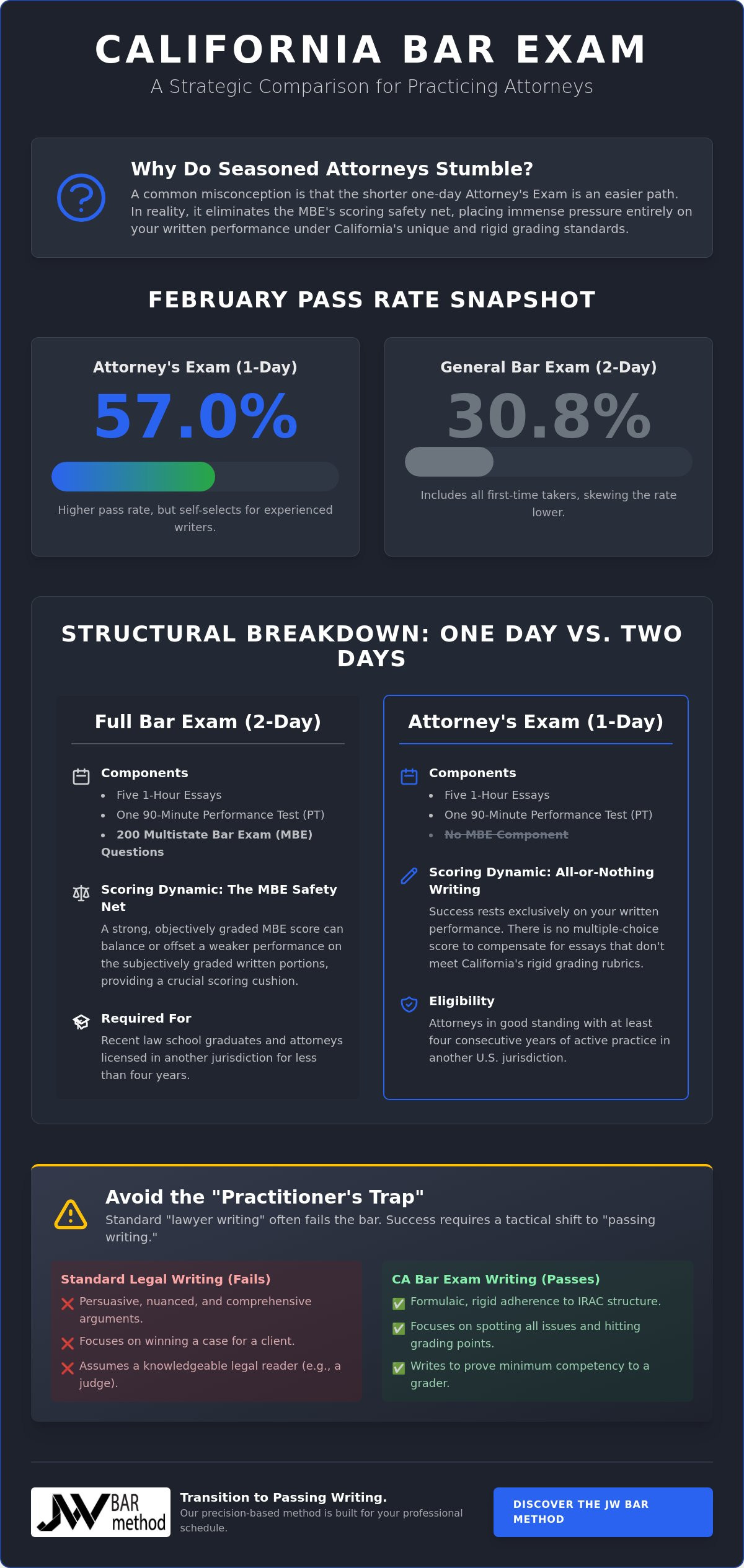
The standard path consists of a two-day gauntlet. Day one covers five one-hour essays and one 90-minute Performance Test. Day two is dedicated entirely to the Multistate Bar Examination (MBE), a 200-question multiple-choice test. This format is mandatory for recent law school graduates and attorneys who have been licensed for less than four years. For many, the MBE acts as a critical scoring stabilizer. Because the MBE is objectively graded, a strong performance here can often offset a mediocre essay score, providing a safety net that the one-day exam lacks. You can find a more detailed California Bar Examination overview to see how these components have evolved to meet modern standards.
The California Attorney's Exam (1-Day Format)
Qualified practitioners often opt for the one-day format to avoid the grueling MBE. This exam consists strictly of the written portion: five essays and the Performance Test administered on a single day. The Attorney's Exam is the written-only portion of the general bar exam for qualified practitioners. While this reduces the testing time, it exponentially increases the pressure on your writing. Without the MBE to balance your total score, your ability to master California's specific essay "IRAC" style becomes the sole factor in your success. If your writing doesn't hit the mark, there is no multiple-choice cushion to save your application.
Eligibility Requirements: Do You Qualify for the One-Day Exam?
Confirming your eligibility is the first vital step before committing to a 2026 study schedule. The distinction in the california attorney's exam vs full bar exam is rooted in your professional history and standing in other jurisdictions. California is famously protective of its legal standards and does not offer admission on motion or reciprocity. Every applicant must pass a version of the exam, but the state provides a condensed path for seasoned practitioners who meet specific active practice thresholds and ethical requirements.
The 4-Year Active Practice Threshold
To sit for the one-day Attorney's Exam, you must be an attorney in good standing in another U.S. jurisdiction and have been actively licensed for at least four consecutive years. The State Bar of California is meticulous when calculating "active" time. Any period spent on inactive status or a gap in your practice history could disqualify you from the shorter format. If you fall short of this four-year requirement, you'll be redirected to the full two-day exam regardless of your total career experience. You can find the Official California Bar Exam Information for the latest 2026 regulatory updates on status verification.
Moral Character and the MPRE
Passing the written portion is only one component of the licensure process. You must also secure a positive Moral Character Determination and achieve a scaled score of 86 or higher on the MPRE. Seasoned attorneys often underestimate the length of the character and fitness investigation, assuming their clean record elsewhere guarantees a fast-track approval. California's background check is exceptionally thorough, often taking six months or longer to complete. It's critical to file your California bar exam moral character application early to prevent administrative delays from stalling your admission after you've passed the exam.
Foreign practitioners generally don't qualify for the one-day format unless they've already secured admission in another U.S. state and met the four-year rule. If you're navigating these complex requirements while maintaining a full-time practice, you need a strategy that accounts for every technicality. Consulting with the experts at Jackson-Wagner LLC can help you verify your eligibility and select the study track that aligns with your specific professional standing.
Structural Comparison: MBE vs. Essays and Performance Tests
The structural reality of the california attorney's exam vs full bar exam is that while the knowledge base is identical, the risk distribution is fundamentally different. Both exams test the same 13+ areas of law, ranging from core subjects like Torts and Contracts to state-specific nuances like Community Property. However, the presence or absence of the Multistate Bar Examination (MBE) changes how you must approach your preparation. In the full exam, the 200-question MBE provides a quantitative buffer; if you struggle with a specific essay prompt, a high multiple-choice score can pull your total above the passing threshold. Without this buffer, the Attorney's Exam becomes a high-stakes demonstration of writing precision where every word carries immense weight.
Mastering the "California Way" of writing is the only path to success in either format. Graders look for a specific issue-spotting density and a rigid adherence to the IRAC (Issue, Rule, Analysis, Conclusion) structure. You must also conquer the 90-minute Performance Test (PT), which evaluates your ability to handle a "closed-universe" legal task using only the provided file and library. This isn't just about knowing the law; it's about demonstrating professional lawyering skills under extreme time pressure. You can review the Official California Bar Exam Rules to understand exactly how these components are evaluated by the State Bar.
Scoring and Weighting: The Hidden Danger
In the Full Bar Exam, the MBE accounts for exactly 50% of your final grade. For those taking the Attorney's Exam, that percentage drops to zero, meaning your entire professional future rests on six pieces of writing. This "all-or-nothing" written scoring represents the single biggest risk for practicing lawyers who may have grown accustomed to a more conversational or practical writing style. Attorney's Exam candidates must score a 1390 scaled score entirely on the written portion. There is no room for error or "off" days when your score is calculated this way.
Tested Subjects for 2026
Success requires a deep dive into both core and California-specific subjects. For 2026, you must be prepared for state-specific rules in Community Property, Professional Responsibility, and Wills and Trusts. These often appear alongside core subjects like Real Property, Constitutional Law, and Evidence. When you don't have the MBE to guide your study or provide "easy" points, you must prioritize your subjects based on their frequency and your own writing proficiency. Practicing lawyers often find that they need to "un-learn" their daily habits to meet the academic expectations of these specific tested areas.
The Strategic Dilemma: Is the One-Day Exam Actually Easier?
The most dangerous assumption a practicing lawyer can make is that the one-day format offers a path of least resistance. When weighing the california attorney's exam vs full bar exam, you must look beyond the clock. While a one-day "sprint" sounds preferable to a two-day "marathon," the lack of an MBE safety net means your margin for error is non-existent. In February 2026, the Attorney's Exam pass rate reached 57.0%, significantly higher than the 30.8% seen in the General Bar Exam. However, this data is deceptive. In July 2025, the Attorney's Exam pass rate actually dropped to 43.4%, while the General Bar Exam pass rate was 54.8%. This volatility proves that the shorter exam is a specialized academic challenge, not a guaranteed shortcut.
Practitioners often fall into the "Practitioner's Trap," where years of successful lawyering actually hinder their performance. Graders aren't looking for the nuanced, conversational advice you give to clients; they're looking for rigid, mechanical applications of black-letter law. If you write like a "real" lawyer, you will likely fail. You must decide if your testing strengths align with an all-or-nothing written score or if you would benefit from the objective scoring of the MBE to balance out a potentially difficult essay session.
Why Attorneys Fail the California Bar
Failure usually stems from an over-reliance on "common sense" or general legal principles. California graders require specific, verbatim rule statements that many seasoned attorneys haven't looked at in years. Returning to academic study after a decade in the workforce is a psychological hurdle that requires a complete shift in mindset. Many applicants also struggle with the specific formatting expected by California examiners, failing to hit the "issue-spotting" density required to reach a 1390 scaled score. Without a structured approach, your professional experience can become a liability rather than an asset.
Choosing Your Path Confidently
To make a data-driven decision, you should evaluate whether you are an essay specialist or a multiple-choice master. If you consistently score high on standardized tests, the two-day exam might actually be the safer bet for you. You can use California bar exam practice to test your aptitude under timed conditions before you commit to a registration path. Always consult the State of California State Bar for the most recent updates on late filing fees and laptop requirements to ensure your administrative ducks are in a row. For those ready to master the written portion with surgical precision, the JW Bar Method Prep - Attorney’s Exam California Bar provides the structured, results-oriented framework necessary to overcome the practitioner's trap and secure your California license.
The JW Bar Method: Precision Prep for Professional Licensure
Generic, high-volume prep courses are designed for law students with fresh academic memories and empty calendars. Jackson-Wagner LLC understands that practicing attorneys require a different approach. When you are deciding between the california attorney's exam vs full bar exam, you need a method that prioritizes surgical precision over high-volume busywork. We specialize in transforming your professional expertise into a format that satisfies California's rigid grading standards. This transition is essential because the practical, nuanced writing used in daily practice often clashes with the mechanical IRAC structure demanded by bar examiners.
Our results-oriented framework replaces high-stakes anxiety with professional empowerment. We provide a modern alternative to legacy education models, focusing on the practical needs of a learner who requires maximum flexibility. Jackson-Wagner LLC utilizes a sophisticated pedagogical approach to ensure you aren't just memorizing rules, but applying them with the issue-spotting density required for a 1390 scaled score. We act as a disruptive mentor, helping you strip away the conversational habits of a practitioner to meet the academic expectations of the State Bar.
JW Bar Method Prep - Attorney’s Exam California Bar
This program is engineered for qualified practitioners who are tackling the one-day written gauntlet. Because the Attorney's Exam removes the multiple-choice cushion, your writing must be flawless. We provide intensive feedback loops on Essays and Performance Tests, moving beyond generic critiques to provide actionable, point-scoring adjustments. Our strategic drills are updated for the 2026 cycle, helping you navigate complex California-specific subjects like Community Property and Wills with confidence. Every instructional element is designed to maximize your efficiency without requiring months of leave from your firm.
Structured Success for Out-of-State Lawyers
Our best bar exam preparation service removes the uncertainty of California admission. For those who cannot pause their practice for months, the JW Bar Method Accelerated Prep - Attorney’s Exam California Bar offers a high-impact, streamlined curriculum. Jackson-Wagner LLC is so certain of our efficacy that we offer a binary performance guarantee. We assume the financial risk of your performance outcome, acting as a partner in your success. This bold reliability is what distinguishes our methodology from cautious, conventional formats, ensuring your path to licensure is as efficient as it is dependable.
Secure Your California License with Precision
Navigating the california attorney's exam vs full bar exam requires a cold, analytical look at your testing strengths and professional constraints. You've seen that the one-day format isn't a shortcut; it's a high-stakes written gauntlet that demands the elimination of practitioner habits in favor of rigid academic rubrics. Whether you qualify for the Attorney's Exam or must tackle the two-day marathon, your success depends on a study methodology that respects your time and prioritizes measurable outcomes. Relying on legacy models designed for law students only increases your risk of professional setback.
We provide specialized programs for practicing attorneys and accelerated 2026 prep tracks that deliver proven results for out-of-state practitioners. Don't leave your licensure to chance or high-volume courses that don't understand your unique needs. Master the California Bar with the JW Bar Method and take the final step toward your professional goals. Our results-oriented framework ensures you have the tools to meet California's standards with absolute certainty. You have the experience; now it's time to secure your future in the California legal landscape with confidence.
Frequently Asked Questions
What is the pass rate for the California Attorney's Exam vs. the Full Bar?
Pass rates for the Attorney's Exam fluctuate significantly and are not always higher than the General Bar Exam. In February 2026, the Attorney's Exam pass rate was 57.0% while the General Bar Exam pass rate was 30.8%. However, July 2025 data showed the General Bar Exam at 54.8% and the Attorney's Exam at 43.4%, proving that the shorter format is not a guaranteed path to success.
Can I take the California Attorney's Exam if I'm a foreign-licensed lawyer?
Foreign-licensed lawyers generally do not qualify for the one-day Attorney's Exam unless they are also admitted to practice in another U.S. jurisdiction. You must meet the four-year active practice requirement within a U.S. state or territory to be eligible for the condensed format. Most foreign practitioners must sit for the two-day General Bar Exam to gain California licensure.
How many years of practice do I need for the California Attorney's Exam?
You must have been an active member in good standing of another U.S. jurisdiction for at least four consecutive years immediately preceding your application. The State Bar of California is very strict about this timeframe; any period spent on inactive status or a gap in your practice history will likely disqualify you. If you don't meet this threshold, you must take the full two-day exam.
Is the MBE required for the California Attorney's Exam in 2026?
The Multistate Bar Examination (MBE) is not part of the California Attorney's Exam in 2026. This version of the test is strictly a one-day written exam consisting of five essay questions and one 90-minute Performance Test. While this removes the 200 multiple-choice questions from your schedule, it also removes the scoring cushion that a strong MBE performance typically provides.
What happens if I fail the Attorney's Exam but would have passed with an MBE score?
There is no way to retroactively apply an MBE score to an Attorney's Exam result because the scoring is entirely separate. In the california attorney's exam vs full bar exam debate, practitioners must weigh the risk of an "all-or-nothing" written score. You must reach the 1390 scaled passing score solely through your essays and Performance Test without the help of a multiple-choice safety net.
How much does it cost to take the California Bar Exam vs. the Attorney's Exam?
The State Bar application fee for the General Bar Exam is $878, whereas the Attorney's Exam application fee is $1,650. You should also account for the $185 MPRE registration fee and potential laptop fees. Late filing can add between $50 and $250 to your total costs, making early registration a critical financial strategy for busy professionals.
Can I switch from the Full Bar to the Attorney's Exam after registering?
Switching your exam format after registration is subject to rigid administrative deadlines and is generally not permitted once the final filing window has closed. You must verify your eligibility and practice history before submitting your initial application. Changing your status late in the cycle can result in forfeited fees or a rejected application, so clear confirmation of your status is essential.
Does California have reciprocity with any other states in 2026?
California does not have reciprocity or admission on motion with any other jurisdiction in 2026. Every applicant must pass either the General Bar Exam or the Attorney's Exam to practice law in the state. Additionally, all candidates must satisfy the MPRE requirement with a score of 86 or higher and secure a positive Moral Character Determination through a separate, comprehensive application process.


