For out-of-state attorneys, the California Bar isn't just a test of legal knowledge; it's a high-stakes administrative project where the biggest hurdle isn't the law, but the transition from seasoned practitioner to exam-precision specialist. You've spent years building a successful practice, yet California famously refuses reciprocity, forcing you to prove your worth once again. We understand the frustration of balancing a full caseload while trying to master 17 distinct subjects that often contradict your daily experience in other jurisdictions.
This strategic guide clarifies the california bar exam requirements for out of state attorneys, ensuring you don't waste a single hour on unnecessary study. We will confirm your eligibility for the one-day Attorney's Exam and provide a structured timeline for the 2026 cycle. You'll learn how to navigate the six to eight month moral character process and implement an accelerated study method that respects your professional schedule. From the July 2026 filing deadlines to the specific subjects that trip up veterans, we provide the roadmap to secure your California licensure with absolute confidence.
Key Takeaways
- Confirm your eligibility for the streamlined one-day Attorney’s Exam by verifying you meet the "4-Year Rule" for active practitioners in good standing.
- Avoid critical licensing delays by submitting your Moral Character application at least eight months before your intended 2026 exam date.
- Identify the specific California distinctions within the 17 tested subjects that often trip up experienced attorneys accustomed to general law.
- Master the california bar exam requirements for out of state attorneys through a precision-engineered study schedule built for a professional workload.
- Transition from out-of-state status to California licensure using an accelerated methodology that prioritizes exam-specific performance over legacy study habits.
The Reality of California Licensure: No Reciprocity, Only Opportunity
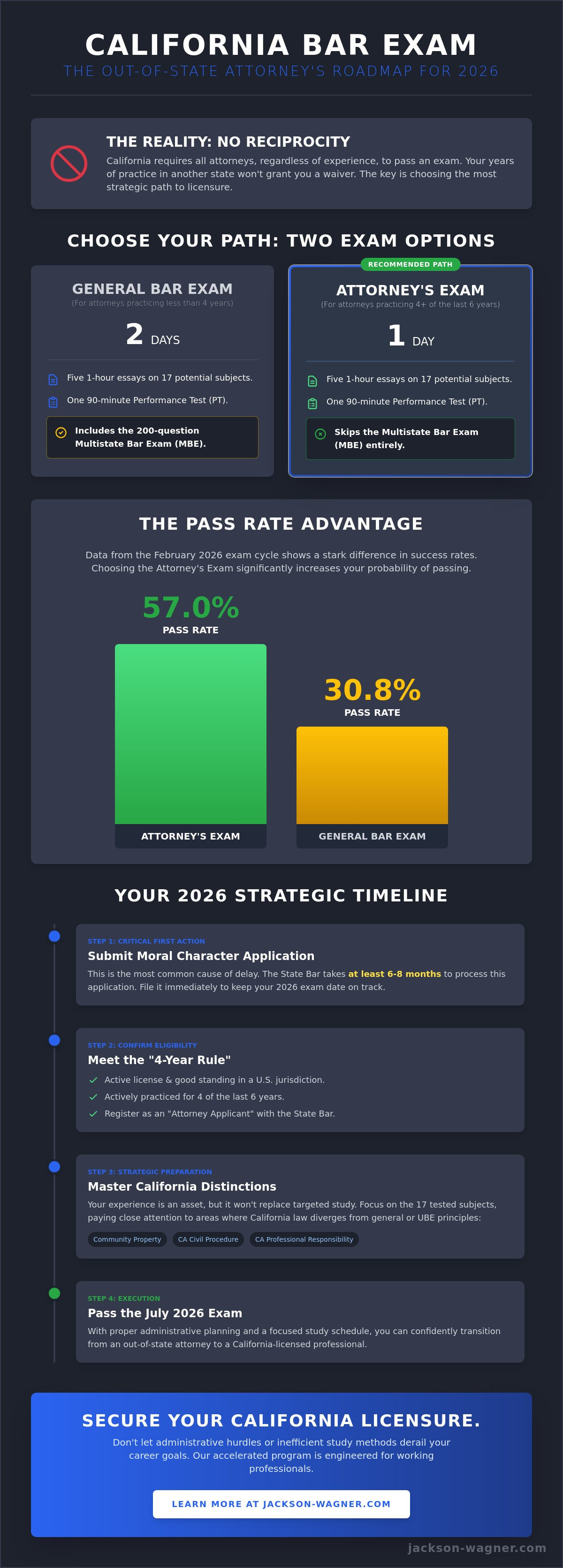
California remains a legal island. While many jurisdictions permit experienced lawyers to waive in through reciprocity or "Admission on Motion," California maintains a strict policy of examination for every applicant. This means that regardless of your years of practice or your standing in another state, you must sit for an exam to gain entry. Understanding the california bar exam requirements for out of state attorneys is the first step in converting this administrative hurdle into a strategic professional asset. The State Bar of California distinguishes between "Student Applicants" and "Attorney Applicants," offering a modified path for those who meet specific criteria. This "modified" exam, often called the Attorney's Exam, allows qualifying practitioners to bypass the Multistate Bar Examination (MBE) entirely.
Why California Rejects Traditional Reciprocity
The refusal to grant reciprocity isn't arbitrary. It's rooted in the state's unique legal framework. California's legal system relies heavily on specific distinctions, such as Community Property and unique civil procedure rules, which aren't covered by the Uniform Bar Exam (UBE). Additionally, the California Rules of Professional Conduct often diverge from the ABA Model Rules. An Attorney Applicant is defined as a licensed lawyer in good standing in another US jurisdiction. To qualify for the streamlined one-day exam, you must meet these standards:
- Maintain active status in good standing in another U.S. jurisdiction.
- Have been actively licensed and practicing for at least four of the six years immediately preceding the application.
- Submit a positive moral character determination.
Navigating the california bar exam requirements for out of state attorneys requires a shift in mindset. You aren't just proving you're a lawyer; you're proving you're a California lawyer. By requiring these professionals to test, the state ensures that every practitioner understands critical local nuances before they advise a single client.
The 2026 Landscape for Out-of-State Transfers
Entering the California market in 2026 offers significant rewards for those who navigate the process correctly. Recent data shows that the pass rate for the February 2026 Attorney's Exam was 57.0%. This is significantly higher than the 30.8% pass rate for the General Bar Exam during the same period. This discrepancy highlights the advantage of the one-day exam format. However, success requires more than just legal knowledge. It requires early administrative action. You must register as an Attorney Applicant and begin the Moral Character and Fitness application immediately. This process takes a minimum of six to eight months. A delay in filing can push your licensure back by an entire year. Securing licensure in California isn't just about passing a test. It's about expanding your national reach into one of the world's largest economies.
Choosing Your Path: General Bar Exam vs. the One-Day Attorney’s Exam
The decision between the General Bar Exam and the Attorney’s Exam hinges on your practice history and your tolerance for standardized testing. While both paths lead to the same licensure, the administrative burden and the testing experience differ significantly. The official requirements for out-of-state attorneys dictate that if you've practiced for less than four years, you're relegated to the two-day General Bar Exam. This includes the Multistate Bar Examination (MBE), a 200-question multiple-choice marathon that many veteran lawyers find disconnected from their daily practice. In contrast, those who meet the "4-year rule" can opt for the one-day Attorney’s Examination, which focuses exclusively on written proficiency. Understanding these california bar exam requirements for out of state attorneys is vital for choosing the path with the highest probability of success.
The 4-Year Eligibility Requirement Decoded
To qualify for the abbreviated exam, you must have been actively licensed and practicing in another U.S. jurisdiction for at least four of the six years immediately preceding your application. "Active status" means you held a license that permitted the practice of law without supervision. If you spent two years on inactive status while raising a family or working in a non-legal role, those years won't count toward your four-year total. Partial years are calculated strictly; even being short by a few weeks can disqualify you from the one-day format. If you're at the 3.5-year mark, it's often strategically sound to wait six months to bypass the MBE, provided your career timeline allows for the delay.
Exam Components: Essays and the Performance Test
The Attorney's Exam consists of five one-hour essay questions and one 90-minute Performance Test (PT). The essays test your ability to apply "General Law" and California-specific distinctions across 17 potential subjects. For a practicing attorney, the PT is often the strongest asset. It simulates a real-world legal task, such as drafting a memorandum or a closing argument, using a provided "file" and "library." While the General Bar Exam splits its scoring 50/50 between the written portion and the MBE, the Attorney's Exam is 100% written. This means your success depends entirely on your ability to communicate complex legal analysis under pressure. If you're preparing for this specific challenge, the JW Bar Method Prep - Attorney’s Exam California Bar provides the precision-engineered focus required to master the written format without the distraction of multiple-choice drills.
When weighing your options, consider the pass rates. The February 2026 pass rate for attorney applicants was 57.0%, nearly double that of the general applicant pool. Unless you're a standardized testing expert who recently took the UBE, waiting to qualify for the one-day exam is almost always the superior strategic move. It respects your professional workload and aligns with the california bar exam requirements for out of state attorneys that reward experience over rote memorization.
The Administrative Gauntlet: Moral Character, MPRE, and Compliance
Securing your California law license is a multi-phase administrative project that begins long before you step into the exam room. While your legal expertise is the focus of your study, your compliance with the State Bar's rigorous entry standards is what determines your actual admission date. The California requirements for out-of-state attorneys are among the most stringent in the nation. You must approach these steps with the same level of precision you apply to a complex litigation filing. The process moves through five distinct stages: registration as an Attorney Applicant, the moral character determination, the MPRE, child support compliance, and finally, the exam application itself.
Navigating the Moral Character Application
The Moral Character application is the most common source of delay for out-of-state practitioners. You must submit this application at least eight months before your intended exam date. The State Bar routinely takes six to eight months to process these files, and any "red flags" can extend that timeline significantly. Common issues for experienced attorneys include past disciplinary history, even if minor, and financial disclosures that require additional documentation. You'll need to gather official certificates of good standing from every jurisdiction where you've ever held a license. We provide a comprehensive framework for this process in our guide on decoding the moral character application. Don't make the tactical error of waiting until after the exam to start this; doing so will likely push your licensure back by an entire year.
The MPRE and Professional Responsibility Requirements
Every applicant must clear the Multistate Professional Responsibility Examination (MPRE) with a scaled score of 86 or higher. If it's been several years since you last took the MPRE, check the State Bar's rules on score expiration, as you may need to retake it. California's ethical standards are unique; you must understand where the California Rules of Professional Conduct (CRPC) diverge from the ABA Model Rules. Mastering the california bar exam requirements for out of state attorneys means recognizing that "general" ethics knowledge isn't enough to satisfy California's specific standards. We recommend sitting for the MPRE in a separate administration from the bar exam to ensure your focus remains undivided.
Finalizing your eligibility also requires ensuring you're in compliance with the Department of Child Support Services. The State Bar will not admit any applicant who is delinquent on these obligations. Once these foundational requirements are in motion, you can focus on the filing window for the exam itself. For the July 2026 administration, the timely filing period opens on March 1 and closes on April 1. Missing this window adds unnecessary late fees and administrative stress to an already high-stakes process. Success in California requires mastering the paperwork just as much as the law.
Strategic Mastery of the 17 Tested Subjects for Working Attorneys
The transition from a high-level legal practice to the granular requirements of the California Bar is often a jarring experience. While your daily work relies on nuanced logic and specialized expertise, the exam demands a broad, rote-memorization approach across 17 distinct subjects. This is where many experienced practitioners falter. They attempt to apply real-world legal reasoning to scenarios that require "Bar Law" answers. To succeed, you must pivot from a practitioner's mindset to an exam specialist's precision. Understanding the california bar exam requirements for out of state attorneys means recognizing that your years of experience are a double-edged sword; they provide context, but they can also lead you to overthink simple black-letter law issues.
Efficiency is your primary objective. You don't have the luxury of the 400-plus hours that traditional bar prep programs demand. Instead, you must prioritize subjects based on their frequency and the weight of their California-specific distinctions. You must balance the seven Multistate Bar Examination (MBE) subjects, which California tests as essays, with the ten additional subjects that are unique to this jurisdiction. Success isn't about knowing everything. It's about knowing exactly what the graders expect to see on the page.
California-Specific Subjects You Can't Ignore
California is notorious for its specific legal doctrines that deviate from general common law. Community Property, Wills, and Trusts are frequent fliers on the essay portion and require a deep dive into state-specific statutes. Perhaps the most significant challenge is California Civil Procedure. Many out-of-state attorneys are deeply familiar with the Federal Rules of Civil Procedure (FRCP), yet California's rules regarding service, pleading, and discovery are distinct and strictly tested. For a detailed breakdown of how to tackle these nuances, consult our definitive strategic guide for 2026. Mastering these distinctions is what separates those who pass from those who are forced to retake the exam.
The Attorney's Advantage: The Performance Test
The 90-minute Performance Test (PT) is the one area where your professional experience is a massive asset. The PT doesn't require you to bring in any "outside" law. Instead, it provides a "file" and a "library" and asks you to complete a specific legal task. This is exactly what you do every day in your practice. However, the most common mistake attorneys make is relying on their own knowledge of the law rather than the specific statutes and cases provided in the exam packet. If the "library" says the law is X, you must apply X, even if you know the real-world rule is Y. By maximizing your score on the PT, you create a vital scoring buffer that can compensate for a difficult essay on a subject like Future Interests or Remedies. To ensure your written performance meets the State Bar's exact grading criteria, consider the JW Bar Method Prep - Attorney’s Exam California Bar, which is specifically designed to refine the skills you already possess for the one-day format.
Accelerated Preparation: The JW Bar Method for Out-of-State Professionals
Balancing a 50-hour work week with the rigorous california bar exam requirements for out of state attorneys is an exercise in tactical efficiency. Most legacy bar prep courses are designed for recent law graduates with 400 hours of free time; they aren't built for the seasoned practitioner. The JW Bar Method Prep - Attorney’s Exam California Bar is precision-engineered to respect your time and your professional standing. We move beyond the academic exercise of "learning the law" and focus entirely on the mechanics of scoring points. By stripping away the administrative noise and focusing on the high-yield areas that actually appear on the exam, we provide a structured path to success that fits into your existing career.
Our commitment to your success is absolute. We operate on a principle of bold reliability, acting as a partner that assumes the financial risk of your performance. This binary performance guarantee distinguishes us from cautious competitors who offer volume over results. When you choose the JW Bar Method Accelerated Prep - Attorney’s Exam California Bar, you aren't just buying a course; you're securing a results-driven mentorship designed to get you licensed in 2026 without sacrificing your practice.
Precision vs. Volume: The JW Bar Method Advantage
Traditional bar prep often drowns students in thousands of pages of fluff. This volume-based approach is the primary reason why many attorneys struggle with the california bar exam requirements for out of state attorneys. Our curriculum identifies the high-frequency patterns the State Bar of California repeats across decades of testing. We prioritize the "Bar Law" distinctions that graders look for, ensuring your essays meet the exact rubric requirements. You can read more about why precision beats volume in bar prep on our blog. This method allows you to master the 17 tested subjects through targeted drills rather than passive video consumption.
Structured Success for the 2026 Exam Cycles
The 2026 exam cycle requires a methodical approach to both the law and the logistics. Whether you're aiming for the February or July administration, our mentorship model addresses the unique anxieties of out-of-state transfers. We provide a clear, day-by-day timeline that integrates your study sessions with your professional obligations. This structured progression ensures you arrive at the testing center with the confidence of a practitioner and the precision of an exam specialist. The path to your California license is no longer a source of stress; it's a managed project with a clear outcome. Secure your path to California licensure today and join the ranks of elite attorneys who have mastered the California Bar with the JW Bar Method.
Secure Your California Licensure in 2026
Expanding your practice to California is a strategic investment that requires moving beyond traditional study habits. You've seen that the california bar exam requirements for out of state attorneys demand a precise administrative timeline and a mastery of 17 distinct subjects. Success isn't found in the volume of hours you log, but in the efficiency of your preparation. By leveraging the one-day Attorney's Exam and clearing the moral character hurdle early, you position yourself for a seamless transition.
The JW Bar Method is exclusively focused on California licensure, providing the only precision-engineered path for busy professionals. We replace legacy, long-form lectures with an accelerated curriculum that prioritizes high-frequency scoring patterns. With our binary performance guarantee, we assume the risk so you can focus entirely on your results. You don't have to navigate this high-stakes transition alone.
Pass the California Attorney's Exam with the JW Bar Method and unlock the next chapter of your legal career. You have the experience; we provide the strategy to ensure you cross the finish line.
Frequently Asked Questions
Does California have reciprocity with any other states in 2026?
No, California does not offer reciprocity or "Admission on Motion" for any other jurisdiction as of 2026. Every practitioner must pass either the General Bar Examination or the one-day Attorney's Examination to secure licensure. This policy remains a core pillar of the State Bar's standards. Navigating the california bar exam requirements for out of state attorneys requires a commitment to testing, regardless of your years of practice or standing in other states.
What is the '4-year rule' for the California Attorney's Exam?
The "4-year rule" determines your eligibility for the abbreviated one-day exam format. To qualify, you must have been actively licensed and practicing in another U.S. jurisdiction for at least four of the six years immediately preceding your application. You must also be in good standing. If you don't meet this specific threshold, you must take the full two-day General Bar Exam, which includes the 200-question Multistate Bar Examination portion.
Can I take the one-day Attorney's Exam if I am licensed in a foreign country?
No, the one-day Attorney's Examination is strictly reserved for those licensed in U.S. jurisdictions. Foreign-educated attorneys or those licensed only in international jurisdictions are generally required to take the two-day General Bar Examination. While foreign lawyers can often sit for the exam without additional U.S. schooling, they cannot bypass the MBE portion through the attorney's path. This distinction is a critical part of the california bar exam requirements for out of state attorneys.
How long does the California Moral Character determination take to process?
A positive moral character determination typically takes a minimum of six to eight months to process. Because of this lengthy timeline, the State Bar recommends submitting your application well before you sit for the exam. Any issues in your history, such as past disciplinary actions or financial complications, can extend this period to ten months or longer. Early filing is the only reliable way to ensure your admission isn't delayed after passing the test.
What MPRE score is required for admission to the State Bar of California?
You must achieve a scaled score of 86 or higher on the Multistate Professional Responsibility Examination (MPRE) to qualify for admission. This score must be officially reported to the State Bar. If you have an existing score from several years ago, you should verify its validity with the admissions office. California's rules regarding the age of MPRE scores can lead to retake requirements for long-practicing attorneys seeking new licensure.
Is the California Attorney's Exam easier than the General Bar Exam?
The Attorney's Exam is shorter, but its difficulty is subjective. While the pass rate for the February 2026 Attorney's Exam was 57.0%, compared to 30.8% for the General Bar Exam, the one-day format is 100% written. There is no multiple-choice portion to buffer a low essay score. For practitioners with strong writing skills, it is often more manageable, but it requires extreme precision in California-specific legal distinctions.
What happens if I fail the Attorney's Exam but pass the Moral Character portion?
If you pass the moral character portion but fail the exam, your positive determination remains valid for three years. You don't need to reapply for moral character during subsequent exam attempts within that specific window. However, you must still meet all other requirements, including the MPRE and child support compliance, at the time of your eventual admission. This allows you to focus purely on your study for the next administration.
Do I need to be a California resident to take the bar exam?
No, there is no residency requirement to take the California Bar Exam or to be admitted to the State Bar. Many out-of-state attorneys secure California licensure while maintaining their primary practice and residence in another jurisdiction. This flexibility allows for national practice growth and the ability to serve clients with California-based legal needs without the necessity of relocating your entire professional operation or home.


