The one-day Attorney's Exam is often viewed as a shortcut; however, for many seasoned practitioners, it's actually a high-stakes trap that removes the safety net of the multiple-choice section. You've likely spent years building a successful practice in another state, and now the prospect of sitting for a multi-day test feels like an unnecessary hurdle. When weighing the attorney's exam vs full bar exam california, it's easy to focus on the time saved rather than the strategic risk involved. We recognize the professional pressure you're under. You need a California license to expand your career, but you don't have months to waste on legacy study models that don't respect your existing expertise.
This comparison will help you master the critical differences between California's licensure paths so you can choose the one that aligns with your 2026 study timeline and professional standing. You'll discover why the 57% pass rate for the Attorney's Exam in February 2026 isn't the only metric that matters for your success. We'll break down the 4-year eligibility rule, compare the intense written-only sprint against the two-day marathon, and introduce a structured study method designed for results. By the end, you'll have total confidence in your strategy and a clear, modern path to your California bar card.
Key Takeaways
- Calculate your exact eligibility for the one-day format by applying the State Bar's strict four year rule to your specific admission date.
- Analyze the strategic scoring differences of the attorney's exam vs full bar exam california to determine if you should leverage the MBE as a critical performance buffer.
- Uncover the "Expert's Paradox" to understand why your years of successful practice might actually hinder your performance on the California written sprint.
- Learn why the 90-minute Performance Test is the most frequent point of failure for experienced attorneys and how to master its specific rubric.
- Align your 2026 study schedule with a modern pedagogical approach that respects your professional time while providing a structured path to success.
The 'One-Day' Trap: Understanding California Licensure Paths in 2026
The allure of a "shorter" exam is a powerful psychological magnet for busy practitioners, yet the reality of the attorney's exam vs full bar exam california debate is far more complex than counting hours. The State Bar of California maintains two distinct paths to licensure, each presenting unique strategic risks. While the Attorney's Exam is a single-day commitment, it's also a high-density written sprint with zero margin for error. You're stripped of the Multistate Bar Examination (MBE) safety net, meaning your entire professional future in the state hinges on a handful of essays and a single Performance Test.
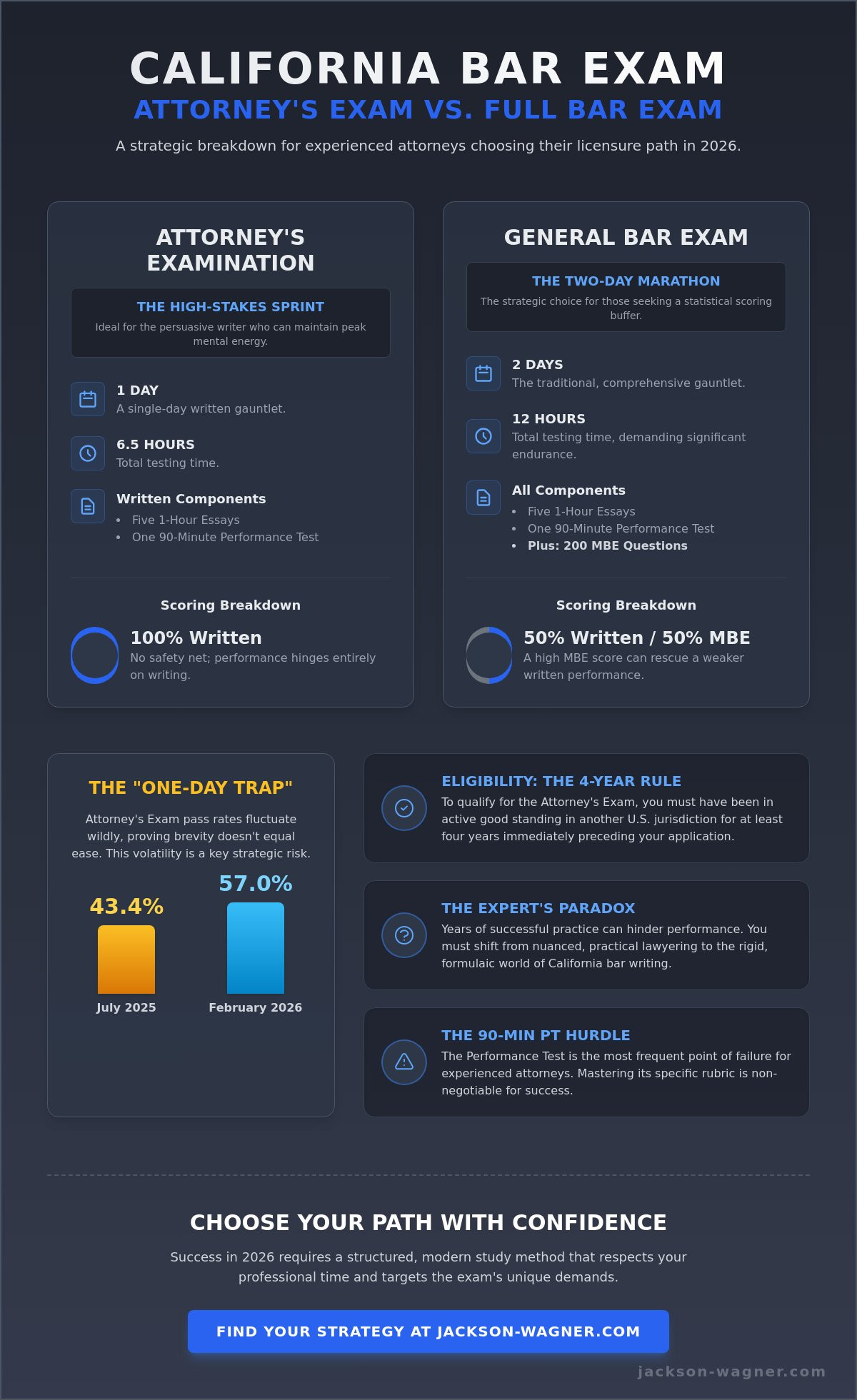
The 2026 testing environment remains one of the most rigorous in the nation. With a required scaled score of 1390, the pressure is absolute. Many experienced lawyers fall into the "One-Day Trap" because they assume their years of practice translate to exam success. They don't. In fact, the pass rate for the Attorney's Exam fluctuates wildly; it reached 57.0% in February 2026 but was a much lower 43.4% in July 2025. This volatility proves that brevity doesn't equal ease. Re-entering the examinee mindset requires a complete pedagogical shift. You must move from the nuanced, practical world of lawyering to the rigid, formulaic world of California bar writing.
Success in 2026 demands more than just legal knowledge; it requires an understanding of the specific rubric that California graders use to filter applicants. Whether you choose the one-day sprint or the two-day marathon, you're entering a system designed to test your ability to perform under extreme time constraints. You aren't just proving you know the law; you're proving you can apply it within the State Bar's narrow, academic framework.
What is the California Attorney's Examination?
This specialized path is a one-day written gauntlet. It consists of five one-hour essays and one 90-minute Performance Test. To qualify, you must have been in active good standing in another U.S. jurisdiction for at least four years immediately preceding your application. While it bypasses the 200-question multiple choice section, you still must satisfy the MPRE requirement and clear the Moral Character Determination. This path is built for the persuasive writer who can maintain peak mental energy for six and a half hours of pure drafting.
What is the Full California Bar Exam?
The General Bar Exam is the traditional two-day gauntlet. Day one is identical to the written portion of the Attorney's Exam, but day two introduces the Multistate Bar Examination (MBE). For some eligible attorneys, this is actually the preferred strategic choice. Because the MBE and the written section are each weighted at 50%, a high multiple-choice score can rescue a mediocre essay performance. If you're a naturally gifted test-taker who hasn't written a formal legal essay in a decade, the full exam offers a statistical safety net that the one-day version simply cannot provide.
Structural Breakdown: Full Bar Exam vs. Attorney's Examination
The mental tax of the California Bar is legendary, but the structural differences between these two paths create entirely different pressure points. Choosing between the attorney's exam vs full bar exam california requires a cold, calculated look at how you perform under distinct types of stress. One path tests your endurance over 12 hours of total testing time, while the other demands flawless execution across a six-hour written sprint. You're either committing to a two-day marathon or a one-day high-velocity event where every sentence carries double the weight.
Exam Components and Timing
Both examinations begin with the Day 1 written gauntlet. This session includes five one-hour essays followed by one 90-minute Performance Test (PT). The Performance Test evaluates an applicant's ability to handle a legal task in a simulated environment. For those taking the Attorney's Examination, the journey ends here. However, applicants for the Full Bar Exam must return for Day 2 to face two three-hour sessions of the Multistate Bar Examination (MBE). This 200-question multiple-choice marathon adds significant physical and mental fatigue to the process, but it also provides a critical scoring alternative.
Scoring and Pass Marks
In 2026, the State Bar of California maintains a consistent passing standard: a scaled score of 1390. While the target is the same, the math used to reach it varies wildly. For the Full Bar Exam, your score is a 50/50 split between your written performance and your MBE results. This creates a "Safety Net." If you struggle with the subjective nature of essay grading, a dominant performance on the objective MBE can pull your total score above the 1390 threshold. Many applicants find comfort in knowing their multiple-choice skills can buffer a difficult essay day.
Conversely, the Attorney's Examination is 100% written. There is no safety net. Every single point depends on your ability to master California-specific law and the PT rubric. This lack of balance is why California Attorney's Examination eligibility is only granted to those with four years of active practice; the State Bar expects a level of writing precision that novices rarely possess. If your drafting skills aren't razor-sharp, you might consider the JW Bar Method Prep to refine your approach. Written precision is non-negotiable when 100% of your score rests on the examiner's pen.
Strategic Eligibility: Which Exam Should You Actually Take?
Eligibility for the one-day format isn't just a administrative checkbox; it's a strategic pivot point that can determine your success or failure. The State Bar of California enforces a strict 4-year rule: you must be in active good standing in another U.S. jurisdiction for at least four years immediately preceding the exam. If you fall even a day short of this requirement, your path is already decided. However, for those who do qualify, the choice between the attorney's exam vs full bar exam california becomes a question of playing to your cognitive strengths rather than just looking for a shorter schedule.
Calculating your admission date precisely is the first step. You must account for any periods of inactive status or administrative suspension, as these can reset your eligibility clock. Beyond the logistics, you must evaluate the "Recency Factor." If you sat for the Multistate Bar Examination (MBE) in another state within the last few years, those skills might still be sharp. Conversely, if it's been a decade since you've seen a multiple-choice question about the Rule Against Perpetuities, re-learning that specific "black letter" law might be an inefficient use of your limited study hours.
The Case for the Attorney's Exam
This path is ideal for practitioners with deep experience in legal writing and complex analysis. If your daily life involves drafting motions, briefs, or detailed opinions, you already possess the foundational skills required for the written sprint. The primary benefit is the shorter study window. Our JW Bar Method Prep - Attorney’s Exam is specifically designed for partners and senior associates who cannot afford to lose months to a general bar review. By skipping the 200-question MBE, you can focus 100% of your energy on mastering California’s specific essay rubrics and the 90-minute Performance Test.
The Case for the Full Bar Exam
Attorneys with less than four years of experience have no choice but to take the full exam, but some veteran lawyers choose this path intentionally. They do so to leverage the "Points Buffer." Because of the structure of the California Bar Exam, a high MBE score can offset a mediocre performance on the essays. If you are a naturally gifted test-taker who finds written exams subjective and unpredictable, the two-day format provides a statistical safety net. Before committing, you should review the California Bar Exam Requirements for out-of-state practitioners to ensure you aren't overlooking any critical documentation that could delay your 2026 application.
Preparation Pivot: Why Experienced Attorneys Fail the Written Sprint
The "Expert's Paradox" is a primary reason why high-achieving practitioners fail the California licensure process. In your daily practice, you thrive on nuance, creative problem solving, and strategic ambiguity. The State Bar of California, however, demands the exact opposite. When comparing the attorney's exam vs full bar exam california, experienced lawyers often underestimate the rigid, academic structure required to score points. You aren't being tested on how well you can represent a client; you're being tested on how well you can mimic a specific, formulaic writing style known as "Bar-Speak."
The most dangerous objection we hear is, "I don't need to study because I do this for a living." This hubris leads to a catastrophic failure rate among out-of-state attorneys. Practicing law for a decade can actually build "bad" habits for the bar, such as skipping foundational rule statements or failing to use the IRAC (Issue, Rule, Analysis, Conclusion) structure with clinical precision. Graders have roughly three minutes to read your essay. If they don't see the specific headers and rule blocks they expect, you won't pass, regardless of your professional pedigree.
The Performance Test (PT) Strategy
The 90-minute Performance Test is the single most common point of failure for attorneys. You must treat the PT as a "closed universe" where outside legal knowledge is not only unnecessary but actively harmful. Your task is to extract the rule from the provided library and apply it to the specific facts in the file under extreme time pressure. The Performance Test is a test of legal process rather than legal knowledge. If you rely on your own jurisdiction's case law instead of the provided materials, your score will plummet. Success requires a methodical approach to sorting the file and drafting the memo simultaneously.
Essay Writing for the California Bar
You must master 14 distinct subjects, many of which you likely haven't touched since law school. Graders prioritize issue spotting over issue solving; they want to see that you can identify every potential legal conflict within a fact pattern, even the ones that wouldn't survive a motion to dismiss in real life. For a deeper dive into these tactics, consult our Strategic Guide to Passing the California Bar. To ensure your writing meets these exacting standards, consider enrolling in the JW Bar Method Accelerated Prep to refine your drafting speed and accuracy before the 2026 administration.
The JW Bar Method: Precision Training for California Success
Legacy bar prep programs are a relic of a slower era. They force you into 10-hour lecture marathons and passive video consumption that simply don't fit the schedule of a high-performing partner or senior associate. The JW Bar Method is a disruptive, modern alternative designed specifically for the professional who demands efficiency. We replace the stress of high-pressure certification with a structured, pedagogical approach that respects your time. When navigating the attorney's exam vs full bar exam california, you don't just need a review; you need a strategic partner that assumes the financial risk of your performance outcome through our binary performance guarantee.
Our methodology is built on the reality of the 2026 testing environment. We understand that out-of-state attorneys fail not because they lack legal knowledge, but because they lack the specific "Bar-Speak" required by California graders. We provide a structured path to success that replaces the "Expert's Paradox" with clinical writing precision. By focusing on active learning and high-impact drafting, we ensure you're prepared for the 1390 scaled score threshold without sacrificing your practice or your sanity.
Tailored Programs for Every Candidate
We've engineered specific tracks to match your professional standing and available study hours. For those facing the two-day marathon, the JW Bar Method Prep - Full Exam California Bar provides comprehensive coverage of both the written sprint and the MBE. If you've met the four-year eligibility requirement, the JW Bar Method Prep - Attorney’s Exam California Bar offers focused, high-intensity training for the one-day written gauntlet. Professionals with even tighter windows can leverage our 30 and 60-day options: the JW Bar Method Accelerated Prep - Full California Bar Exam or the JW Bar Method Accelerated Prep - Attorney’s Exam California Bar.
Why Precision Beats Volume
We've moved away from the industry standard of "volume over value." Instead of drowning you in thousands of pages of outlines, we provide high-impact, active learning modules that prioritize the most frequently tested issues. Our structured feedback and essay grading mirror the State Bar's exacting standards, giving you a clear, transparent look at your progress. You'll receive the same type of cold, calculated analysis that a grader will apply to your exam book. This level of precision is the only way to guarantee results in a state with pass rates as volatile as California's. Don't leave your license to chance with a legacy provider. Secure your 2026 California licensure with the JW Bar Method and transition into the next phase of your career with absolute confidence.
Secure Your California Licensure Strategy
Deciding between the attorney's exam vs full bar exam california is the most significant strategic pivot of your 2026 licensure journey. You now understand that the one-day format is a high-stakes sprint requiring absolute written precision, while the two-day option offers a critical scoring buffer through the MBE. Whether you qualify for the abbreviated path or must tackle the full gauntlet, your success depends on moving beyond legacy study models that ignore the specific needs of working professionals. You don't just need more information; you need a structured, results-oriented methodology that respects your existing expertise.
Our proprietary JW Bar Method pedagogy is engineered specifically for this high-pressure environment. By utilizing our accelerated study tracks for working attorneys, you can master the California-specific rubric without abandoning your active practice. We maintain an exclusive focus on California licensure success, assuming the risk of your performance so you can study with absolute security. The path to your California bar card is clear, modern, and reliable. It's time to stop worrying about the pass rates and start executing a plan that guarantees results. Pass the California Bar with the JW Bar Method and take command of your professional future today.
Frequently Asked Questions
Is the California Attorney's Exam easier than the General Bar Exam?
No, the Attorney's Exam isn't objectively easier; it's simply a different strategic challenge. While it's shorter in duration, the lack of the Multistate Bar Examination (MBE) means your entire score depends on your written performance. In July 2025, the Attorney's Exam pass rate was 43.4%, which was actually lower than the General Bar's 54.8%. This proves that a shorter exam doesn't guarantee a simpler path to licensure.
Can a foreign-licensed attorney take the one-day California Attorney's Exam?
No, foreign-licensed attorneys are generally ineligible for the one-day format. This specific path is strictly reserved for those in active good standing with a bar of another U.S. jurisdiction for at least four years. If you're licensed only outside the United States, you must typically sit for the full two-day General Bar Exam to meet California's standards. You'll need to provide a certificate of good standing from your domestic jurisdiction to prove eligibility.
What happens if I fail the Attorney's Exam? Can I take the full bar next time?
You're free to choose either path for your next attempt provided you still meet the eligibility requirements. If you fail the Attorney's Exam, you can register for the General Bar Exam in the following administration. Some candidates find that adding the MBE provides a necessary scoring buffer after struggling with the written-only format. Switching paths is a common tactical move for those who realize they're stronger at multiple-choice questions than pure essay drafting.
Do I still need to take the MPRE if I take the Attorney's Exam?
Yes, you must satisfy the Multistate Professional Responsibility Examination (MPRE) requirement regardless of which path you take. The State Bar of California requires a minimum scaled score of 86 on the MPRE. This is a separate requirement from the bar exam itself and must be completed before you can be sworn in as an attorney. Many practitioners choose to clear this hurdle well before their actual bar exam date to reduce stress.
How many years of practice do I need to qualify for the shorter exam?
You need at least four years of active good standing in another U.S. jurisdiction to qualify for the one-day format. This duration must immediately precede the date of the examination you intend to take. When comparing the attorney's exam vs full bar exam california, this four-year rule is the primary legal boundary that determines your initial eligibility. Periods of inactive status or administrative suspension don't count toward this four-year requirement.
What is the pass rate for the California Attorney's Exam vs. the General Bar?
Pass rates fluctuate significantly between administrations due to the varying size of the applicant pools. In February 2026, the Attorney's Exam pass rate was 57.0%, while the General Bar Exam pass rate was 30.8%. However, in July 2025, the General Bar pass rate was higher at 54.8% compared to 43.4% for the Attorney's Exam. These swings demonstrate that the attorney-only pool is more volatile and sensitive to individual performance.
Can I work full-time while preparing for the California Attorney's Examination?
Yes, many practitioners successfully prepare for the attorney's exam vs full bar exam california while maintaining a full-time legal practice. This is exactly why we offer accelerated 30 and 60-day tracks designed for the time-constrained professional. Success while working requires a shift from high-volume reading to high-impact, active learning. You must target the specific rubrics used by California graders rather than relying on general legal knowledge.
What subjects are tested on the California Attorney's Exam in 2026?
The 2026 exam tests 14 specific subjects, including Business Associations, Civil Procedure, Community Property, and Constitutional Law. Other areas include Contracts, Criminal Law and Procedure, Evidence, Professional Responsibility, Real Property, and Remedies. You must also master Torts, Trusts, and Wills and Succession. Graders expect you to address any of these subjects within the five one-hour essays or the 90-minute Performance Test administered on the first day.


